OAuth2 权限范围
你可以直接在 FastAPI 中使用 OAuth2 权限范围,它们已集成并能够无缝工作。
这将允许你在 OpenAPI 应用(以及 API 文档)中拥有一个更细粒度的权限系统,遵循 OAuth2 标准。
带有权限范围的 OAuth2 是许多大型认证提供商(如 Facebook、Google、GitHub、Microsoft、X(Twitter)等)使用的机制。他们用它来为用户和应用提供特定权限。
每次你通过 Facebook、Google、GitHub、Microsoft、X(Twitter)“登录”时,这些应用都在使用带有权限范围的 OAuth2。
在本节中,你将看到如何在 FastAPI 应用中管理认证和授权,使用相同的带有权限范围的 OAuth2。
Warning
这是一个相对高级的章节。如果你是初学者,可以跳过它。
你并不一定需要 OAuth2 权限范围,你可以按自己的方式处理认证和授权。
但带有权限范围的 OAuth2 可以很好地集成到你的 API(通过 OpenAPI)和 API 文档中。
尽管如此,你仍然可以在代码中根据需要强制执行这些权限范围或其他安全/授权要求。
在许多情况下,带有权限范围的 OAuth2 可能有些过度。
但如果你知道你需要它,或者你对此感到好奇,请继续阅读。
OAuth2 权限范围与 OpenAPI
OAuth2 规范将“权限范围”定义为由空格分隔的字符串列表。
每个字符串的内容可以是任何格式,但不应该包含空格。
这些权限范围代表“权限”。
在 OpenAPI(例如 API 文档)中,你可以定义“安全方案”。
当这些安全方案之一使用 OAuth2 时,你也可以声明和使用权限范围。
每个“权限范围”只是一个字符串(不含空格)。
它们通常用于声明特定的安全权限,例如:
users:read或users:write是常见的例子。instagram_basic被 Facebook / Instagram 使用。https://www.googleapis.com/auth/drive被 Google 使用。
Info
在 OAuth2 中,“权限范围”只是一个声明所需特定权限的字符串。
它是否包含其他字符(如 :)或是否是一个 URL 并不重要。
这些细节是具体实现相关的。
对于 OAuth2 来说,它们只是字符串。
全局概览
首先,让我们快速看一下与主教程 - 用户指南中使用密码(和哈希)的 OAuth2,带有 JWT 令牌的 Bearer 示例相比变化的部分。现在使用 OAuth2 权限范围:
from datetime import datetime, timedelta, timezone
from typing import Annotated

import jwt
from fastapi import Depends, FastAPI, HTTPException, Security, status
from fastapi.security import (
    OAuth2PasswordBearer,
    OAuth2PasswordRequestForm,
    SecurityScopes,
)
from jwt.exceptions import InvalidTokenError
from passlib.context import CryptContext
from pydantic import BaseModel, ValidationError

# to get a string like this run:
# openssl rand -hex 32
SECRET_KEY = "09d25e094faa6ca2556c818166b7a9563b93f7099f6f0f4caa6cf63b88e8d3e7"
ALGORITHM = "HS256"
ACCESS_TOKEN_EXPIRE_MINUTES = 30


fake_users_db = {
    "johndoe": {
        "username": "johndoe",
        "full_name": "John Doe",
        "email": "johndoe@example.com",
        "hashed_password": "$2b$12$EixZaYVK1fsbw1ZfbX3OXePaWxn96p36WQoeG6Lruj3vjPGga31lW",
        "disabled": False,
    },
    "alice": {
        "username": "alice",
        "full_name": "Alice Chains",
        "email": "alicechains@example.com",
        "hashed_password": "$2b$12$gSvqqUPvlXP2tfVFaWK1Be7DlH.PKZbv5H8KnzzVgXXbVxpva.pFm",
        "disabled": True,
    },
}


class Token(BaseModel):
    access_token: str
    token_type: str


class TokenData(BaseModel):
    username: str | None = None
    scopes: list[str] = []


class User(BaseModel):
    username: str
    email: str | None = None
    full_name: str | None = None
    disabled: bool | None = None


class UserInDB(User):
    hashed_password: str


pwd_context = CryptContext(schemes=["bcrypt"], deprecated="auto")

oauth2_scheme = OAuth2PasswordBearer(
    tokenUrl="token",
    scopes={"me": "Read information about the current user.", "items": "Read items."},
)

app = FastAPI()


def verify_password(plain_password, hashed_password):
    return pwd_context.verify(plain_password, hashed_password)


def get_password_hash(password):
    return pwd_context.hash(password)


def get_user(db, username: str):
    if username in db:
        user_dict = db[username]
        return UserInDB(**user_dict)


def authenticate_user(fake_db, username: str, password: str):
    user = get_user(fake_db, username)
    if not user:
        return False
    if not verify_password(password, user.hashed_password):
        return False
    return user


def create_access_token(data: dict, expires_delta: timedelta | None = None):
    to_encode = data.copy()
    if expires_delta:
        expire = datetime.now(timezone.utc) + expires_delta
    else:
        expire = datetime.now(timezone.utc) + timedelta(minutes=15)
    to_encode.update({"exp": expire})
    encoded_jwt = jwt.encode(to_encode, SECRET_KEY, algorithm=ALGORITHM)
    return encoded_jwt


async def get_current_user(
    security_scopes: SecurityScopes, token: Annotated[str, Depends(oauth2_scheme)]
):
    if security_scopes.scopes:
        authenticate_value = f'Bearer scope="{security_scopes.scope_str}"'
    else:
        authenticate_value = "Bearer"
    credentials_exception = HTTPException(
        status_code=status.HTTP_401_UNAUTHORIZED,
        detail="Could not validate credentials",
        headers={"WWW-Authenticate": authenticate_value},
    )
    try:
        payload = jwt.decode(token, SECRET_KEY, algorithms=[ALGORITHM])
        username = payload.get("sub")
        if username is None:
            raise credentials_exception
        scope: str = payload.get("scope", "")
        token_scopes = scope.split(" ")
        token_data = TokenData(scopes=token_scopes, username=username)
    except (InvalidTokenError, ValidationError):
        raise credentials_exception
    user = get_user(fake_users_db, username=token_data.username)
    if user is None:
        raise credentials_exception
    for scope in security_scopes.scopes:
        if scope not in token_data.scopes:
            raise HTTPException(
                status_code=status.HTTP_401_UNAUTHORIZED,
                detail="Not enough permissions",
                headers={"WWW-Authenticate": authenticate_value},
            )
    return user


async def get_current_active_user(
    current_user: Annotated[User, Security(get_current_user, scopes=["me"])],
):
    if current_user.disabled:
        raise HTTPException(status_code=400, detail="Inactive user")
    return current_user


@app.post("/token")
async def login_for_access_token(
    form_data: Annotated[OAuth2PasswordRequestForm, Depends()],
) -> Token:
    user = authenticate_user(fake_users_db, form_data.username, form_data.password)
    if not user:
        raise HTTPException(status_code=400, detail="Incorrect username or password")
    access_token_expires = timedelta(minutes=ACCESS_TOKEN_EXPIRE_MINUTES)
    access_token = create_access_token(
        data={"sub": user.username, "scope": " ".join(form_data.scopes)},
        expires_delta=access_token_expires,
    )
    return Token(access_token=access_token, token_type="bearer")


@app.get("/users/me/", response_model=User)
async def read_users_me(
    current_user: Annotated[User, Depends(get_current_active_user)],
):
    return current_user


@app.get("/users/me/items/")
async def read_own_items(
    current_user: Annotated[User, Security(get_current_active_user, scopes=["items"])],
):
    return [{"item_id": "Foo", "owner": current_user.username}]


@app.get("/status/")
async def read_system_status(current_user: Annotated[User, Depends(get_current_user)]):
    return {"status": "ok"}
🤓 Other versions and variants
from datetime import datetime, timedelta, timezone
from typing import Annotated, Union

import jwt
from fastapi import Depends, FastAPI, HTTPException, Security, status
from fastapi.security import (
    OAuth2PasswordBearer,
    OAuth2PasswordRequestForm,
    SecurityScopes,
)
from jwt.exceptions import InvalidTokenError
from passlib.context import CryptContext
from pydantic import BaseModel, ValidationError

# to get a string like this run:
# openssl rand -hex 32
SECRET_KEY = "09d25e094faa6ca2556c818166b7a9563b93f7099f6f0f4caa6cf63b88e8d3e7"
ALGORITHM = "HS256"
ACCESS_TOKEN_EXPIRE_MINUTES = 30


fake_users_db = {
    "johndoe": {
        "username": "johndoe",
        "full_name": "John Doe",
        "email": "johndoe@example.com",
        "hashed_password": "$2b$12$EixZaYVK1fsbw1ZfbX3OXePaWxn96p36WQoeG6Lruj3vjPGga31lW",
        "disabled": False,
    },
    "alice": {
        "username": "alice",
        "full_name": "Alice Chains",
        "email": "alicechains@example.com",
        "hashed_password": "$2b$12$gSvqqUPvlXP2tfVFaWK1Be7DlH.PKZbv5H8KnzzVgXXbVxpva.pFm",
        "disabled": True,
    },
}


class Token(BaseModel):
    access_token: str
    token_type: str


class TokenData(BaseModel):
    username: Union[str, None] = None
    scopes: list[str] = []


class User(BaseModel):
    username: str
    email: Union[str, None] = None
    full_name: Union[str, None] = None
    disabled: Union[bool, None] = None


class UserInDB(User):
    hashed_password: str


pwd_context = CryptContext(schemes=["bcrypt"], deprecated="auto")

oauth2_scheme = OAuth2PasswordBearer(
    tokenUrl="token",
    scopes={"me": "Read information about the current user.", "items": "Read items."},
)

app = FastAPI()


def verify_password(plain_password, hashed_password):
    return pwd_context.verify(plain_password, hashed_password)


def get_password_hash(password):
    return pwd_context.hash(password)


def get_user(db, username: str):
    if username in db:
        user_dict = db[username]
        return UserInDB(**user_dict)


def authenticate_user(fake_db, username: str, password: str):
    user = get_user(fake_db, username)
    if not user:
        return False
    if not verify_password(password, user.hashed_password):
        return False
    return user


def create_access_token(data: dict, expires_delta: Union[timedelta, None] = None):
    to_encode = data.copy()
    if expires_delta:
        expire = datetime.now(timezone.utc) + expires_delta
    else:
        expire = datetime.now(timezone.utc) + timedelta(minutes=15)
    to_encode.update({"exp": expire})
    encoded_jwt = jwt.encode(to_encode, SECRET_KEY, algorithm=ALGORITHM)
    return encoded_jwt


async def get_current_user(
    security_scopes: SecurityScopes, token: Annotated[str, Depends(oauth2_scheme)]
):
    if security_scopes.scopes:
        authenticate_value = f'Bearer scope="{security_scopes.scope_str}"'
    else:
        authenticate_value = "Bearer"
    credentials_exception = HTTPException(
        status_code=status.HTTP_401_UNAUTHORIZED,
        detail="Could not validate credentials",
        headers={"WWW-Authenticate": authenticate_value},
    )
    try:
        payload = jwt.decode(token, SECRET_KEY, algorithms=[ALGORITHM])
        username = payload.get("sub")
        if username is None:
            raise credentials_exception
        scope: str = payload.get("scope", "")
        token_scopes = scope.split(" ")
        token_data = TokenData(scopes=token_scopes, username=username)
    except (InvalidTokenError, ValidationError):
        raise credentials_exception
    user = get_user(fake_users_db, username=token_data.username)
    if user is None:
        raise credentials_exception
    for scope in security_scopes.scopes:
        if scope not in token_data.scopes:
            raise HTTPException(
                status_code=status.HTTP_401_UNAUTHORIZED,
                detail="Not enough permissions",
                headers={"WWW-Authenticate": authenticate_value},
            )
    return user


async def get_current_active_user(
    current_user: Annotated[User, Security(get_current_user, scopes=["me"])],
):
    if current_user.disabled:
        raise HTTPException(status_code=400, detail="Inactive user")
    return current_user


@app.post("/token")
async def login_for_access_token(
    form_data: Annotated[OAuth2PasswordRequestForm, Depends()],
) -> Token:
    user = authenticate_user(fake_users_db, form_data.username, form_data.password)
    if not user:
        raise HTTPException(status_code=400, detail="Incorrect username or password")
    access_token_expires = timedelta(minutes=ACCESS_TOKEN_EXPIRE_MINUTES)
    access_token = create_access_token(
        data={"sub": user.username, "scope": " ".join(form_data.scopes)},
        expires_delta=access_token_expires,
    )
    return Token(access_token=access_token, token_type="bearer")


@app.get("/users/me/", response_model=User)
async def read_users_me(
    current_user: Annotated[User, Depends(get_current_active_user)],
):
    return current_user


@app.get("/users/me/items/")
async def read_own_items(
    current_user: Annotated[User, Security(get_current_active_user, scopes=["items"])],
):
    return [{"item_id": "Foo", "owner": current_user.username}]


@app.get("/status/")
async def read_system_status(current_user: Annotated[User, Depends(get_current_user)]):
    return {"status": "ok"}
from datetime import datetime, timedelta, timezone
from typing import List, Union

import jwt
from fastapi import Depends, FastAPI, HTTPException, Security, status
from fastapi.security import (
    OAuth2PasswordBearer,
    OAuth2PasswordRequestForm,
    SecurityScopes,
)
from jwt.exceptions import InvalidTokenError
from passlib.context import CryptContext
from pydantic import BaseModel, ValidationError
from typing_extensions import Annotated

# to get a string like this run:
# openssl rand -hex 32
SECRET_KEY = "09d25e094faa6ca2556c818166b7a9563b93f7099f6f0f4caa6cf63b88e8d3e7"
ALGORITHM = "HS256"
ACCESS_TOKEN_EXPIRE_MINUTES = 30


fake_users_db = {
    "johndoe": {
        "username": "johndoe",
        "full_name": "John Doe",
        "email": "johndoe@example.com",
        "hashed_password": "$2b$12$EixZaYVK1fsbw1ZfbX3OXePaWxn96p36WQoeG6Lruj3vjPGga31lW",
        "disabled": False,
    },
    "alice": {
        "username": "alice",
        "full_name": "Alice Chains",
        "email": "alicechains@example.com",
        "hashed_password": "$2b$12$gSvqqUPvlXP2tfVFaWK1Be7DlH.PKZbv5H8KnzzVgXXbVxpva.pFm",
        "disabled": True,
    },
}


class Token(BaseModel):
    access_token: str
    token_type: str


class TokenData(BaseModel):
    username: Union[str, None] = None
    scopes: List[str] = []


class User(BaseModel):
    username: str
    email: Union[str, None] = None
    full_name: Union[str, None] = None
    disabled: Union[bool, None] = None


class UserInDB(User):
    hashed_password: str


pwd_context = CryptContext(schemes=["bcrypt"], deprecated="auto")

oauth2_scheme = OAuth2PasswordBearer(
    tokenUrl="token",
    scopes={"me": "Read information about the current user.", "items": "Read items."},
)

app = FastAPI()


def verify_password(plain_password, hashed_password):
    return pwd_context.verify(plain_password, hashed_password)


def get_password_hash(password):
    return pwd_context.hash(password)


def get_user(db, username: str):
    if username in db:
        user_dict = db[username]
        return UserInDB(**user_dict)


def authenticate_user(fake_db, username: str, password: str):
    user = get_user(fake_db, username)
    if not user:
        return False
    if not verify_password(password, user.hashed_password):
        return False
    return user


def create_access_token(data: dict, expires_delta: Union[timedelta, None] = None):
    to_encode = data.copy()
    if expires_delta:
        expire = datetime.now(timezone.utc) + expires_delta
    else:
        expire = datetime.now(timezone.utc) + timedelta(minutes=15)
    to_encode.update({"exp": expire})
    encoded_jwt = jwt.encode(to_encode, SECRET_KEY, algorithm=ALGORITHM)
    return encoded_jwt


async def get_current_user(
    security_scopes: SecurityScopes, token: Annotated[str, Depends(oauth2_scheme)]
):
    if security_scopes.scopes:
        authenticate_value = f'Bearer scope="{security_scopes.scope_str}"'
    else:
        authenticate_value = "Bearer"
    credentials_exception = HTTPException(
        status_code=status.HTTP_401_UNAUTHORIZED,
        detail="Could not validate credentials",
        headers={"WWW-Authenticate": authenticate_value},
    )
    try:
        payload = jwt.decode(token, SECRET_KEY, algorithms=[ALGORITHM])
        username = payload.get("sub")
        if username is None:
            raise credentials_exception
        scope: str = payload.get("scope", "")
        token_scopes = scope.split(" ")
        token_data = TokenData(scopes=token_scopes, username=username)
    except (InvalidTokenError, ValidationError):
        raise credentials_exception
    user = get_user(fake_users_db, username=token_data.username)
    if user is None:
        raise credentials_exception
    for scope in security_scopes.scopes:
        if scope not in token_data.scopes:
            raise HTTPException(
                status_code=status.HTTP_401_UNAUTHORIZED,
                detail="Not enough permissions",
                headers={"WWW-Authenticate": authenticate_value},
            )
    return user


async def get_current_active_user(
    current_user: Annotated[User, Security(get_current_user, scopes=["me"])],
):
    if current_user.disabled:
        raise HTTPException(status_code=400, detail="Inactive user")
    return current_user


@app.post("/token")
async def login_for_access_token(
    form_data: Annotated[OAuth2PasswordRequestForm, Depends()],
) -> Token:
    user = authenticate_user(fake_users_db, form_data.username, form_data.password)
    if not user:
        raise HTTPException(status_code=400, detail="Incorrect username or password")
    access_token_expires = timedelta(minutes=ACCESS_TOKEN_EXPIRE_MINUTES)
    access_token = create_access_token(
        data={"sub": user.username, "scope": " ".join(form_data.scopes)},
        expires_delta=access_token_expires,
    )
    return Token(access_token=access_token, token_type="bearer")


@app.get("/users/me/", response_model=User)
async def read_users_me(
    current_user: Annotated[User, Depends(get_current_active_user)],
):
    return current_user


@app.get("/users/me/items/")
async def read_own_items(
    current_user: Annotated[User, Security(get_current_active_user, scopes=["items"])],
):
    return [{"item_id": "Foo", "owner": current_user.username}]


@app.get("/status/")
async def read_system_status(current_user: Annotated[User, Depends(get_current_user)]):
    return {"status": "ok"}
Tip
Prefer to use the Annotated version if possible.
from datetime import datetime, timedelta, timezone

import jwt
from fastapi import Depends, FastAPI, HTTPException, Security, status
from fastapi.security import (
    OAuth2PasswordBearer,
    OAuth2PasswordRequestForm,
    SecurityScopes,
)
from jwt.exceptions import InvalidTokenError
from passlib.context import CryptContext
from pydantic import BaseModel, ValidationError

# to get a string like this run:
# openssl rand -hex 32
SECRET_KEY = "09d25e094faa6ca2556c818166b7a9563b93f7099f6f0f4caa6cf63b88e8d3e7"
ALGORITHM = "HS256"
ACCESS_TOKEN_EXPIRE_MINUTES = 30


fake_users_db = {
    "johndoe": {
        "username": "johndoe",
        "full_name": "John Doe",
        "email": "johndoe@example.com",
        "hashed_password": "$2b$12$EixZaYVK1fsbw1ZfbX3OXePaWxn96p36WQoeG6Lruj3vjPGga31lW",
        "disabled": False,
    },
    "alice": {
        "username": "alice",
        "full_name": "Alice Chains",
        "email": "alicechains@example.com",
        "hashed_password": "$2b$12$gSvqqUPvlXP2tfVFaWK1Be7DlH.PKZbv5H8KnzzVgXXbVxpva.pFm",
        "disabled": True,
    },
}


class Token(BaseModel):
    access_token: str
    token_type: str


class TokenData(BaseModel):
    username: str | None = None
    scopes: list[str] = []


class User(BaseModel):
    username: str
    email: str | None = None
    full_name: str | None = None
    disabled: bool | None = None


class UserInDB(User):
    hashed_password: str


pwd_context = CryptContext(schemes=["bcrypt"], deprecated="auto")

oauth2_scheme = OAuth2PasswordBearer(
    tokenUrl="token",
    scopes={"me": "Read information about the current user.", "items": "Read items."},
)

app = FastAPI()


def verify_password(plain_password, hashed_password):
    return pwd_context.verify(plain_password, hashed_password)


def get_password_hash(password):
    return pwd_context.hash(password)


def get_user(db, username: str):
    if username in db:
        user_dict = db[username]
        return UserInDB(**user_dict)


def authenticate_user(fake_db, username: str, password: str):
    user = get_user(fake_db, username)
    if not user:
        return False
    if not verify_password(password, user.hashed_password):
        return False
    return user


def create_access_token(data: dict, expires_delta: timedelta | None = None):
    to_encode = data.copy()
    if expires_delta:
        expire = datetime.now(timezone.utc) + expires_delta
    else:
        expire = datetime.now(timezone.utc) + timedelta(minutes=15)
    to_encode.update({"exp": expire})
    encoded_jwt = jwt.encode(to_encode, SECRET_KEY, algorithm=ALGORITHM)
    return encoded_jwt


async def get_current_user(
    security_scopes: SecurityScopes, token: str = Depends(oauth2_scheme)
):
    if security_scopes.scopes:
        authenticate_value = f'Bearer scope="{security_scopes.scope_str}"'
    else:
        authenticate_value = "Bearer"
    credentials_exception = HTTPException(
        status_code=status.HTTP_401_UNAUTHORIZED,
        detail="Could not validate credentials",
        headers={"WWW-Authenticate": authenticate_value},
    )
    try:
        payload = jwt.decode(token, SECRET_KEY, algorithms=[ALGORITHM])
        username: str = payload.get("sub")
        if username is None:
            raise credentials_exception
        scope: str = payload.get("scope", "")
        token_scopes = scope.split(" ")
        token_data = TokenData(scopes=token_scopes, username=username)
    except (InvalidTokenError, ValidationError):
        raise credentials_exception
    user = get_user(fake_users_db, username=token_data.username)
    if user is None:
        raise credentials_exception
    for scope in security_scopes.scopes:
        if scope not in token_data.scopes:
            raise HTTPException(
                status_code=status.HTTP_401_UNAUTHORIZED,
                detail="Not enough permissions",
                headers={"WWW-Authenticate": authenticate_value},
            )
    return user


async def get_current_active_user(
    current_user: User = Security(get_current_user, scopes=["me"]),
):
    if current_user.disabled:
        raise HTTPException(status_code=400, detail="Inactive user")
    return current_user


@app.post("/token")
async def login_for_access_token(
    form_data: OAuth2PasswordRequestForm = Depends(),
) -> Token:
    user = authenticate_user(fake_users_db, form_data.username, form_data.password)
    if not user:
        raise HTTPException(status_code=400, detail="Incorrect username or password")
    access_token_expires = timedelta(minutes=ACCESS_TOKEN_EXPIRE_MINUTES)
    access_token = create_access_token(
        data={"sub": user.username, "scope": " ".join(form_data.scopes)},
        expires_delta=access_token_expires,
    )
    return Token(access_token=access_token, token_type="bearer")


@app.get("/users/me/", response_model=User)
async def read_users_me(current_user: User = Depends(get_current_active_user)):
    return current_user


@app.get("/users/me/items/")
async def read_own_items(
    current_user: User = Security(get_current_active_user, scopes=["items"]),
):
    return [{"item_id": "Foo", "owner": current_user.username}]


@app.get("/status/")
async def read_system_status(current_user: User = Depends(get_current_user)):
    return {"status": "ok"}
Tip
Prefer to use the Annotated version if possible.
from datetime import datetime, timedelta, timezone
from typing import Union

import jwt
from fastapi import Depends, FastAPI, HTTPException, Security, status
from fastapi.security import (
    OAuth2PasswordBearer,
    OAuth2PasswordRequestForm,
    SecurityScopes,
)
from jwt.exceptions import InvalidTokenError
from passlib.context import CryptContext
from pydantic import BaseModel, ValidationError

# to get a string like this run:
# openssl rand -hex 32
SECRET_KEY = "09d25e094faa6ca2556c818166b7a9563b93f7099f6f0f4caa6cf63b88e8d3e7"
ALGORITHM = "HS256"
ACCESS_TOKEN_EXPIRE_MINUTES = 30


fake_users_db = {
    "johndoe": {
        "username": "johndoe",
        "full_name": "John Doe",
        "email": "johndoe@example.com",
        "hashed_password": "$2b$12$EixZaYVK1fsbw1ZfbX3OXePaWxn96p36WQoeG6Lruj3vjPGga31lW",
        "disabled": False,
    },
    "alice": {
        "username": "alice",
        "full_name": "Alice Chains",
        "email": "alicechains@example.com",
        "hashed_password": "$2b$12$gSvqqUPvlXP2tfVFaWK1Be7DlH.PKZbv5H8KnzzVgXXbVxpva.pFm",
        "disabled": True,
    },
}


class Token(BaseModel):
    access_token: str
    token_type: str


class TokenData(BaseModel):
    username: Union[str, None] = None
    scopes: list[str] = []


class User(BaseModel):
    username: str
    email: Union[str, None] = None
    full_name: Union[str, None] = None
    disabled: Union[bool, None] = None


class UserInDB(User):
    hashed_password: str


pwd_context = CryptContext(schemes=["bcrypt"], deprecated="auto")

oauth2_scheme = OAuth2PasswordBearer(
    tokenUrl="token",
    scopes={"me": "Read information about the current user.", "items": "Read items."},
)

app = FastAPI()


def verify_password(plain_password, hashed_password):
    return pwd_context.verify(plain_password, hashed_password)


def get_password_hash(password):
    return pwd_context.hash(password)


def get_user(db, username: str):
    if username in db:
        user_dict = db[username]
        return UserInDB(**user_dict)


def authenticate_user(fake_db, username: str, password: str):
    user = get_user(fake_db, username)
    if not user:
        return False
    if not verify_password(password, user.hashed_password):
        return False
    return user


def create_access_token(data: dict, expires_delta: Union[timedelta, None] = None):
    to_encode = data.copy()
    if expires_delta:
        expire = datetime.now(timezone.utc) + expires_delta
    else:
        expire = datetime.now(timezone.utc) + timedelta(minutes=15)
    to_encode.update({"exp": expire})
    encoded_jwt = jwt.encode(to_encode, SECRET_KEY, algorithm=ALGORITHM)
    return encoded_jwt


async def get_current_user(
    security_scopes: SecurityScopes, token: str = Depends(oauth2_scheme)
):
    if security_scopes.scopes:
        authenticate_value = f'Bearer scope="{security_scopes.scope_str}"'
    else:
        authenticate_value = "Bearer"
    credentials_exception = HTTPException(
        status_code=status.HTTP_401_UNAUTHORIZED,
        detail="Could not validate credentials",
        headers={"WWW-Authenticate": authenticate_value},
    )
    try:
        payload = jwt.decode(token, SECRET_KEY, algorithms=[ALGORITHM])
        username: str = payload.get("sub")
        if username is None:
            raise credentials_exception
        scope: str = payload.get("scope", "")
        token_scopes = scope.split(" ")
        token_data = TokenData(scopes=token_scopes, username=username)
    except (InvalidTokenError, ValidationError):
        raise credentials_exception
    user = get_user(fake_users_db, username=token_data.username)
    if user is None:
        raise credentials_exception
    for scope in security_scopes.scopes:
        if scope not in token_data.scopes:
            raise HTTPException(
                status_code=status.HTTP_401_UNAUTHORIZED,
                detail="Not enough permissions",
                headers={"WWW-Authenticate": authenticate_value},
            )
    return user


async def get_current_active_user(
    current_user: User = Security(get_current_user, scopes=["me"]),
):
    if current_user.disabled:
        raise HTTPException(status_code=400, detail="Inactive user")
    return current_user


@app.post("/token")
async def login_for_access_token(
    form_data: OAuth2PasswordRequestForm = Depends(),
) -> Token:
    user = authenticate_user(fake_users_db, form_data.username, form_data.password)
    if not user:
        raise HTTPException(status_code=400, detail="Incorrect username or password")
    access_token_expires = timedelta(minutes=ACCESS_TOKEN_EXPIRE_MINUTES)
    access_token = create_access_token(
        data={"sub": user.username, "scope": " ".join(form_data.scopes)},
        expires_delta=access_token_expires,
    )
    return Token(access_token=access_token, token_type="bearer")


@app.get("/users/me/", response_model=User)
async def read_users_me(current_user: User = Depends(get_current_active_user)):
    return current_user


@app.get("/users/me/items/")
async def read_own_items(
    current_user: User = Security(get_current_active_user, scopes=["items"]),
):
    return [{"item_id": "Foo", "owner": current_user.username}]


@app.get("/status/")
async def read_system_status(current_user: User = Depends(get_current_user)):
    return {"status": "ok"}
Tip
Prefer to use the Annotated version if possible.
from datetime import datetime, timedelta, timezone
from typing import List, Union

import jwt
from fastapi import Depends, FastAPI, HTTPException, Security, status
from fastapi.security import (
    OAuth2PasswordBearer,
    OAuth2PasswordRequestForm,
    SecurityScopes,
)
from jwt.exceptions import InvalidTokenError
from passlib.context import CryptContext
from pydantic import BaseModel, ValidationError

# to get a string like this run:
# openssl rand -hex 32
SECRET_KEY = "09d25e094faa6ca2556c818166b7a9563b93f7099f6f0f4caa6cf63b88e8d3e7"
ALGORITHM = "HS256"
ACCESS_TOKEN_EXPIRE_MINUTES = 30


fake_users_db = {
    "johndoe": {
        "username": "johndoe",
        "full_name": "John Doe",
        "email": "johndoe@example.com",
        "hashed_password": "$2b$12$EixZaYVK1fsbw1ZfbX3OXePaWxn96p36WQoeG6Lruj3vjPGga31lW",
        "disabled": False,
    },
    "alice": {
        "username": "alice",
        "full_name": "Alice Chains",
        "email": "alicechains@example.com",
        "hashed_password": "$2b$12$gSvqqUPvlXP2tfVFaWK1Be7DlH.PKZbv5H8KnzzVgXXbVxpva.pFm",
        "disabled": True,
    },
}


class Token(BaseModel):
    access_token: str
    token_type: str


class TokenData(BaseModel):
    username: Union[str, None] = None
    scopes: List[str] = []


class User(BaseModel):
    username: str
    email: Union[str, None] = None
    full_name: Union[str, None] = None
    disabled: Union[bool, None] = None


class UserInDB(User):
    hashed_password: str


pwd_context = CryptContext(schemes=["bcrypt"], deprecated="auto")

oauth2_scheme = OAuth2PasswordBearer(
    tokenUrl="token",
    scopes={"me": "Read information about the current user.", "items": "Read items."},
)

app = FastAPI()


def verify_password(plain_password, hashed_password):
    return pwd_context.verify(plain_password, hashed_password)


def get_password_hash(password):
    return pwd_context.hash(password)


def get_user(db, username: str):
    if username in db:
        user_dict = db[username]
        return UserInDB(**user_dict)


def authenticate_user(fake_db, username: str, password: str):
    user = get_user(fake_db, username)
    if not user:
        return False
    if not verify_password(password, user.hashed_password):
        return False
    return user


def create_access_token(data: dict, expires_delta: Union[timedelta, None] = None):
    to_encode = data.copy()
    if expires_delta:
        expire = datetime.now(timezone.utc) + expires_delta
    else:
        expire = datetime.now(timezone.utc) + timedelta(minutes=15)
    to_encode.update({"exp": expire})
    encoded_jwt = jwt.encode(to_encode, SECRET_KEY, algorithm=ALGORITHM)
    return encoded_jwt


async def get_current_user(
    security_scopes: SecurityScopes, token: str = Depends(oauth2_scheme)
):
    if security_scopes.scopes:
        authenticate_value = f'Bearer scope="{security_scopes.scope_str}"'
    else:
        authenticate_value = "Bearer"
    credentials_exception = HTTPException(
        status_code=status.HTTP_401_UNAUTHORIZED,
        detail="Could not validate credentials",
        headers={"WWW-Authenticate": authenticate_value},
    )
    try:
        payload = jwt.decode(token, SECRET_KEY, algorithms=[ALGORITHM])
        username: str = payload.get("sub")
        if username is None:
            raise credentials_exception
        scope: str = payload.get("scope", "")
        token_scopes = scope.split(" ")
        token_data = TokenData(scopes=token_scopes, username=username)
    except (InvalidTokenError, ValidationError):
        raise credentials_exception
    user = get_user(fake_users_db, username=token_data.username)
    if user is None:
        raise credentials_exception
    for scope in security_scopes.scopes:
        if scope not in token_data.scopes:
            raise HTTPException(
                status_code=status.HTTP_401_UNAUTHORIZED,
                detail="Not enough permissions",
                headers={"WWW-Authenticate": authenticate_value},
            )
    return user


async def get_current_active_user(
    current_user: User = Security(get_current_user, scopes=["me"]),
):
    if current_user.disabled:
        raise HTTPException(status_code=400, detail="Inactive user")
    return current_user


@app.post("/token")
async def login_for_access_token(
    form_data: OAuth2PasswordRequestForm = Depends(),
) -> Token:
    user = authenticate_user(fake_users_db, form_data.username, form_data.password)
    if not user:
        raise HTTPException(status_code=400, detail="Incorrect username or password")
    access_token_expires = timedelta(minutes=ACCESS_TOKEN_EXPIRE_MINUTES)
    access_token = create_access_token(
        data={"sub": user.username, "scope": " ".join(form_data.scopes)},
        expires_delta=access_token_expires,
    )
    return Token(access_token=access_token, token_type="bearer")


@app.get("/users/me/", response_model=User)
async def read_users_me(current_user: User = Depends(get_current_active_user)):
    return current_user


@app.get("/users/me/items/")
async def read_own_items(
    current_user: User = Security(get_current_active_user, scopes=["items"]),
):
    return [{"item_id": "Foo", "owner": current_user.username}]


@app.get("/status/")
async def read_system_status(current_user: User = Depends(get_current_user)):
    return {"status": "ok"}
现在让我们逐步回顾这些变化。
OAuth2 安全方案
第一个变化是现在我们声明了 OAuth2 安全方案,带有两个可用的权限范围,me 和 items。
scopes 参数接收一个 dict,其中每个权限范围作为键,描述作为值:
from datetime import datetime, timedelta, timezone
from typing import Annotated

import jwt
from fastapi import Depends, FastAPI, HTTPException, Security, status
from fastapi.security import (
    OAuth2PasswordBearer,
    OAuth2PasswordRequestForm,
    SecurityScopes,
)
from jwt.exceptions import InvalidTokenError
from passlib.context import CryptContext
from pydantic import BaseModel, ValidationError

# to get a string like this run:
# openssl rand -hex 32
SECRET_KEY = "09d25e094faa6ca2556c818166b7a9563b93f7099f6f0f4caa6cf63b88e8d3e7"
ALGORITHM = "HS256"
ACCESS_TOKEN_EXPIRE_MINUTES = 30


fake_users_db = {
    "johndoe": {
        "username": "johndoe",
        "full_name": "John Doe",
        "email": "johndoe@example.com",
        "hashed_password": "$2b$12$EixZaYVK1fsbw1ZfbX3OXePaWxn96p36WQoeG6Lruj3vjPGga31lW",
        "disabled": False,
    },
    "alice": {
        "username": "alice",
        "full_name": "Alice Chains",
        "email": "alicechains@example.com",
        "hashed_password": "$2b$12$gSvqqUPvlXP2tfVFaWK1Be7DlH.PKZbv5H8KnzzVgXXbVxpva.pFm",
        "disabled": True,
    },
}


class Token(BaseModel):
    access_token: str
    token_type: str


class TokenData(BaseModel):
    username: str | None = None
    scopes: list[str] = []


class User(BaseModel):
    username: str
    email: str | None = None
    full_name: str | None = None
    disabled: bool | None = None


class UserInDB(User):
    hashed_password: str


pwd_context = CryptContext(schemes=["bcrypt"], deprecated="auto")

oauth2_scheme = OAuth2PasswordBearer(
    tokenUrl="token",
    scopes={"me": "Read information about the current user.", "items": "Read items."},
)

app = FastAPI()


def verify_password(plain_password, hashed_password):
    return pwd_context.verify(plain_password, hashed_password)


def get_password_hash(password):
    return pwd_context.hash(password)


def get_user(db, username: str):
    if username in db:
        user_dict = db[username]
        return UserInDB(**user_dict)


def authenticate_user(fake_db, username: str, password: str):
    user = get_user(fake_db, username)
    if not user:
        return False
    if not verify_password(password, user.hashed_password):
        return False
    return user


def create_access_token(data: dict, expires_delta: timedelta | None = None):
    to_encode = data.copy()
    if expires_delta:
        expire = datetime.now(timezone.utc) + expires_delta
    else:
        expire = datetime.now(timezone.utc) + timedelta(minutes=15)
    to_encode.update({"exp": expire})
    encoded_jwt = jwt.encode(to_encode, SECRET_KEY, algorithm=ALGORITHM)
    return encoded_jwt


async def get_current_user(
    security_scopes: SecurityScopes, token: Annotated[str, Depends(oauth2_scheme)]
):
    if security_scopes.scopes:
        authenticate_value = f'Bearer scope="{security_scopes.scope_str}"'
    else:
        authenticate_value = "Bearer"
    credentials_exception = HTTPException(
        status_code=status.HTTP_401_UNAUTHORIZED,
        detail="Could not validate credentials",
        headers={"WWW-Authenticate": authenticate_value},
    )
    try:
        payload = jwt.decode(token, SECRET_KEY, algorithms=[ALGORITHM])
        username = payload.get("sub")
        if username is None:
            raise credentials_exception
        scope: str = payload.get("scope", "")
        token_scopes = scope.split(" ")
        token_data = TokenData(scopes=token_scopes, username=username)
    except (InvalidTokenError, ValidationError):
        raise credentials_exception
    user = get_user(fake_users_db, username=token_data.username)
    if user is None:
        raise credentials_exception
    for scope in security_scopes.scopes:
        if scope not in token_data.scopes:
            raise HTTPException(
                status_code=status.HTTP_401_UNAUTHORIZED,
                detail="Not enough permissions",
                headers={"WWW-Authenticate": authenticate_value},
            )
    return user


async def get_current_active_user(
    current_user: Annotated[User, Security(get_current_user, scopes=["me"])],
):
    if current_user.disabled:
        raise HTTPException(status_code=400, detail="Inactive user")
    return current_user


@app.post("/token")
async def login_for_access_token(
    form_data: Annotated[OAuth2PasswordRequestForm, Depends()],
) -> Token:
    user = authenticate_user(fake_users_db, form_data.username, form_data.password)
    if not user:
        raise HTTPException(status_code=400, detail="Incorrect username or password")
    access_token_expires = timedelta(minutes=ACCESS_TOKEN_EXPIRE_MINUTES)
    access_token = create_access_token(
        data={"sub": user.username, "scope": " ".join(form_data.scopes)},
        expires_delta=access_token_expires,
    )
    return Token(access_token=access_token, token_type="bearer")


@app.get("/users/me/", response_model=User)
async def read_users_me(
    current_user: Annotated[User, Depends(get_current_active_user)],
):
    return current_user


@app.get("/users/me/items/")
async def read_own_items(
    current_user: Annotated[User, Security(get_current_active_user, scopes=["items"])],
):
    return [{"item_id": "Foo", "owner": current_user.username}]


@app.get("/status/")
async def read_system_status(current_user: Annotated[User, Depends(get_current_user)]):
    return {"status": "ok"}
🤓 Other versions and variants
from datetime import datetime, timedelta, timezone
from typing import Annotated, Union

import jwt
from fastapi import Depends, FastAPI, HTTPException, Security, status
from fastapi.security import (
    OAuth2PasswordBearer,
    OAuth2PasswordRequestForm,
    SecurityScopes,
)
from jwt.exceptions import InvalidTokenError
from passlib.context import CryptContext
from pydantic import BaseModel, ValidationError

# to get a string like this run:
# openssl rand -hex 32
SECRET_KEY = "09d25e094faa6ca2556c818166b7a9563b93f7099f6f0f4caa6cf63b88e8d3e7"
ALGORITHM = "HS256"
ACCESS_TOKEN_EXPIRE_MINUTES = 30


fake_users_db = {
    "johndoe": {
        "username": "johndoe",
        "full_name": "John Doe",
        "email": "johndoe@example.com",
        "hashed_password": "$2b$12$EixZaYVK1fsbw1ZfbX3OXePaWxn96p36WQoeG6Lruj3vjPGga31lW",
        "disabled": False,
    },
    "alice": {
        "username": "alice",
        "full_name": "Alice Chains",
        "email": "alicechains@example.com",
        "hashed_password": "$2b$12$gSvqqUPvlXP2tfVFaWK1Be7DlH.PKZbv5H8KnzzVgXXbVxpva.pFm",
        "disabled": True,
    },
}


class Token(BaseModel):
    access_token: str
    token_type: str


class TokenData(BaseModel):
    username: Union[str, None] = None
    scopes: list[str] = []


class User(BaseModel):
    username: str
    email: Union[str, None] = None
    full_name: Union[str, None] = None
    disabled: Union[bool, None] = None


class UserInDB(User):
    hashed_password: str


pwd_context = CryptContext(schemes=["bcrypt"], deprecated="auto")

oauth2_scheme = OAuth2PasswordBearer(
    tokenUrl="token",
    scopes={"me": "Read information about the current user.", "items": "Read items."},
)

app = FastAPI()


def verify_password(plain_password, hashed_password):
    return pwd_context.verify(plain_password, hashed_password)


def get_password_hash(password):
    return pwd_context.hash(password)


def get_user(db, username: str):
    if username in db:
        user_dict = db[username]
        return UserInDB(**user_dict)


def authenticate_user(fake_db, username: str, password: str):
    user = get_user(fake_db, username)
    if not user:
        return False
    if not verify_password(password, user.hashed_password):
        return False
    return user


def create_access_token(data: dict, expires_delta: Union[timedelta, None] = None):
    to_encode = data.copy()
    if expires_delta:
        expire = datetime.now(timezone.utc) + expires_delta
    else:
        expire = datetime.now(timezone.utc) + timedelta(minutes=15)
    to_encode.update({"exp": expire})
    encoded_jwt = jwt.encode(to_encode, SECRET_KEY, algorithm=ALGORITHM)
    return encoded_jwt


async def get_current_user(
    security_scopes: SecurityScopes, token: Annotated[str, Depends(oauth2_scheme)]
):
    if security_scopes.scopes:
        authenticate_value = f'Bearer scope="{security_scopes.scope_str}"'
    else:
        authenticate_value = "Bearer"
    credentials_exception = HTTPException(
        status_code=status.HTTP_401_UNAUTHORIZED,
        detail="Could not validate credentials",
        headers={"WWW-Authenticate": authenticate_value},
    )
    try:
        payload = jwt.decode(token, SECRET_KEY, algorithms=[ALGORITHM])
        username = payload.get("sub")
        if username is None:
            raise credentials_exception
        scope: str = payload.get("scope", "")
        token_scopes = scope.split(" ")
        token_data = TokenData(scopes=token_scopes, username=username)
    except (InvalidTokenError, ValidationError):
        raise credentials_exception
    user = get_user(fake_users_db, username=token_data.username)
    if user is None:
        raise credentials_exception
    for scope in security_scopes.scopes:
        if scope not in token_data.scopes:
            raise HTTPException(
                status_code=status.HTTP_401_UNAUTHORIZED,
                detail="Not enough permissions",
                headers={"WWW-Authenticate": authenticate_value},
            )
    return user


async def get_current_active_user(
    current_user: Annotated[User, Security(get_current_user, scopes=["me"])],
):
    if current_user.disabled:
        raise HTTPException(status_code=400, detail="Inactive user")
    return current_user


@app.post("/token")
async def login_for_access_token(
    form_data: Annotated[OAuth2PasswordRequestForm, Depends()],
) -> Token:
    user = authenticate_user(fake_users_db, form_data.username, form_data.password)
    if not user:
        raise HTTPException(status_code=400, detail="Incorrect username or password")
    access_token_expires = timedelta(minutes=ACCESS_TOKEN_EXPIRE_MINUTES)
    access_token = create_access_token(
        data={"sub": user.username, "scope": " ".join(form_data.scopes)},
        expires_delta=access_token_expires,
    )
    return Token(access_token=access_token, token_type="bearer")


@app.get("/users/me/", response_model=User)
async def read_users_me(
    current_user: Annotated[User, Depends(get_current_active_user)],
):
    return current_user


@app.get("/users/me/items/")
async def read_own_items(
    current_user: Annotated[User, Security(get_current_active_user, scopes=["items"])],
):
    return [{"item_id": "Foo", "owner": current_user.username}]


@app.get("/status/")
async def read_system_status(current_user: Annotated[User, Depends(get_current_user)]):
    return {"status": "ok"}
from datetime import datetime, timedelta, timezone
from typing import List, Union

import jwt
from fastapi import Depends, FastAPI, HTTPException, Security, status
from fastapi.security import (
    OAuth2PasswordBearer,
    OAuth2PasswordRequestForm,
    SecurityScopes,
)
from jwt.exceptions import InvalidTokenError
from passlib.context import CryptContext
from pydantic import BaseModel, ValidationError
from typing_extensions import Annotated

# to get a string like this run:
# openssl rand -hex 32
SECRET_KEY = "09d25e094faa6ca2556c818166b7a9563b93f7099f6f0f4caa6cf63b88e8d3e7"
ALGORITHM = "HS256"
ACCESS_TOKEN_EXPIRE_MINUTES = 30


fake_users_db = {
    "johndoe": {
        "username": "johndoe",
        "full_name": "John Doe",
        "email": "johndoe@example.com",
        "hashed_password": "$2b$12$EixZaYVK1fsbw1ZfbX3OXePaWxn96p36WQoeG6Lruj3vjPGga31lW",
        "disabled": False,
    },
    "alice": {
        "username": "alice",
        "full_name": "Alice Chains",
        "email": "alicechains@example.com",
        "hashed_password": "$2b$12$gSvqqUPvlXP2tfVFaWK1Be7DlH.PKZbv5H8KnzzVgXXbVxpva.pFm",
        "disabled": True,
    },
}


class Token(BaseModel):
    access_token: str
    token_type: str


class TokenData(BaseModel):
    username: Union[str, None] = None
    scopes: List[str] = []


class User(BaseModel):
    username: str
    email: Union[str, None] = None
    full_name: Union[str, None] = None
    disabled: Union[bool, None] = None


class UserInDB(User):
    hashed_password: str


pwd_context = CryptContext(schemes=["bcrypt"], deprecated="auto")

oauth2_scheme = OAuth2PasswordBearer(
    tokenUrl="token",
    scopes={"me": "Read information about the current user.", "items": "Read items."},
)

app = FastAPI()


def verify_password(plain_password, hashed_password):
    return pwd_context.verify(plain_password, hashed_password)


def get_password_hash(password):
    return pwd_context.hash(password)


def get_user(db, username: str):
    if username in db:
        user_dict = db[username]
        return UserInDB(**user_dict)


def authenticate_user(fake_db, username: str, password: str):
    user = get_user(fake_db, username)
    if not user:
        return False
    if not verify_password(password, user.hashed_password):
        return False
    return user


def create_access_token(data: dict, expires_delta: Union[timedelta, None] = None):
    to_encode = data.copy()
    if expires_delta:
        expire = datetime.now(timezone.utc) + expires_delta
    else:
        expire = datetime.now(timezone.utc) + timedelta(minutes=15)
    to_encode.update({"exp": expire})
    encoded_jwt = jwt.encode(to_encode, SECRET_KEY, algorithm=ALGORITHM)
    return encoded_jwt


async def get_current_user(
    security_scopes: SecurityScopes, token: Annotated[str, Depends(oauth2_scheme)]
):
    if security_scopes.scopes:
        authenticate_value = f'Bearer scope="{security_scopes.scope_str}"'
    else:
        authenticate_value = "Bearer"
    credentials_exception = HTTPException(
        status_code=status.HTTP_401_UNAUTHORIZED,
        detail="Could not validate credentials",
        headers={"WWW-Authenticate": authenticate_value},
    )
    try:
        payload = jwt.decode(token, SECRET_KEY, algorithms=[ALGORITHM])
        username = payload.get("sub")
        if username is None:
            raise credentials_exception
        scope: str = payload.get("scope", "")
        token_scopes = scope.split(" ")
        token_data = TokenData(scopes=token_scopes, username=username)
    except (InvalidTokenError, ValidationError):
        raise credentials_exception
    user = get_user(fake_users_db, username=token_data.username)
    if user is None:
        raise credentials_exception
    for scope in security_scopes.scopes:
        if scope not in token_data.scopes:
            raise HTTPException(
                status_code=status.HTTP_401_UNAUTHORIZED,
                detail="Not enough permissions",
                headers={"WWW-Authenticate": authenticate_value},
            )
    return user


async def get_current_active_user(
    current_user: Annotated[User, Security(get_current_user, scopes=["me"])],
):
    if current_user.disabled:
        raise HTTPException(status_code=400, detail="Inactive user")
    return current_user


@app.post("/token")
async def login_for_access_token(
    form_data: Annotated[OAuth2PasswordRequestForm, Depends()],
) -> Token:
    user = authenticate_user(fake_users_db, form_data.username, form_data.password)
    if not user:
        raise HTTPException(status_code=400, detail="Incorrect username or password")
    access_token_expires = timedelta(minutes=ACCESS_TOKEN_EXPIRE_MINUTES)
    access_token = create_access_token(
        data={"sub": user.username, "scope": " ".join(form_data.scopes)},
        expires_delta=access_token_expires,
    )
    return Token(access_token=access_token, token_type="bearer")


@app.get("/users/me/", response_model=User)
async def read_users_me(
    current_user: Annotated[User, Depends(get_current_active_user)],
):
    return current_user


@app.get("/users/me/items/")
async def read_own_items(
    current_user: Annotated[User, Security(get_current_active_user, scopes=["items"])],
):
    return [{"item_id": "Foo", "owner": current_user.username}]


@app.get("/status/")
async def read_system_status(current_user: Annotated[User, Depends(get_current_user)]):
    return {"status": "ok"}
Tip
Prefer to use the Annotated version if possible.
from datetime import datetime, timedelta, timezone

import jwt
from fastapi import Depends, FastAPI, HTTPException, Security, status
from fastapi.security import (
    OAuth2PasswordBearer,
    OAuth2PasswordRequestForm,
    SecurityScopes,
)
from jwt.exceptions import InvalidTokenError
from passlib.context import CryptContext
from pydantic import BaseModel, ValidationError

# to get a string like this run:
# openssl rand -hex 32
SECRET_KEY = "09d25e094faa6ca2556c818166b7a9563b93f7099f6f0f4caa6cf63b88e8d3e7"
ALGORITHM = "HS256"
ACCESS_TOKEN_EXPIRE_MINUTES = 30


fake_users_db = {
    "johndoe": {
        "username": "johndoe",
        "full_name": "John Doe",
        "email": "johndoe@example.com",
        "hashed_password": "$2b$12$EixZaYVK1fsbw1ZfbX3OXePaWxn96p36WQoeG6Lruj3vjPGga31lW",
        "disabled": False,
    },
    "alice": {
        "username": "alice",
        "full_name": "Alice Chains",
        "email": "alicechains@example.com",
        "hashed_password": "$2b$12$gSvqqUPvlXP2tfVFaWK1Be7DlH.PKZbv5H8KnzzVgXXbVxpva.pFm",
        "disabled": True,
    },
}


class Token(BaseModel):
    access_token: str
    token_type: str


class TokenData(BaseModel):
    username: str | None = None
    scopes: list[str] = []


class User(BaseModel):
    username: str
    email: str | None = None
    full_name: str | None = None
    disabled: bool | None = None


class UserInDB(User):
    hashed_password: str


pwd_context = CryptContext(schemes=["bcrypt"], deprecated="auto")

oauth2_scheme = OAuth2PasswordBearer(
    tokenUrl="token",
    scopes={"me": "Read information about the current user.", "items": "Read items."},
)

app = FastAPI()


def verify_password(plain_password, hashed_password):
    return pwd_context.verify(plain_password, hashed_password)


def get_password_hash(password):
    return pwd_context.hash(password)


def get_user(db, username: str):
    if username in db:
        user_dict = db[username]
        return UserInDB(**user_dict)


def authenticate_user(fake_db, username: str, password: str):
    user = get_user(fake_db, username)
    if not user:
        return False
    if not verify_password(password, user.hashed_password):
        return False
    return user


def create_access_token(data: dict, expires_delta: timedelta | None = None):
    to_encode = data.copy()
    if expires_delta:
        expire = datetime.now(timezone.utc) + expires_delta
    else:
        expire = datetime.now(timezone.utc) + timedelta(minutes=15)
    to_encode.update({"exp": expire})
    encoded_jwt = jwt.encode(to_encode, SECRET_KEY, algorithm=ALGORITHM)
    return encoded_jwt


async def get_current_user(
    security_scopes: SecurityScopes, token: str = Depends(oauth2_scheme)
):
    if security_scopes.scopes:
        authenticate_value = f'Bearer scope="{security_scopes.scope_str}"'
    else:
        authenticate_value = "Bearer"
    credentials_exception = HTTPException(
        status_code=status.HTTP_401_UNAUTHORIZED,
        detail="Could not validate credentials",
        headers={"WWW-Authenticate": authenticate_value},
    )
    try:
        payload = jwt.decode(token, SECRET_KEY, algorithms=[ALGORITHM])
        username: str = payload.get("sub")
        if username is None:
            raise credentials_exception
        scope: str = payload.get("scope", "")
        token_scopes = scope.split(" ")
        token_data = TokenData(scopes=token_scopes, username=username)
    except (InvalidTokenError, ValidationError):
        raise credentials_exception
    user = get_user(fake_users_db, username=token_data.username)
    if user is None:
        raise credentials_exception
    for scope in security_scopes.scopes:
        if scope not in token_data.scopes:
            raise HTTPException(
                status_code=status.HTTP_401_UNAUTHORIZED,
                detail="Not enough permissions",
                headers={"WWW-Authenticate": authenticate_value},
            )
    return user


async def get_current_active_user(
    current_user: User = Security(get_current_user, scopes=["me"]),
):
    if current_user.disabled:
        raise HTTPException(status_code=400, detail="Inactive user")
    return current_user


@app.post("/token")
async def login_for_access_token(
    form_data: OAuth2PasswordRequestForm = Depends(),
) -> Token:
    user = authenticate_user(fake_users_db, form_data.username, form_data.password)
    if not user:
        raise HTTPException(status_code=400, detail="Incorrect username or password")
    access_token_expires = timedelta(minutes=ACCESS_TOKEN_EXPIRE_MINUTES)
    access_token = create_access_token(
        data={"sub": user.username, "scope": " ".join(form_data.scopes)},
        expires_delta=access_token_expires,
    )
    return Token(access_token=access_token, token_type="bearer")


@app.get("/users/me/", response_model=User)
async def read_users_me(current_user: User = Depends(get_current_active_user)):
    return current_user


@app.get("/users/me/items/")
async def read_own_items(
    current_user: User = Security(get_current_active_user, scopes=["items"]),
):
    return [{"item_id": "Foo", "owner": current_user.username}]


@app.get("/status/")
async def read_system_status(current_user: User = Depends(get_current_user)):
    return {"status": "ok"}
Tip
Prefer to use the Annotated version if possible.
from datetime import datetime, timedelta, timezone
from typing import Union

import jwt
from fastapi import Depends, FastAPI, HTTPException, Security, status
from fastapi.security import (
    OAuth2PasswordBearer,
    OAuth2PasswordRequestForm,
    SecurityScopes,
)
from jwt.exceptions import InvalidTokenError
from passlib.context import CryptContext
from pydantic import BaseModel, ValidationError

# to get a string like this run:
# openssl rand -hex 32
SECRET_KEY = "09d25e094faa6ca2556c818166b7a9563b93f7099f6f0f4caa6cf63b88e8d3e7"
ALGORITHM = "HS256"
ACCESS_TOKEN_EXPIRE_MINUTES = 30


fake_users_db = {
    "johndoe": {
        "username": "johndoe",
        "full_name": "John Doe",
        "email": "johndoe@example.com",
        "hashed_password": "$2b$12$EixZaYVK1fsbw1ZfbX3OXePaWxn96p36WQoeG6Lruj3vjPGga31lW",
        "disabled": False,
    },
    "alice": {
        "username": "alice",
        "full_name": "Alice Chains",
        "email": "alicechains@example.com",
        "hashed_password": "$2b$12$gSvqqUPvlXP2tfVFaWK1Be7DlH.PKZbv5H8KnzzVgXXbVxpva.pFm",
        "disabled": True,
    },
}


class Token(BaseModel):
    access_token: str
    token_type: str


class TokenData(BaseModel):
    username: Union[str, None] = None
    scopes: list[str] = []


class User(BaseModel):
    username: str
    email: Union[str, None] = None
    full_name: Union[str, None] = None
    disabled: Union[bool, None] = None


class UserInDB(User):
    hashed_password: str


pwd_context = CryptContext(schemes=["bcrypt"], deprecated="auto")

oauth2_scheme = OAuth2PasswordBearer(
    tokenUrl="token",
    scopes={"me": "Read information about the current user.", "items": "Read items."},
)

app = FastAPI()


def verify_password(plain_password, hashed_password):
    return pwd_context.verify(plain_password, hashed_password)


def get_password_hash(password):
    return pwd_context.hash(password)


def get_user(db, username: str):
    if username in db:
        user_dict = db[username]
        return UserInDB(**user_dict)


def authenticate_user(fake_db, username: str, password: str):
    user = get_user(fake_db, username)
    if not user:
        return False
    if not verify_password(password, user.hashed_password):
        return False
    return user


def create_access_token(data: dict, expires_delta: Union[timedelta, None] = None):
    to_encode = data.copy()
    if expires_delta:
        expire = datetime.now(timezone.utc) + expires_delta
    else:
        expire = datetime.now(timezone.utc) + timedelta(minutes=15)
    to_encode.update({"exp": expire})
    encoded_jwt = jwt.encode(to_encode, SECRET_KEY, algorithm=ALGORITHM)
    return encoded_jwt


async def get_current_user(
    security_scopes: SecurityScopes, token: str = Depends(oauth2_scheme)
):
    if security_scopes.scopes:
        authenticate_value = f'Bearer scope="{security_scopes.scope_str}"'
    else:
        authenticate_value = "Bearer"
    credentials_exception = HTTPException(
        status_code=status.HTTP_401_UNAUTHORIZED,
        detail="Could not validate credentials",
        headers={"WWW-Authenticate": authenticate_value},
    )
    try:
        payload = jwt.decode(token, SECRET_KEY, algorithms=[ALGORITHM])
        username: str = payload.get("sub")
        if username is None:
            raise credentials_exception
        scope: str = payload.get("scope", "")
        token_scopes = scope.split(" ")
        token_data = TokenData(scopes=token_scopes, username=username)
    except (InvalidTokenError, ValidationError):
        raise credentials_exception
    user = get_user(fake_users_db, username=token_data.username)
    if user is None:
        raise credentials_exception
    for scope in security_scopes.scopes:
        if scope not in token_data.scopes:
            raise HTTPException(
                status_code=status.HTTP_401_UNAUTHORIZED,
                detail="Not enough permissions",
                headers={"WWW-Authenticate": authenticate_value},
            )
    return user


async def get_current_active_user(
    current_user: User = Security(get_current_user, scopes=["me"]),
):
    if current_user.disabled:
        raise HTTPException(status_code=400, detail="Inactive user")
    return current_user


@app.post("/token")
async def login_for_access_token(
    form_data: OAuth2PasswordRequestForm = Depends(),
) -> Token:
    user = authenticate_user(fake_users_db, form_data.username, form_data.password)
    if not user:
        raise HTTPException(status_code=400, detail="Incorrect username or password")
    access_token_expires = timedelta(minutes=ACCESS_TOKEN_EXPIRE_MINUTES)
    access_token = create_access_token(
        data={"sub": user.username, "scope": " ".join(form_data.scopes)},
        expires_delta=access_token_expires,
    )
    return Token(access_token=access_token, token_type="bearer")


@app.get("/users/me/", response_model=User)
async def read_users_me(current_user: User = Depends(get_current_active_user)):
    return current_user


@app.get("/users/me/items/")
async def read_own_items(
    current_user: User = Security(get_current_active_user, scopes=["items"]),
):
    return [{"item_id": "Foo", "owner": current_user.username}]


@app.get("/status/")
async def read_system_status(current_user: User = Depends(get_current_user)):
    return {"status": "ok"}
Tip
Prefer to use the Annotated version if possible.
from datetime import datetime, timedelta, timezone
from typing import List, Union

import jwt
from fastapi import Depends, FastAPI, HTTPException, Security, status
from fastapi.security import (
    OAuth2PasswordBearer,
    OAuth2PasswordRequestForm,
    SecurityScopes,
)
from jwt.exceptions import InvalidTokenError
from passlib.context import CryptContext
from pydantic import BaseModel, ValidationError

# to get a string like this run:
# openssl rand -hex 32
SECRET_KEY = "09d25e094faa6ca2556c818166b7a9563b93f7099f6f0f4caa6cf63b88e8d3e7"
ALGORITHM = "HS256"
ACCESS_TOKEN_EXPIRE_MINUTES = 30


fake_users_db = {
    "johndoe": {
        "username": "johndoe",
        "full_name": "John Doe",
        "email": "johndoe@example.com",
        "hashed_password": "$2b$12$EixZaYVK1fsbw1ZfbX3OXePaWxn96p36WQoeG6Lruj3vjPGga31lW",
        "disabled": False,
    },
    "alice": {
        "username": "alice",
        "full_name": "Alice Chains",
        "email": "alicechains@example.com",
        "hashed_password": "$2b$12$gSvqqUPvlXP2tfVFaWK1Be7DlH.PKZbv5H8KnzzVgXXbVxpva.pFm",
        "disabled": True,
    },
}


class Token(BaseModel):
    access_token: str
    token_type: str


class TokenData(BaseModel):
    username: Union[str, None] = None
    scopes: List[str] = []


class User(BaseModel):
    username: str
    email: Union[str, None] = None
    full_name: Union[str, None] = None
    disabled: Union[bool, None] = None


class UserInDB(User):
    hashed_password: str


pwd_context = CryptContext(schemes=["bcrypt"], deprecated="auto")

oauth2_scheme = OAuth2PasswordBearer(
    tokenUrl="token",
    scopes={"me": "Read information about the current user.", "items": "Read items."},
)

app = FastAPI()


def verify_password(plain_password, hashed_password):
    return pwd_context.verify(plain_password, hashed_password)


def get_password_hash(password):
    return pwd_context.hash(password)


def get_user(db, username: str):
    if username in db:
        user_dict = db[username]
        return UserInDB(**user_dict)


def authenticate_user(fake_db, username: str, password: str):
    user = get_user(fake_db, username)
    if not user:
        return False
    if not verify_password(password, user.hashed_password):
        return False
    return user


def create_access_token(data: dict, expires_delta: Union[timedelta, None] = None):
    to_encode = data.copy()
    if expires_delta:
        expire = datetime.now(timezone.utc) + expires_delta
    else:
        expire = datetime.now(timezone.utc) + timedelta(minutes=15)
    to_encode.update({"exp": expire})
    encoded_jwt = jwt.encode(to_encode, SECRET_KEY, algorithm=ALGORITHM)
    return encoded_jwt


async def get_current_user(
    security_scopes: SecurityScopes, token: str = Depends(oauth2_scheme)
):
    if security_scopes.scopes:
        authenticate_value = f'Bearer scope="{security_scopes.scope_str}"'
    else:
        authenticate_value = "Bearer"
    credentials_exception = HTTPException(
        status_code=status.HTTP_401_UNAUTHORIZED,
        detail="Could not validate credentials",
        headers={"WWW-Authenticate": authenticate_value},
    )
    try:
        payload = jwt.decode(token, SECRET_KEY, algorithms=[ALGORITHM])
        username: str = payload.get("sub")
        if username is None:
            raise credentials_exception
        scope: str = payload.get("scope", "")
        token_scopes = scope.split(" ")
        token_data = TokenData(scopes=token_scopes, username=username)
    except (InvalidTokenError, ValidationError):
        raise credentials_exception
    user = get_user(fake_users_db, username=token_data.username)
    if user is None:
        raise credentials_exception
    for scope in security_scopes.scopes:
        if scope not in token_data.scopes:
            raise HTTPException(
                status_code=status.HTTP_401_UNAUTHORIZED,
                detail="Not enough permissions",
                headers={"WWW-Authenticate": authenticate_value},
            )
    return user


async def get_current_active_user(
    current_user: User = Security(get_current_user, scopes=["me"]),
):
    if current_user.disabled:
        raise HTTPException(status_code=400, detail="Inactive user")
    return current_user


@app.post("/token")
async def login_for_access_token(
    form_data: OAuth2PasswordRequestForm = Depends(),
) -> Token:
    user = authenticate_user(fake_users_db, form_data.username, form_data.password)
    if not user:
        raise HTTPException(status_code=400, detail="Incorrect username or password")
    access_token_expires = timedelta(minutes=ACCESS_TOKEN_EXPIRE_MINUTES)
    access_token = create_access_token(
        data={"sub": user.username, "scope": " ".join(form_data.scopes)},
        expires_delta=access_token_expires,
    )
    return Token(access_token=access_token, token_type="bearer")


@app.get("/users/me/", response_model=User)
async def read_users_me(current_user: User = Depends(get_current_active_user)):
    return current_user


@app.get("/users/me/items/")
async def read_own_items(
    current_user: User = Security(get_current_active_user, scopes=["items"]),
):
    return [{"item_id": "Foo", "owner": current_user.username}]


@app.get("/status/")
async def read_system_status(current_user: User = Depends(get_current_user)):
    return {"status": "ok"}
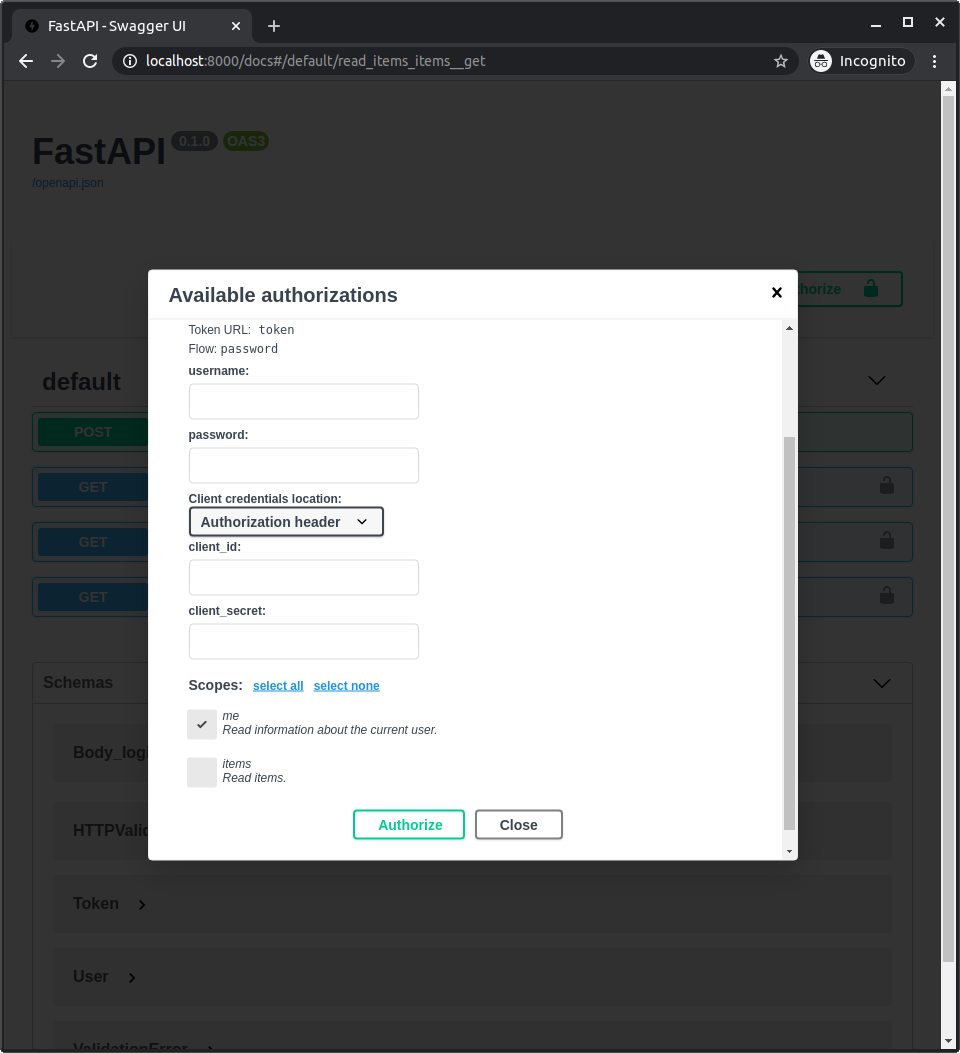
因为我们现在声明了这些权限范围,它们会在你登录/授权时显示在 API 文档中。
你可以选择你想要授予访问权限的权限范围:me 和 items。
这与你在使用 Facebook、Google、GitHub 等登录时授予权限的机制相同:
带有权限范围的 JWT 令牌
现在,修改令牌的路径操作以返回请求的权限范围。
我们仍然使用相同的 OAuth2PasswordRequestForm。它包含一个 scopes 属性,其中有一个 list 的 str,包含请求中接收到的每个权限范围。
我们将权限范围作为 JWT 令牌的一部分返回。
Danger
为了简单起见,这里我们只是将接收到的权限范围直接添加到令牌中。
但在你的应用中,为了安全起见,你应该确保只添加用户实际能够拥有的权限范围,或你预定义的权限范围。
from datetime import datetime, timedelta, timezone
from typing import Annotated

import jwt
from fastapi import Depends, FastAPI, HTTPException, Security, status
from fastapi.security import (
    OAuth2PasswordBearer,
    OAuth2PasswordRequestForm,
    SecurityScopes,
)
from jwt.exceptions import InvalidTokenError
from passlib.context import CryptContext
from pydantic import BaseModel, ValidationError

# to get a string like this run:
# openssl rand -hex 32
SECRET_KEY = "09d25e094faa6ca2556c818166b7a9563b93f7099f6f0f4caa6cf63b88e8d3e7"
ALGORITHM = "HS256"
ACCESS_TOKEN_EXPIRE_MINUTES = 30


fake_users_db = {
    "johndoe": {
        "username": "johndoe",
        "full_name": "John Doe",
        "email": "johndoe@example.com",
        "hashed_password": "$2b$12$EixZaYVK1fsbw1ZfbX3OXePaWxn96p36WQoeG6Lruj3vjPGga31lW",
        "disabled": False,
    },
    "alice": {
        "username": "alice",
        "full_name": "Alice Chains",
        "email": "alicechains@example.com",
        "hashed_password": "$2b$12$gSvqqUPvlXP2tfVFaWK1Be7DlH.PKZbv5H8KnzzVgXXbVxpva.pFm",
        "disabled": True,
    },
}


class Token(BaseModel):
    access_token: str
    token_type: str


class TokenData(BaseModel):
    username: str | None = None
    scopes: list[str] = []


class User(BaseModel):
    username: str
    email: str | None = None
    full_name: str | None = None
    disabled: bool | None = None


class UserInDB(User):
    hashed_password: str


pwd_context = CryptContext(schemes=["bcrypt"], deprecated="auto")

oauth2_scheme = OAuth2PasswordBearer(
    tokenUrl="token",
    scopes={"me": "Read information about the current user.", "items": "Read items."},
)

app = FastAPI()


def verify_password(plain_password, hashed_password):
    return pwd_context.verify(plain_password, hashed_password)


def get_password_hash(password):
    return pwd_context.hash(password)


def get_user(db, username: str):
    if username in db:
        user_dict = db[username]
        return UserInDB(**user_dict)


def authenticate_user(fake_db, username: str, password: str):
    user = get_user(fake_db, username)
    if not user:
        return False
    if not verify_password(password, user.hashed_password):
        return False
    return user


def create_access_token(data: dict, expires_delta: timedelta | None = None):
    to_encode = data.copy()
    if expires_delta:
        expire = datetime.now(timezone.utc) + expires_delta
    else:
        expire = datetime.now(timezone.utc) + timedelta(minutes=15)
    to_encode.update({"exp": expire})
    encoded_jwt = jwt.encode(to_encode, SECRET_KEY, algorithm=ALGORITHM)
    return encoded_jwt


async def get_current_user(
    security_scopes: SecurityScopes, token: Annotated[str, Depends(oauth2_scheme)]
):
    if security_scopes.scopes:
        authenticate_value = f'Bearer scope="{security_scopes.scope_str}"'
    else:
        authenticate_value = "Bearer"
    credentials_exception = HTTPException(
        status_code=status.HTTP_401_UNAUTHORIZED,
        detail="Could not validate credentials",
        headers={"WWW-Authenticate": authenticate_value},
    )
    try:
        payload = jwt.decode(token, SECRET_KEY, algorithms=[ALGORITHM])
        username = payload.get("sub")
        if username is None:
            raise credentials_exception
        scope: str = payload.get("scope", "")
        token_scopes = scope.split(" ")
        token_data = TokenData(scopes=token_scopes, username=username)
    except (InvalidTokenError, ValidationError):
        raise credentials_exception
    user = get_user(fake_users_db, username=token_data.username)
    if user is None:
        raise credentials_exception
    for scope in security_scopes.scopes:
        if scope not in token_data.scopes:
            raise HTTPException(
                status_code=status.HTTP_401_UNAUTHORIZED,
                detail="Not enough permissions",
                headers={"WWW-Authenticate": authenticate_value},
            )
    return user


async def get_current_active_user(
    current_user: Annotated[User, Security(get_current_user, scopes=["me"])],
):
    if current_user.disabled:
        raise HTTPException(status_code=400, detail="Inactive user")
    return current_user


@app.post("/token")
async def login_for_access_token(
    form_data: Annotated[OAuth2PasswordRequestForm, Depends()],
) -> Token:
    user = authenticate_user(fake_users_db, form_data.username, form_data.password)
    if not user:
        raise HTTPException(status_code=400, detail="Incorrect username or password")
    access_token_expires = timedelta(minutes=ACCESS_TOKEN_EXPIRE_MINUTES)
    access_token = create_access_token(
        data={"sub": user.username, "scope": " ".join(form_data.scopes)},
        expires_delta=access_token_expires,
    )
    return Token(access_token=access_token, token_type="bearer")


@app.get("/users/me/", response_model=User)
async def read_users_me(
    current_user: Annotated[User, Depends(get_current_active_user)],
):
    return current_user


@app.get("/users/me/items/")
async def read_own_items(
    current_user: Annotated[User, Security(get_current_active_user, scopes=["items"])],
):
    return [{"item_id": "Foo", "owner": current_user.username}]


@app.get("/status/")
async def read_system_status(current_user: Annotated[User, Depends(get_current_user)]):
    return {"status": "ok"}
🤓 Other versions and variants
from datetime import datetime, timedelta, timezone
from typing import Annotated, Union

import jwt
from fastapi import Depends, FastAPI, HTTPException, Security, status
from fastapi.security import (
    OAuth2PasswordBearer,
    OAuth2PasswordRequestForm,
    SecurityScopes,
)
from jwt.exceptions import InvalidTokenError
from passlib.context import CryptContext
from pydantic import BaseModel, ValidationError

# to get a string like this run:
# openssl rand -hex 32
SECRET_KEY = "09d25e094faa6ca2556c818166b7a9563b93f7099f6f0f4caa6cf63b88e8d3e7"
ALGORITHM = "HS256"
ACCESS_TOKEN_EXPIRE_MINUTES = 30


fake_users_db = {
    "johndoe": {
        "username": "johndoe",
        "full_name": "John Doe",
        "email": "johndoe@example.com",
        "hashed_password": "$2b$12$EixZaYVK1fsbw1ZfbX3OXePaWxn96p36WQoeG6Lruj3vjPGga31lW",
        "disabled": False,
    },
    "alice": {
        "username": "alice",
        "full_name": "Alice Chains",
        "email": "alicechains@example.com",
        "hashed_password": "$2b$12$gSvqqUPvlXP2tfVFaWK1Be7DlH.PKZbv5H8KnzzVgXXbVxpva.pFm",
        "disabled": True,
    },
}


class Token(BaseModel):
    access_token: str
    token_type: str


class TokenData(BaseModel):
    username: Union[str, None] = None
    scopes: list[str] = []


class User(BaseModel):
    username: str
    email: Union[str, None] = None
    full_name: Union[str, None] = None
    disabled: Union[bool, None] = None


class UserInDB(User):
    hashed_password: str


pwd_context = CryptContext(schemes=["bcrypt"], deprecated="auto")

oauth2_scheme = OAuth2PasswordBearer(
    tokenUrl="token",
    scopes={"me": "Read information about the current user.", "items": "Read items."},
)

app = FastAPI()


def verify_password(plain_password, hashed_password):
    return pwd_context.verify(plain_password, hashed_password)


def get_password_hash(password):
    return pwd_context.hash(password)


def get_user(db, username: str):
    if username in db:
        user_dict = db[username]
        return UserInDB(**user_dict)


def authenticate_user(fake_db, username: str, password: str):
    user = get_user(fake_db, username)
    if not user:
        return False
    if not verify_password(password, user.hashed_password):
        return False
    return user


def create_access_token(data: dict, expires_delta: Union[timedelta, None] = None):
    to_encode = data.copy()
    if expires_delta:
        expire = datetime.now(timezone.utc) + expires_delta
    else:
        expire = datetime.now(timezone.utc) + timedelta(minutes=15)
    to_encode.update({"exp": expire})
    encoded_jwt = jwt.encode(to_encode, SECRET_KEY, algorithm=ALGORITHM)
    return encoded_jwt


async def get_current_user(
    security_scopes: SecurityScopes, token: Annotated[str, Depends(oauth2_scheme)]
):
    if security_scopes.scopes:
        authenticate_value = f'Bearer scope="{security_scopes.scope_str}"'
    else:
        authenticate_value = "Bearer"
    credentials_exception = HTTPException(
        status_code=status.HTTP_401_UNAUTHORIZED,
        detail="Could not validate credentials",
        headers={"WWW-Authenticate": authenticate_value},
    )
    try:
        payload = jwt.decode(token, SECRET_KEY, algorithms=[ALGORITHM])
        username = payload.get("sub")
        if username is None:
            raise credentials_exception
        scope: str = payload.get("scope", "")
        token_scopes = scope.split(" ")
        token_data = TokenData(scopes=token_scopes, username=username)
    except (InvalidTokenError, ValidationError):
        raise credentials_exception
    user = get_user(fake_users_db, username=token_data.username)
    if user is None:
        raise credentials_exception
    for scope in security_scopes.scopes:
        if scope not in token_data.scopes:
            raise HTTPException(
                status_code=status.HTTP_401_UNAUTHORIZED,
                detail="Not enough permissions",
                headers={"WWW-Authenticate": authenticate_value},
            )
    return user


async def get_current_active_user(
    current_user: Annotated[User, Security(get_current_user, scopes=["me"])],
):
    if current_user.disabled:
        raise HTTPException(status_code=400, detail="Inactive user")
    return current_user


@app.post("/token")
async def login_for_access_token(
    form_data: Annotated[OAuth2PasswordRequestForm, Depends()],
) -> Token:
    user = authenticate_user(fake_users_db, form_data.username, form_data.password)
    if not user:
        raise HTTPException(status_code=400, detail="Incorrect username or password")
    access_token_expires = timedelta(minutes=ACCESS_TOKEN_EXPIRE_MINUTES)
    access_token = create_access_token(
        data={"sub": user.username, "scope": " ".join(form_data.scopes)},
        expires_delta=access_token_expires,
    )
    return Token(access_token=access_token, token_type="bearer")


@app.get("/users/me/", response_model=User)
async def read_users_me(
    current_user: Annotated[User, Depends(get_current_active_user)],
):
    return current_user


@app.get("/users/me/items/")
async def read_own_items(
    current_user: Annotated[User, Security(get_current_active_user, scopes=["items"])],
):
    return [{"item_id": "Foo", "owner": current_user.username}]


@app.get("/status/")
async def read_system_status(current_user: Annotated[User, Depends(get_current_user)]):
    return {"status": "ok"}
from datetime import datetime, timedelta, timezone
from typing import List, Union

import jwt
from fastapi import Depends, FastAPI, HTTPException, Security, status
from fastapi.security import (
    OAuth2PasswordBearer,
    OAuth2PasswordRequestForm,
    SecurityScopes,
)
from jwt.exceptions import InvalidTokenError
from passlib.context import CryptContext
from pydantic import BaseModel, ValidationError
from typing_extensions import Annotated

# to get a string like this run:
# openssl rand -hex 32
SECRET_KEY = "09d25e094faa6ca2556c818166b7a9563b93f7099f6f0f4caa6cf63b88e8d3e7"
ALGORITHM = "HS256"
ACCESS_TOKEN_EXPIRE_MINUTES = 30


fake_users_db = {
    "johndoe": {
        "username": "johndoe",
        "full_name": "John Doe",
        "email": "johndoe@example.com",
        "hashed_password": "$2b$12$EixZaYVK1fsbw1ZfbX3OXePaWxn96p36WQoeG6Lruj3vjPGga31lW",
        "disabled": False,
    },
    "alice": {
        "username": "alice",
        "full_name": "Alice Chains",
        "email": "alicechains@example.com",
        "hashed_password": "$2b$12$gSvqqUPvlXP2tfVFaWK1Be7DlH.PKZbv5H8KnzzVgXXbVxpva.pFm",
        "disabled": True,
    },
}


class Token(BaseModel):
    access_token: str
    token_type: str


class TokenData(BaseModel):
    username: Union[str, None] = None
    scopes: List[str] = []


class User(BaseModel):
    username: str
    email: Union[str, None] = None
    full_name: Union[str, None] = None
    disabled: Union[bool, None] = None


class UserInDB(User):
    hashed_password: str


pwd_context = CryptContext(schemes=["bcrypt"], deprecated="auto")

oauth2_scheme = OAuth2PasswordBearer(
    tokenUrl="token",
    scopes={"me": "Read information about the current user.", "items": "Read items."},
)

app = FastAPI()


def verify_password(plain_password, hashed_password):
    return pwd_context.verify(plain_password, hashed_password)


def get_password_hash(password):
    return pwd_context.hash(password)


def get_user(db, username: str):
    if username in db:
        user_dict = db[username]
        return UserInDB(**user_dict)


def authenticate_user(fake_db, username: str, password: str):
    user = get_user(fake_db, username)
    if not user:
        return False
    if not verify_password(password, user.hashed_password):
        return False
    return user


def create_access_token(data: dict, expires_delta: Union[timedelta, None] = None):
    to_encode = data.copy()
    if expires_delta:
        expire = datetime.now(timezone.utc) + expires_delta
    else:
        expire = datetime.now(timezone.utc) + timedelta(minutes=15)
    to_encode.update({"exp": expire})
    encoded_jwt = jwt.encode(to_encode, SECRET_KEY, algorithm=ALGORITHM)
    return encoded_jwt


async def get_current_user(
    security_scopes: SecurityScopes, token: Annotated[str, Depends(oauth2_scheme)]
):
    if security_scopes.scopes:
        authenticate_value = f'Bearer scope="{security_scopes.scope_str}"'
    else:
        authenticate_value = "Bearer"
    credentials_exception = HTTPException(
        status_code=status.HTTP_401_UNAUTHORIZED,
        detail="Could not validate credentials",
        headers={"WWW-Authenticate": authenticate_value},
    )
    try:
        payload = jwt.decode(token, SECRET_KEY, algorithms=[ALGORITHM])
        username = payload.get("sub")
        if username is None:
            raise credentials_exception
        scope: str = payload.get("scope", "")
        token_scopes = scope.split(" ")
        token_data = TokenData(scopes=token_scopes, username=username)
    except (InvalidTokenError, ValidationError):
        raise credentials_exception
    user = get_user(fake_users_db, username=token_data.username)
    if user is None:
        raise credentials_exception
    for scope in security_scopes.scopes:
        if scope not in token_data.scopes:
            raise HTTPException(
                status_code=status.HTTP_401_UNAUTHORIZED,
                detail="Not enough permissions",
                headers={"WWW-Authenticate": authenticate_value},
            )
    return user


async def get_current_active_user(
    current_user: Annotated[User, Security(get_current_user, scopes=["me"])],
):
    if current_user.disabled:
        raise HTTPException(status_code=400, detail="Inactive user")
    return current_user


@app.post("/token")
async def login_for_access_token(
    form_data: Annotated[OAuth2PasswordRequestForm, Depends()],
) -> Token:
    user = authenticate_user(fake_users_db, form_data.username, form_data.password)
    if not user:
        raise HTTPException(status_code=400, detail="Incorrect username or password")
    access_token_expires = timedelta(minutes=ACCESS_TOKEN_EXPIRE_MINUTES)
    access_token = create_access_token(
        data={"sub": user.username, "scope": " ".join(form_data.scopes)},
        expires_delta=access_token_expires,
    )
    return Token(access_token=access_token, token_type="bearer")


@app.get("/users/me/", response_model=User)
async def read_users_me(
    current_user: Annotated[User, Depends(get_current_active_user)],
):
    return current_user


@app.get("/users/me/items/")
async def read_own_items(
    current_user: Annotated[User, Security(get_current_active_user, scopes=["items"])],
):
    return [{"item_id": "Foo", "owner": current_user.username}]


@app.get("/status/")
async def read_system_status(current_user: Annotated[User, Depends(get_current_user)]):
    return {"status": "ok"}
Tip
Prefer to use the Annotated version if possible.
from datetime import datetime, timedelta, timezone

import jwt
from fastapi import Depends, FastAPI, HTTPException, Security, status
from fastapi.security import (
    OAuth2PasswordBearer,
    OAuth2PasswordRequestForm,
    SecurityScopes,
)
from jwt.exceptions import InvalidTokenError
from passlib.context import CryptContext
from pydantic import BaseModel, ValidationError

# to get a string like this run:
# openssl rand -hex 32
SECRET_KEY = "09d25e094faa6ca2556c818166b7a9563b93f7099f6f0f4caa6cf63b88e8d3e7"
ALGORITHM = "HS256"
ACCESS_TOKEN_EXPIRE_MINUTES = 30


fake_users_db = {
    "johndoe": {
        "username": "johndoe",
        "full_name": "John Doe",
        "email": "johndoe@example.com",
        "hashed_password": "$2b$12$EixZaYVK1fsbw1ZfbX3OXePaWxn96p36WQoeG6Lruj3vjPGga31lW",
        "disabled": False,
    },
    "alice": {
        "username": "alice",
        "full_name": "Alice Chains",
        "email": "alicechains@example.com",
        "hashed_password": "$2b$12$gSvqqUPvlXP2tfVFaWK1Be7DlH.PKZbv5H8KnzzVgXXbVxpva.pFm",
        "disabled": True,
    },
}


class Token(BaseModel):
    access_token: str
    token_type: str


class TokenData(BaseModel):
    username: str | None = None
    scopes: list[str] = []


class User(BaseModel):
    username: str
    email: str | None = None
    full_name: str | None = None
    disabled: bool | None = None


class UserInDB(User):
    hashed_password: str


pwd_context = CryptContext(schemes=["bcrypt"], deprecated="auto")

oauth2_scheme = OAuth2PasswordBearer(
    tokenUrl="token",
    scopes={"me": "Read information about the current user.", "items": "Read items."},
)

app = FastAPI()


def verify_password(plain_password, hashed_password):
    return pwd_context.verify(plain_password, hashed_password)


def get_password_hash(password):
    return pwd_context.hash(password)


def get_user(db, username: str):
    if username in db:
        user_dict = db[username]
        return UserInDB(**user_dict)


def authenticate_user(fake_db, username: str, password: str):
    user = get_user(fake_db, username)
    if not user:
        return False
    if not verify_password(password, user.hashed_password):
        return False
    return user


def create_access_token(data: dict, expires_delta: timedelta | None = None):
    to_encode = data.copy()
    if expires_delta:
        expire = datetime.now(timezone.utc) + expires_delta
    else:
        expire = datetime.now(timezone.utc) + timedelta(minutes=15)
    to_encode.update({"exp": expire})
    encoded_jwt = jwt.encode(to_encode, SECRET_KEY, algorithm=ALGORITHM)
    return encoded_jwt


async def get_current_user(
    security_scopes: SecurityScopes, token: str = Depends(oauth2_scheme)
):
    if security_scopes.scopes:
        authenticate_value = f'Bearer scope="{security_scopes.scope_str}"'
    else:
        authenticate_value = "Bearer"
    credentials_exception = HTTPException(
        status_code=status.HTTP_401_UNAUTHORIZED,
        detail="Could not validate credentials",
        headers={"WWW-Authenticate": authenticate_value},
    )
    try:
        payload = jwt.decode(token, SECRET_KEY, algorithms=[ALGORITHM])
        username: str = payload.get("sub")
        if username is None:
            raise credentials_exception
        scope: str = payload.get("scope", "")
        token_scopes = scope.split(" ")
        token_data = TokenData(scopes=token_scopes, username=username)
    except (InvalidTokenError, ValidationError):
        raise credentials_exception
    user = get_user(fake_users_db, username=token_data.username)
    if user is None:
        raise credentials_exception
    for scope in security_scopes.scopes:
        if scope not in token_data.scopes:
            raise HTTPException(
                status_code=status.HTTP_401_UNAUTHORIZED,
                detail="Not enough permissions",
                headers={"WWW-Authenticate": authenticate_value},
            )
    return user


async def get_current_active_user(
    current_user: User = Security(get_current_user, scopes=["me"]),
):
    if current_user.disabled:
        raise HTTPException(status_code=400, detail="Inactive user")
    return current_user


@app.post("/token")
async def login_for_access_token(
    form_data: OAuth2PasswordRequestForm = Depends(),
) -> Token:
    user = authenticate_user(fake_users_db, form_data.username, form_data.password)
    if not user:
        raise HTTPException(status_code=400, detail="Incorrect username or password")
    access_token_expires = timedelta(minutes=ACCESS_TOKEN_EXPIRE_MINUTES)
    access_token = create_access_token(
        data={"sub": user.username, "scope": " ".join(form_data.scopes)},
        expires_delta=access_token_expires,
    )
    return Token(access_token=access_token, token_type="bearer")


@app.get("/users/me/", response_model=User)
async def read_users_me(current_user: User = Depends(get_current_active_user)):
    return current_user


@app.get("/users/me/items/")
async def read_own_items(
    current_user: User = Security(get_current_active_user, scopes=["items"]),
):
    return [{"item_id": "Foo", "owner": current_user.username}]


@app.get("/status/")
async def read_system_status(current_user: User = Depends(get_current_user)):
    return {"status": "ok"}
Tip
Prefer to use the Annotated version if possible.
from datetime import datetime, timedelta, timezone
from typing import Union

import jwt
from fastapi import Depends, FastAPI, HTTPException, Security, status
from fastapi.security import (
    OAuth2PasswordBearer,
    OAuth2PasswordRequestForm,
    SecurityScopes,
)
from jwt.exceptions import InvalidTokenError
from passlib.context import CryptContext
from pydantic import BaseModel, ValidationError

# to get a string like this run:
# openssl rand -hex 32
SECRET_KEY = "09d25e094faa6ca2556c818166b7a9563b93f7099f6f0f4caa6cf63b88e8d3e7"
ALGORITHM = "HS256"
ACCESS_TOKEN_EXPIRE_MINUTES = 30


fake_users_db = {
    "johndoe": {
        "username": "johndoe",
        "full_name": "John Doe",
        "email": "johndoe@example.com",
        "hashed_password": "$2b$12$EixZaYVK1fsbw1ZfbX3OXePaWxn96p36WQoeG6Lruj3vjPGga31lW",
        "disabled": False,
    },
    "alice": {
        "username": "alice",
        "full_name": "Alice Chains",
        "email": "alicechains@example.com",
        "hashed_password": "$2b$12$gSvqqUPvlXP2tfVFaWK1Be7DlH.PKZbv5H8KnzzVgXXbVxpva.pFm",
        "disabled": True,
    },
}


class Token(BaseModel):
    access_token: str
    token_type: str


class TokenData(BaseModel):
    username: Union[str, None] = None
    scopes: list[str] = []


class User(BaseModel):
    username: str
    email: Union[str, None] = None
    full_name: Union[str, None] = None
    disabled: Union[bool, None] = None


class UserInDB(User):
    hashed_password: str


pwd_context = CryptContext(schemes=["bcrypt"], deprecated="auto")

oauth2_scheme = OAuth2PasswordBearer(
    tokenUrl="token",
    scopes={"me": "Read information about the current user.", "items": "Read items."},
)

app = FastAPI()


def verify_password(plain_password, hashed_password):
    return pwd_context.verify(plain_password, hashed_password)


def get_password_hash(password):
    return pwd_context.hash(password)


def get_user(db, username: str):
    if username in db:
        user_dict = db[username]
        return UserInDB(**user_dict)


def authenticate_user(fake_db, username: str, password: str):
    user = get_user(fake_db, username)
    if not user:
        return False
    if not verify_password(password, user.hashed_password):
        return False
    return user


def create_access_token(data: dict, expires_delta: Union[timedelta, None] = None):
    to_encode = data.copy()
    if expires_delta:
        expire = datetime.now(timezone.utc) + expires_delta
    else:
        expire = datetime.now(timezone.utc) + timedelta(minutes=15)
    to_encode.update({"exp": expire})
    encoded_jwt = jwt.encode(to_encode, SECRET_KEY, algorithm=ALGORITHM)
    return encoded_jwt


async def get_current_user(
    security_scopes: SecurityScopes, token: str = Depends(oauth2_scheme)
):
    if security_scopes.scopes:
        authenticate_value = f'Bearer scope="{security_scopes.scope_str}"'
    else:
        authenticate_value = "Bearer"
    credentials_exception = HTTPException(
        status_code=status.HTTP_401_UNAUTHORIZED,
        detail="Could not validate credentials",
        headers={"WWW-Authenticate": authenticate_value},
    )
    try:
        payload = jwt.decode(token, SECRET_KEY, algorithms=[ALGORITHM])
        username: str = payload.get("sub")
        if username is None:
            raise credentials_exception
        scope: str = payload.get("scope", "")
        token_scopes = scope.split(" ")
        token_data = TokenData(scopes=token_scopes, username=username)
    except (InvalidTokenError, ValidationError):
        raise credentials_exception
    user = get_user(fake_users_db, username=token_data.username)
    if user is None:
        raise credentials_exception
    for scope in security_scopes.scopes:
        if scope not in token_data.scopes:
            raise HTTPException(
                status_code=status.HTTP_401_UNAUTHORIZED,
                detail="Not enough permissions",
                headers={"WWW-Authenticate": authenticate_value},
            )
    return user


async def get_current_active_user(
    current_user: User = Security(get_current_user, scopes=["me"]),
):
    if current_user.disabled:
        raise HTTPException(status_code=400, detail="Inactive user")
    return current_user


@app.post("/token")
async def login_for_access_token(
    form_data: OAuth2PasswordRequestForm = Depends(),
) -> Token:
    user = authenticate_user(fake_users_db, form_data.username, form_data.password)
    if not user:
        raise HTTPException(status_code=400, detail="Incorrect username or password")
    access_token_expires = timedelta(minutes=ACCESS_TOKEN_EXPIRE_MINUTES)
    access_token = create_access_token(
        data={"sub": user.username, "scope": " ".join(form_data.scopes)},
        expires_delta=access_token_expires,
    )
    return Token(access_token=access_token, token_type="bearer")


@app.get("/users/me/", response_model=User)
async def read_users_me(current_user: User = Depends(get_current_active_user)):
    return current_user


@app.get("/users/me/items/")
async def read_own_items(
    current_user: User = Security(get_current_active_user, scopes=["items"]),
):
    return [{"item_id": "Foo", "owner": current_user.username}]


@app.get("/status/")
async def read_system_status(current_user: User = Depends(get_current_user)):
    return {"status": "ok"}
Tip
Prefer to use the Annotated version if possible.
from datetime import datetime, timedelta, timezone
from typing import List, Union

import jwt
from fastapi import Depends, FastAPI, HTTPException, Security, status
from fastapi.security import (
    OAuth2PasswordBearer,
    OAuth2PasswordRequestForm,
    SecurityScopes,
)
from jwt.exceptions import InvalidTokenError
from passlib.context import CryptContext
from pydantic import BaseModel, ValidationError

# to get a string like this run:
# openssl rand -hex 32
SECRET_KEY = "09d25e094faa6ca2556c818166b7a9563b93f7099f6f0f4caa6cf63b88e8d3e7"
ALGORITHM = "HS256"
ACCESS_TOKEN_EXPIRE_MINUTES = 30


fake_users_db = {
    "johndoe": {
        "username": "johndoe",
        "full_name": "John Doe",
        "email": "johndoe@example.com",
        "hashed_password": "$2b$12$EixZaYVK1fsbw1ZfbX3OXePaWxn96p36WQoeG6Lruj3vjPGga31lW",
        "disabled": False,
    },
    "alice": {
        "username": "alice",
        "full_name": "Alice Chains",
        "email": "alicechains@example.com",
        "hashed_password": "$2b$12$gSvqqUPvlXP2tfVFaWK1Be7DlH.PKZbv5H8KnzzVgXXbVxpva.pFm",
        "disabled": True,
    },
}


class Token(BaseModel):
    access_token: str
    token_type: str


class TokenData(BaseModel):
    username: Union[str, None] = None
    scopes: List[str] = []


class User(BaseModel):
    username: str
    email: Union[str, None] = None
    full_name: Union[str, None] = None
    disabled: Union[bool, None] = None


class UserInDB(User):
    hashed_password: str


pwd_context = CryptContext(schemes=["bcrypt"], deprecated="auto")

oauth2_scheme = OAuth2PasswordBearer(
    tokenUrl="token",
    scopes={"me": "Read information about the current user.", "items": "Read items."},
)

app = FastAPI()


def verify_password(plain_password, hashed_password):
    return pwd_context.verify(plain_password, hashed_password)


def get_password_hash(password):
    return pwd_context.hash(password)


def get_user(db, username: str):
    if username in db:
        user_dict = db[username]
        return UserInDB(**user_dict)


def authenticate_user(fake_db, username: str, password: str):
    user = get_user(fake_db, username)
    if not user:
        return False
    if not verify_password(password, user.hashed_password):
        return False
    return user


def create_access_token(data: dict, expires_delta: Union[timedelta, None] = None):
    to_encode = data.copy()
    if expires_delta:
        expire = datetime.now(timezone.utc) + expires_delta
    else:
        expire = datetime.now(timezone.utc) + timedelta(minutes=15)
    to_encode.update({"exp": expire})
    encoded_jwt = jwt.encode(to_encode, SECRET_KEY, algorithm=ALGORITHM)
    return encoded_jwt


async def get_current_user(
    security_scopes: SecurityScopes, token: str = Depends(oauth2_scheme)
):
    if security_scopes.scopes:
        authenticate_value = f'Bearer scope="{security_scopes.scope_str}"'
    else:
        authenticate_value = "Bearer"
    credentials_exception = HTTPException(
        status_code=status.HTTP_401_UNAUTHORIZED,
        detail="Could not validate credentials",
        headers={"WWW-Authenticate": authenticate_value},
    )
    try:
        payload = jwt.decode(token, SECRET_KEY, algorithms=[ALGORITHM])
        username: str = payload.get("sub")
        if username is None:
            raise credentials_exception
        scope: str = payload.get("scope", "")
        token_scopes = scope.split(" ")
        token_data = TokenData(scopes=token_scopes, username=username)
    except (InvalidTokenError, ValidationError):
        raise credentials_exception
    user = get_user(fake_users_db, username=token_data.username)
    if user is None:
        raise credentials_exception
    for scope in security_scopes.scopes:
        if scope not in token_data.scopes:
            raise HTTPException(
                status_code=status.HTTP_401_UNAUTHORIZED,
                detail="Not enough permissions",
                headers={"WWW-Authenticate": authenticate_value},
            )
    return user


async def get_current_active_user(
    current_user: User = Security(get_current_user, scopes=["me"]),
):
    if current_user.disabled:
        raise HTTPException(status_code=400, detail="Inactive user")
    return current_user


@app.post("/token")
async def login_for_access_token(
    form_data: OAuth2PasswordRequestForm = Depends(),
) -> Token:
    user = authenticate_user(fake_users_db, form_data.username, form_data.password)
    if not user:
        raise HTTPException(status_code=400, detail="Incorrect username or password")
    access_token_expires = timedelta(minutes=ACCESS_TOKEN_EXPIRE_MINUTES)
    access_token = create_access_token(
        data={"sub": user.username, "scope": " ".join(form_data.scopes)},
        expires_delta=access_token_expires,
    )
    return Token(access_token=access_token, token_type="bearer")


@app.get("/users/me/", response_model=User)
async def read_users_me(current_user: User = Depends(get_current_active_user)):
    return current_user


@app.get("/users/me/items/")
async def read_own_items(
    current_user: User = Security(get_current_active_user, scopes=["items"]),
):
    return [{"item_id": "Foo", "owner": current_user.username}]


@app.get("/status/")
async def read_system_status(current_user: User = Depends(get_current_user)):
    return {"status": "ok"}
在路径操作和依赖项中声明权限范围
现在我们声明 /users/me/items/ 的路径操作需要权限范围 items。
为此,我们从 fastapi 导入并使用 Security。
你可以使用 Security 来声明依赖项(就像 Depends 一样),但 Security 还接收一个 scopes 参数,其中包含一个权限范围(字符串)列表。
在这种情况下,我们将依赖函数 get_current_active_user 传递给 Security(就像我们使用 Depends 一样)。
但我们还传递了一个 list 的权限范围,这里只有一个权限范围:items(可以有更多)。
依赖函数 get_current_active_user 也可以声明子依赖项,不仅可以使用 Depends,还可以使用 Security。声明它自己的子依赖函数(get_current_user)和更多的权限范围要求。
在这种情况下,它需要权限范围 me(可以需要多个权限范围)。
Note
你不一定需要在不同的地方添加不同的权限范围。
我们在这里这样做是为了演示 FastAPI 如何处理在不同级别声明的权限范围。
from datetime import datetime, timedelta, timezone
from typing import Annotated

import jwt
from fastapi import Depends, FastAPI, HTTPException, Security, status
from fastapi.security import (
    OAuth2PasswordBearer,
    OAuth2PasswordRequestForm,
    SecurityScopes,
)
from jwt.exceptions import InvalidTokenError
from passlib.context import CryptContext
from pydantic import BaseModel, ValidationError

# to get a string like this run:
# openssl rand -hex 32
SECRET_KEY = "09d25e094faa6ca2556c818166b7a9563b93f7099f6f0f4caa6cf63b88e8d3e7"
ALGORITHM = "HS256"
ACCESS_TOKEN_EXPIRE_MINUTES = 30


fake_users_db = {
    "johndoe": {
        "username": "johndoe",
        "full_name": "John Doe",
        "email": "johndoe@example.com",
        "hashed_password": "$2b$12$EixZaYVK1fsbw1ZfbX3OXePaWxn96p36WQoeG6Lruj3vjPGga31lW",
        "disabled": False,
    },
    "alice": {
        "username": "alice",
        "full_name": "Alice Chains",
        "email": "alicechains@example.com",
        "hashed_password": "$2b$12$gSvqqUPvlXP2tfVFaWK1Be7DlH.PKZbv5H8KnzzVgXXbVxpva.pFm",
        "disabled": True,
    },
}


class Token(BaseModel):
    access_token: str
    token_type: str


class TokenData(BaseModel):
    username: str | None = None
    scopes: list[str] = []


class User(BaseModel):
    username: str
    email: str | None = None
    full_name: str | None = None
    disabled: bool | None = None


class UserInDB(User):
    hashed_password: str


pwd_context = CryptContext(schemes=["bcrypt"], deprecated="auto")

oauth2_scheme = OAuth2PasswordBearer(
    tokenUrl="token",
    scopes={"me": "Read information about the current user.", "items": "Read items."},
)

app = FastAPI()


def verify_password(plain_password, hashed_password):
    return pwd_context.verify(plain_password, hashed_password)


def get_password_hash(password):
    return pwd_context.hash(password)


def get_user(db, username: str):
    if username in db:
        user_dict = db[username]
        return UserInDB(**user_dict)


def authenticate_user(fake_db, username: str, password: str):
    user = get_user(fake_db, username)
    if not user:
        return False
    if not verify_password(password, user.hashed_password):
        return False
    return user


def create_access_token(data: dict, expires_delta: timedelta | None = None):
    to_encode = data.copy()
    if expires_delta:
        expire = datetime.now(timezone.utc) + expires_delta
    else:
        expire = datetime.now(timezone.utc) + timedelta(minutes=15)
    to_encode.update({"exp": expire})
    encoded_jwt = jwt.encode(to_encode, SECRET_KEY, algorithm=ALGORITHM)
    return encoded_jwt


async def get_current_user(
    security_scopes: SecurityScopes, token: Annotated[str, Depends(oauth2_scheme)]
):
    if security_scopes.scopes:
        authenticate_value = f'Bearer scope="{security_scopes.scope_str}"'
    else:
        authenticate_value = "Bearer"
    credentials_exception = HTTPException(
        status_code=status.HTTP_401_UNAUTHORIZED,
        detail="Could not validate credentials",
        headers={"WWW-Authenticate": authenticate_value},
    )
    try:
        payload = jwt.decode(token, SECRET_KEY, algorithms=[ALGORITHM])
        username = payload.get("sub")
        if username is None:
            raise credentials_exception
        scope: str = payload.get("scope", "")
        token_scopes = scope.split(" ")
        token_data = TokenData(scopes=token_scopes, username=username)
    except (InvalidTokenError, ValidationError):
        raise credentials_exception
    user = get_user(fake_users_db, username=token_data.username)
    if user is None:
        raise credentials_exception
    for scope in security_scopes.scopes:
        if scope not in token_data.scopes:
            raise HTTPException(
                status_code=status.HTTP_401_UNAUTHORIZED,
                detail="Not enough permissions",
                headers={"WWW-Authenticate": authenticate_value},
            )
    return user


async def get_current_active_user(
    current_user: Annotated[User, Security(get_current_user, scopes=["me"])],
):
    if current_user.disabled:
        raise HTTPException(status_code=400, detail="Inactive user")
    return current_user


@app.post("/token")
async def login_for_access_token(
    form_data: Annotated[OAuth2PasswordRequestForm, Depends()],
) -> Token:
    user = authenticate_user(fake_users_db, form_data.username, form_data.password)
    if not user:
        raise HTTPException(status_code=400, detail="Incorrect username or password")
    access_token_expires = timedelta(minutes=ACCESS_TOKEN_EXPIRE_MINUTES)
    access_token = create_access_token(
        data={"sub": user.username, "scope": " ".join(form_data.scopes)},
        expires_delta=access_token_expires,
    )
    return Token(access_token=access_token, token_type="bearer")


@app.get("/users/me/", response_model=User)
async def read_users_me(
    current_user: Annotated[User, Depends(get_current_active_user)],
):
    return current_user


@app.get("/users/me/items/")
async def read_own_items(
    current_user: Annotated[User, Security(get_current_active_user, scopes=["items"])],
):
    return [{"item_id": "Foo", "owner": current_user.username}]


@app.get("/status/")
async def read_system_status(current_user: Annotated[User, Depends(get_current_user)]):
    return {"status": "ok"}
🤓 Other versions and variants
from datetime import datetime, timedelta, timezone
from typing import Annotated, Union

import jwt
from fastapi import Depends, FastAPI, HTTPException, Security, status
from fastapi.security import (
    OAuth2PasswordBearer,
    OAuth2PasswordRequestForm,
    SecurityScopes,
)
from jwt.exceptions import InvalidTokenError
from passlib.context import CryptContext
from pydantic import BaseModel, ValidationError

# to get a string like this run:
# openssl rand -hex 32
SECRET_KEY = "09d25e094faa6ca2556c818166b7a9563b93f7099f6f0f4caa6cf63b88e8d3e7"
ALGORITHM = "HS256"
ACCESS_TOKEN_EXPIRE_MINUTES = 30


fake_users_db = {
    "johndoe": {
        "username": "johndoe",
        "full_name": "John Doe",
        "email": "johndoe@example.com",
        "hashed_password": "$2b$12$EixZaYVK1fsbw1ZfbX3OXePaWxn96p36WQoeG6Lruj3vjPGga31lW",
        "disabled": False,
    },
    "alice": {
        "username": "alice",
        "full_name": "Alice Chains",
        "email": "alicechains@example.com",
        "hashed_password": "$2b$12$gSvqqUPvlXP2tfVFaWK1Be7DlH.PKZbv5H8KnzzVgXXbVxpva.pFm",
        "disabled": True,
    },
}


class Token(BaseModel):
    access_token: str
    token_type: str


class TokenData(BaseModel):
    username: Union[str, None] = None
    scopes: list[str] = []


class User(BaseModel):
    username: str
    email: Union[str, None] = None
    full_name: Union[str, None] = None
    disabled: Union[bool, None] = None


class UserInDB(User):
    hashed_password: str


pwd_context = CryptContext(schemes=["bcrypt"], deprecated="auto")

oauth2_scheme = OAuth2PasswordBearer(
    tokenUrl="token",
    scopes={"me": "Read information about the current user.", "items": "Read items."},
)

app = FastAPI()


def verify_password(plain_password, hashed_password):
    return pwd_context.verify(plain_password, hashed_password)


def get_password_hash(password):
    return pwd_context.hash(password)


def get_user(db, username: str):
    if username in db:
        user_dict = db[username]
        return UserInDB(**user_dict)


def authenticate_user(fake_db, username: str, password: str):
    user = get_user(fake_db, username)
    if not user:
        return False
    if not verify_password(password, user.hashed_password):
        return False
    return user


def create_access_token(data: dict, expires_delta: Union[timedelta, None] = None):
    to_encode = data.copy()
    if expires_delta:
        expire = datetime.now(timezone.utc) + expires_delta
    else:
        expire = datetime.now(timezone.utc) + timedelta(minutes=15)
    to_encode.update({"exp": expire})
    encoded_jwt = jwt.encode(to_encode, SECRET_KEY, algorithm=ALGORITHM)
    return encoded_jwt


async def get_current_user(
    security_scopes: SecurityScopes, token: Annotated[str, Depends(oauth2_scheme)]
):
    if security_scopes.scopes:
        authenticate_value = f'Bearer scope="{security_scopes.scope_str}"'
    else:
        authenticate_value = "Bearer"
    credentials_exception = HTTPException(
        status_code=status.HTTP_401_UNAUTHORIZED,
        detail="Could not validate credentials",
        headers={"WWW-Authenticate": authenticate_value},
    )
    try:
        payload = jwt.decode(token, SECRET_KEY, algorithms=[ALGORITHM])
        username = payload.get("sub")
        if username is None:
            raise credentials_exception
        scope: str = payload.get("scope", "")
        token_scopes = scope.split(" ")
        token_data = TokenData(scopes=token_scopes, username=username)
    except (InvalidTokenError, ValidationError):
        raise credentials_exception
    user = get_user(fake_users_db, username=token_data.username)
    if user is None:
        raise credentials_exception
    for scope in security_scopes.scopes:
        if scope not in token_data.scopes:
            raise HTTPException(
                status_code=status.HTTP_401_UNAUTHORIZED,
                detail="Not enough permissions",
                headers={"WWW-Authenticate": authenticate_value},
            )
    return user


async def get_current_active_user(
    current_user: Annotated[User, Security(get_current_user, scopes=["me"])],
):
    if current_user.disabled:
        raise HTTPException(status_code=400, detail="Inactive user")
    return current_user


@app.post("/token")
async def login_for_access_token(
    form_data: Annotated[OAuth2PasswordRequestForm, Depends()],
) -> Token:
    user = authenticate_user(fake_users_db, form_data.username, form_data.password)
    if not user:
        raise HTTPException(status_code=400, detail="Incorrect username or password")
    access_token_expires = timedelta(minutes=ACCESS_TOKEN_EXPIRE_MINUTES)
    access_token = create_access_token(
        data={"sub": user.username, "scope": " ".join(form_data.scopes)},
        expires_delta=access_token_expires,
    )
    return Token(access_token=access_token, token_type="bearer")


@app.get("/users/me/", response_model=User)
async def read_users_me(
    current_user: Annotated[User, Depends(get_current_active_user)],
):
    return current_user


@app.get("/users/me/items/")
async def read_own_items(
    current_user: Annotated[User, Security(get_current_active_user, scopes=["items"])],
):
    return [{"item_id": "Foo", "owner": current_user.username}]


@app.get("/status/")
async def read_system_status(current_user: Annotated[User, Depends(get_current_user)]):
    return {"status": "ok"}
from datetime import datetime, timedelta, timezone
from typing import List, Union

import jwt
from fastapi import Depends, FastAPI, HTTPException, Security, status
from fastapi.security import (
    OAuth2PasswordBearer,
    OAuth2PasswordRequestForm,
    SecurityScopes,
)
from jwt.exceptions import InvalidTokenError
from passlib.context import CryptContext
from pydantic import BaseModel, ValidationError
from typing_extensions import Annotated

# to get a string like this run:
# openssl rand -hex 32
SECRET_KEY = "09d25e094faa6ca2556c818166b7a9563b93f7099f6f0f4caa6cf63b88e8d3e7"
ALGORITHM = "HS256"
ACCESS_TOKEN_EXPIRE_MINUTES = 30


fake_users_db = {
    "johndoe": {
        "username": "johndoe",
        "full_name": "John Doe",
        "email": "johndoe@example.com",
        "hashed_password": "$2b$12$EixZaYVK1fsbw1ZfbX3OXePaWxn96p36WQoeG6Lruj3vjPGga31lW",
        "disabled": False,
    },
    "alice": {
        "username": "alice",
        "full_name": "Alice Chains",
        "email": "alicechains@example.com",
        "hashed_password": "$2b$12$gSvqqUPvlXP2tfVFaWK1Be7DlH.PKZbv5H8KnzzVgXXbVxpva.pFm",
        "disabled": True,
    },
}


class Token(BaseModel):
    access_token: str
    token_type: str


class TokenData(BaseModel):
    username: Union[str, None] = None
    scopes: List[str] = []


class User(BaseModel):
    username: str
    email: Union[str, None] = None
    full_name: Union[str, None] = None
    disabled: Union[bool, None] = None


class UserInDB(User):
    hashed_password: str


pwd_context = CryptContext(schemes=["bcrypt"], deprecated="auto")

oauth2_scheme = OAuth2PasswordBearer(
    tokenUrl="token",
    scopes={"me": "Read information about the current user.", "items": "Read items."},
)

app = FastAPI()


def verify_password(plain_password, hashed_password):
    return pwd_context.verify(plain_password, hashed_password)


def get_password_hash(password):
    return pwd_context.hash(password)


def get_user(db, username: str):
    if username in db:
        user_dict = db[username]
        return UserInDB(**user_dict)


def authenticate_user(fake_db, username: str, password: str):
    user = get_user(fake_db, username)
    if not user:
        return False
    if not verify_password(password, user.hashed_password):
        return False
    return user


def create_access_token(data: dict, expires_delta: Union[timedelta, None] = None):
    to_encode = data.copy()
    if expires_delta:
        expire = datetime.now(timezone.utc) + expires_delta
    else:
        expire = datetime.now(timezone.utc) + timedelta(minutes=15)
    to_encode.update({"exp": expire})
    encoded_jwt = jwt.encode(to_encode, SECRET_KEY, algorithm=ALGORITHM)
    return encoded_jwt


async def get_current_user(
    security_scopes: SecurityScopes, token: Annotated[str, Depends(oauth2_scheme)]
):
    if security_scopes.scopes:
        authenticate_value = f'Bearer scope="{security_scopes.scope_str}"'
    else:
        authenticate_value = "Bearer"
    credentials_exception = HTTPException(
        status_code=status.HTTP_401_UNAUTHORIZED,
        detail="Could not validate credentials",
        headers={"WWW-Authenticate": authenticate_value},
    )
    try:
        payload = jwt.decode(token, SECRET_KEY, algorithms=[ALGORITHM])
        username = payload.get("sub")
        if username is None:
            raise credentials_exception
        scope: str = payload.get("scope", "")
        token_scopes = scope.split(" ")
        token_data = TokenData(scopes=token_scopes, username=username)
    except (InvalidTokenError, ValidationError):
        raise credentials_exception
    user = get_user(fake_users_db, username=token_data.username)
    if user is None:
        raise credentials_exception
    for scope in security_scopes.scopes:
        if scope not in token_data.scopes:
            raise HTTPException(
                status_code=status.HTTP_401_UNAUTHORIZED,
                detail="Not enough permissions",
                headers={"WWW-Authenticate": authenticate_value},
            )
    return user


async def get_current_active_user(
    current_user: Annotated[User, Security(get_current_user, scopes=["me"])],
):
    if current_user.disabled:
        raise HTTPException(status_code=400, detail="Inactive user")
    return current_user


@app.post("/token")
async def login_for_access_token(
    form_data: Annotated[OAuth2PasswordRequestForm, Depends()],
) -> Token:
    user = authenticate_user(fake_users_db, form_data.username, form_data.password)
    if not user:
        raise HTTPException(status_code=400, detail="Incorrect username or password")
    access_token_expires = timedelta(minutes=ACCESS_TOKEN_EXPIRE_MINUTES)
    access_token = create_access_token(
        data={"sub": user.username, "scope": " ".join(form_data.scopes)},
        expires_delta=access_token_expires,
    )
    return Token(access_token=access_token, token_type="bearer")


@app.get("/users/me/", response_model=User)
async def read_users_me(
    current_user: Annotated[User, Depends(get_current_active_user)],
):
    return current_user


@app.get("/users/me/items/")
async def read_own_items(
    current_user: Annotated[User, Security(get_current_active_user, scopes=["items"])],
):
    return [{"item_id": "Foo", "owner": current_user.username}]


@app.get("/status/")
async def read_system_status(current_user: Annotated[User, Depends(get_current_user)]):
    return {"status": "ok"}
Tip
Prefer to use the Annotated version if possible.
from datetime import datetime, timedelta, timezone

import jwt
from fastapi import Depends, FastAPI, HTTPException, Security, status
from fastapi.security import (
    OAuth2PasswordBearer,
    OAuth2PasswordRequestForm,
    SecurityScopes,
)
from jwt.exceptions import InvalidTokenError
from passlib.context import CryptContext
from pydantic import BaseModel, ValidationError

# to get a string like this run:
# openssl rand -hex 32
SECRET_KEY = "09d25e094faa6ca2556c818166b7a9563b93f7099f6f0f4caa6cf63b88e8d3e7"
ALGORITHM = "HS256"
ACCESS_TOKEN_EXPIRE_MINUTES = 30


fake_users_db = {
    "johndoe": {
        "username": "johndoe",
        "full_name": "John Doe",
        "email": "johndoe@example.com",
        "hashed_password": "$2b$12$EixZaYVK1fsbw1ZfbX3OXePaWxn96p36WQoeG6Lruj3vjPGga31lW",
        "disabled": False,
    },
    "alice": {
        "username": "alice",
        "full_name": "Alice Chains",
        "email": "alicechains@example.com",
        "hashed_password": "$2b$12$gSvqqUPvlXP2tfVFaWK1Be7DlH.PKZbv5H8KnzzVgXXbVxpva.pFm",
        "disabled": True,
    },
}


class Token(BaseModel):
    access_token: str
    token_type: str


class TokenData(BaseModel):
    username: str | None = None
    scopes: list[str] = []


class User(BaseModel):
    username: str
    email: str | None = None
    full_name: str | None = None
    disabled: bool | None = None


class UserInDB(User):
    hashed_password: str


pwd_context = CryptContext(schemes=["bcrypt"], deprecated="auto")

oauth2_scheme = OAuth2PasswordBearer(
    tokenUrl="token",
    scopes={"me": "Read information about the current user.", "items": "Read items."},
)

app = FastAPI()


def verify_password(plain_password, hashed_password):
    return pwd_context.verify(plain_password, hashed_password)


def get_password_hash(password):
    return pwd_context.hash(password)


def get_user(db, username: str):
    if username in db:
        user_dict = db[username]
        return UserInDB(**user_dict)


def authenticate_user(fake_db, username: str, password: str):
    user = get_user(fake_db, username)
    if not user:
        return False
    if not verify_password(password, user.hashed_password):
        return False
    return user


def create_access_token(data: dict, expires_delta: timedelta | None = None):
    to_encode = data.copy()
    if expires_delta:
        expire = datetime.now(timezone.utc) + expires_delta
    else:
        expire = datetime.now(timezone.utc) + timedelta(minutes=15)
    to_encode.update({"exp": expire})
    encoded_jwt = jwt.encode(to_encode, SECRET_KEY, algorithm=ALGORITHM)
    return encoded_jwt


async def get_current_user(
    security_scopes: SecurityScopes, token: str = Depends(oauth2_scheme)
):
    if security_scopes.scopes:
        authenticate_value = f'Bearer scope="{security_scopes.scope_str}"'
    else:
        authenticate_value = "Bearer"
    credentials_exception = HTTPException(
        status_code=status.HTTP_401_UNAUTHORIZED,
        detail="Could not validate credentials",
        headers={"WWW-Authenticate": authenticate_value},
    )
    try:
        payload = jwt.decode(token, SECRET_KEY, algorithms=[ALGORITHM])
        username: str = payload.get("sub")
        if username is None:
            raise credentials_exception
        scope: str = payload.get("scope", "")
        token_scopes = scope.split(" ")
        token_data = TokenData(scopes=token_scopes, username=username)
    except (InvalidTokenError, ValidationError):
        raise credentials_exception
    user = get_user(fake_users_db, username=token_data.username)
    if user is None:
        raise credentials_exception
    for scope in security_scopes.scopes:
        if scope not in token_data.scopes:
            raise HTTPException(
                status_code=status.HTTP_401_UNAUTHORIZED,
                detail="Not enough permissions",
                headers={"WWW-Authenticate": authenticate_value},
            )
    return user


async def get_current_active_user(
    current_user: User = Security(get_current_user, scopes=["me"]),
):
    if current_user.disabled:
        raise HTTPException(status_code=400, detail="Inactive user")
    return current_user


@app.post("/token")
async def login_for_access_token(
    form_data: OAuth2PasswordRequestForm = Depends(),
) -> Token:
    user = authenticate_user(fake_users_db, form_data.username, form_data.password)
    if not user:
        raise HTTPException(status_code=400, detail="Incorrect username or password")
    access_token_expires = timedelta(minutes=ACCESS_TOKEN_EXPIRE_MINUTES)
    access_token = create_access_token(
        data={"sub": user.username, "scope": " ".join(form_data.scopes)},
        expires_delta=access_token_expires,
    )
    return Token(access_token=access_token, token_type="bearer")


@app.get("/users/me/", response_model=User)
async def read_users_me(current_user: User = Depends(get_current_active_user)):
    return current_user


@app.get("/users/me/items/")
async def read_own_items(
    current_user: User = Security(get_current_active_user, scopes=["items"]),
):
    return [{"item_id": "Foo", "owner": current_user.username}]


@app.get("/status/")
async def read_system_status(current_user: User = Depends(get_current_user)):
    return {"status": "ok"}
Tip
Prefer to use the Annotated version if possible.
from datetime import datetime, timedelta, timezone
from typing import Union

import jwt
from fastapi import Depends, FastAPI, HTTPException, Security, status
from fastapi.security import (
    OAuth2PasswordBearer,
    OAuth2PasswordRequestForm,
    SecurityScopes,
)
from jwt.exceptions import InvalidTokenError
from passlib.context import CryptContext
from pydantic import BaseModel, ValidationError

# to get a string like this run:
# openssl rand -hex 32
SECRET_KEY = "09d25e094faa6ca2556c818166b7a9563b93f7099f6f0f4caa6cf63b88e8d3e7"
ALGORITHM = "HS256"
ACCESS_TOKEN_EXPIRE_MINUTES = 30


fake_users_db = {
    "johndoe": {
        "username": "johndoe",
        "full_name": "John Doe",
        "email": "johndoe@example.com",
        "hashed_password": "$2b$12$EixZaYVK1fsbw1ZfbX3OXePaWxn96p36WQoeG6Lruj3vjPGga31lW",
        "disabled": False,
    },
    "alice": {
        "username": "alice",
        "full_name": "Alice Chains",
        "email": "alicechains@example.com",
        "hashed_password": "$2b$12$gSvqqUPvlXP2tfVFaWK1Be7DlH.PKZbv5H8KnzzVgXXbVxpva.pFm",
        "disabled": True,
    },
}


class Token(BaseModel):
    access_token: str
    token_type: str


class TokenData(BaseModel):
    username: Union[str, None] = None
    scopes: list[str] = []


class User(BaseModel):
    username: str
    email: Union[str, None] = None
    full_name: Union[str, None] = None
    disabled: Union[bool, None] = None


class UserInDB(User):
    hashed_password: str


pwd_context = CryptContext(schemes=["bcrypt"], deprecated="auto")

oauth2_scheme = OAuth2PasswordBearer(
    tokenUrl="token",
    scopes={"me": "Read information about the current user.", "items": "Read items."},
)

app = FastAPI()


def verify_password(plain_password, hashed_password):
    return pwd_context.verify(plain_password, hashed_password)


def get_password_hash(password):
    return pwd_context.hash(password)


def get_user(db, username: str):
    if username in db:
        user_dict = db[username]
        return UserInDB(**user_dict)


def authenticate_user(fake_db, username: str, password: str):
    user = get_user(fake_db, username)
    if not user:
        return False
    if not verify_password(password, user.hashed_password):
        return False
    return user


def create_access_token(data: dict, expires_delta: Union[timedelta, None] = None):
    to_encode = data.copy()
    if expires_delta:
        expire = datetime.now(timezone.utc) + expires_delta
    else:
        expire = datetime.now(timezone.utc) + timedelta(minutes=15)
    to_encode.update({"exp": expire})
    encoded_jwt = jwt.encode(to_encode, SECRET_KEY, algorithm=ALGORITHM)
    return encoded_jwt


async def get_current_user(
    security_scopes: SecurityScopes, token: str = Depends(oauth2_scheme)
):
    if security_scopes.scopes:
        authenticate_value = f'Bearer scope="{security_scopes.scope_str}"'
    else:
        authenticate_value = "Bearer"
    credentials_exception = HTTPException(
        status_code=status.HTTP_401_UNAUTHORIZED,
        detail="Could not validate credentials",
        headers={"WWW-Authenticate": authenticate_value},
    )
    try:
        payload = jwt.decode(token, SECRET_KEY, algorithms=[ALGORITHM])
        username: str = payload.get("sub")
        if username is None:
            raise credentials_exception
        scope: str = payload.get("scope", "")
        token_scopes = scope.split(" ")
        token_data = TokenData(scopes=token_scopes, username=username)
    except (InvalidTokenError, ValidationError):
        raise credentials_exception
    user = get_user(fake_users_db, username=token_data.username)
    if user is None:
        raise credentials_exception
    for scope in security_scopes.scopes:
        if scope not in token_data.scopes:
            raise HTTPException(
                status_code=status.HTTP_401_UNAUTHORIZED,
                detail="Not enough permissions",
                headers={"WWW-Authenticate": authenticate_value},
            )
    return user


async def get_current_active_user(
    current_user: User = Security(get_current_user, scopes=["me"]),
):
    if current_user.disabled:
        raise HTTPException(status_code=400, detail="Inactive user")
    return current_user


@app.post("/token")
async def login_for_access_token(
    form_data: OAuth2PasswordRequestForm = Depends(),
) -> Token:
    user = authenticate_user(fake_users_db, form_data.username, form_data.password)
    if not user:
        raise HTTPException(status_code=400, detail="Incorrect username or password")
    access_token_expires = timedelta(minutes=ACCESS_TOKEN_EXPIRE_MINUTES)
    access_token = create_access_token(
        data={"sub": user.username, "scope": " ".join(form_data.scopes)},
        expires_delta=access_token_expires,
    )
    return Token(access_token=access_token, token_type="bearer")


@app.get("/users/me/", response_model=User)
async def read_users_me(current_user: User = Depends(get_current_active_user)):
    return current_user


@app.get("/users/me/items/")
async def read_own_items(
    current_user: User = Security(get_current_active_user, scopes=["items"]),
):
    return [{"item_id": "Foo", "owner": current_user.username}]


@app.get("/status/")
async def read_system_status(current_user: User = Depends(get_current_user)):
    return {"status": "ok"}
Tip
Prefer to use the Annotated version if possible.
from datetime import datetime, timedelta, timezone
from typing import List, Union

import jwt
from fastapi import Depends, FastAPI, HTTPException, Security, status
from fastapi.security import (
    OAuth2PasswordBearer,
    OAuth2PasswordRequestForm,
    SecurityScopes,
)
from jwt.exceptions import InvalidTokenError
from passlib.context import CryptContext
from pydantic import BaseModel, ValidationError

# to get a string like this run:
# openssl rand -hex 32
SECRET_KEY = "09d25e094faa6ca2556c818166b7a9563b93f7099f6f0f4caa6cf63b88e8d3e7"
ALGORITHM = "HS256"
ACCESS_TOKEN_EXPIRE_MINUTES = 30


fake_users_db = {
    "johndoe": {
        "username": "johndoe",
        "full_name": "John Doe",
        "email": "johndoe@example.com",
        "hashed_password": "$2b$12$EixZaYVK1fsbw1ZfbX3OXePaWxn96p36WQoeG6Lruj3vjPGga31lW",
        "disabled": False,
    },
    "alice": {
        "username": "alice",
        "full_name": "Alice Chains",
        "email": "alicechains@example.com",
        "hashed_password": "$2b$12$gSvqqUPvlXP2tfVFaWK1Be7DlH.PKZbv5H8KnzzVgXXbVxpva.pFm",
        "disabled": True,
    },
}


class Token(BaseModel):
    access_token: str
    token_type: str


class TokenData(BaseModel):
    username: Union[str, None] = None
    scopes: List[str] = []


class User(BaseModel):
    username: str
    email: Union[str, None] = None
    full_name: Union[str, None] = None
    disabled: Union[bool, None] = None


class UserInDB(User):
    hashed_password: str


pwd_context = CryptContext(schemes=["bcrypt"], deprecated="auto")

oauth2_scheme = OAuth2PasswordBearer(
    tokenUrl="token",
    scopes={"me": "Read information about the current user.", "items": "Read items."},
)

app = FastAPI()


def verify_password(plain_password, hashed_password):
    return pwd_context.verify(plain_password, hashed_password)


def get_password_hash(password):
    return pwd_context.hash(password)


def get_user(db, username: str):
    if username in db:
        user_dict = db[username]
        return UserInDB(**user_dict)


def authenticate_user(fake_db, username: str, password: str):
    user = get_user(fake_db, username)
    if not user:
        return False
    if not verify_password(password, user.hashed_password):
        return False
    return user


def create_access_token(data: dict, expires_delta: Union[timedelta, None] = None):
    to_encode = data.copy()
    if expires_delta:
        expire = datetime.now(timezone.utc) + expires_delta
    else:
        expire = datetime.now(timezone.utc) + timedelta(minutes=15)
    to_encode.update({"exp": expire})
    encoded_jwt = jwt.encode(to_encode, SECRET_KEY, algorithm=ALGORITHM)
    return encoded_jwt


async def get_current_user(
    security_scopes: SecurityScopes, token: str = Depends(oauth2_scheme)
):
    if security_scopes.scopes:
        authenticate_value = f'Bearer scope="{security_scopes.scope_str}"'
    else:
        authenticate_value = "Bearer"
    credentials_exception = HTTPException(
        status_code=status.HTTP_401_UNAUTHORIZED,
        detail="Could not validate credentials",
        headers={"WWW-Authenticate": authenticate_value},
    )
    try:
        payload = jwt.decode(token, SECRET_KEY, algorithms=[ALGORITHM])
        username: str = payload.get("sub")
        if username is None:
            raise credentials_exception
        scope: str = payload.get("scope", "")
        token_scopes = scope.split(" ")
        token_data = TokenData(scopes=token_scopes, username=username)
    except (InvalidTokenError, ValidationError):
        raise credentials_exception
    user = get_user(fake_users_db, username=token_data.username)
    if user is None:
        raise credentials_exception
    for scope in security_scopes.scopes:
        if scope not in token_data.scopes:
            raise HTTPException(
                status_code=status.HTTP_401_UNAUTHORIZED,
                detail="Not enough permissions",
                headers={"WWW-Authenticate": authenticate_value},
            )
    return user


async def get_current_active_user(
    current_user: User = Security(get_current_user, scopes=["me"]),
):
    if current_user.disabled:
        raise HTTPException(status_code=400, detail="Inactive user")
    return current_user


@app.post("/token")
async def login_for_access_token(
    form_data: OAuth2PasswordRequestForm = Depends(),
) -> Token:
    user = authenticate_user(fake_users_db, form_data.username, form_data.password)
    if not user:
        raise HTTPException(status_code=400, detail="Incorrect username or password")
    access_token_expires = timedelta(minutes=ACCESS_TOKEN_EXPIRE_MINUTES)
    access_token = create_access_token(
        data={"sub": user.username, "scope": " ".join(form_data.scopes)},
        expires_delta=access_token_expires,
    )
    return Token(access_token=access_token, token_type="bearer")


@app.get("/users/me/", response_model=User)
async def read_users_me(current_user: User = Depends(get_current_active_user)):
    return current_user


@app.get("/users/me/items/")
async def read_own_items(
    current_user: User = Security(get_current_active_user, scopes=["items"]),
):
    return [{"item_id": "Foo", "owner": current_user.username}]


@app.get("/status/")
async def read_system_status(current_user: User = Depends(get_current_user)):
    return {"status": "ok"}
技术细节
Security 实际上是 Depends 的子类,它只有一个额外的参数,我们稍后会看到。
但通过使用 Security 而不是 Depends,FastAPI 将知道它可以声明安全权限范围,在内部使用它们,并使用 OpenAPI 记录 API。
但当你从 fastapi 导入 Query、Path、Depends、Security 和其他内容时,这些实际上是返回特殊类的函数。
使用 SecurityScopes
现在更新依赖项 get_current_user。
这是上面依赖项使用的那个。
这里我们使用之前创建的相同 OAuth2 方案,将其声明为依赖项:oauth2_scheme。
因为这个依赖函数本身没有任何权限范围要求,我们可以使用 Depends 和 oauth2_scheme,当我们不需要指定安全权限范围时,不必使用 Security。
我们还声明了一个特殊参数,类型为 SecurityScopes,从 fastapi.security 导入。
这个 SecurityScopes 类类似于 Request(Request 用于直接获取请求对象)。
from datetime import datetime, timedelta, timezone
from typing import Annotated

import jwt
from fastapi import Depends, FastAPI, HTTPException, Security, status
from fastapi.security import (
    OAuth2PasswordBearer,
    OAuth2PasswordRequestForm,
    SecurityScopes,
)
from jwt.exceptions import InvalidTokenError
from passlib.context import CryptContext
from pydantic import BaseModel, ValidationError

# to get a string like this run:
# openssl rand -hex 32
SECRET_KEY = "09d25e094faa6ca2556c818166b7a9563b93f7099f6f0f4caa6cf63b88e8d3e7"
ALGORITHM = "HS256"
ACCESS_TOKEN_EXPIRE_MINUTES = 30


fake_users_db = {
    "johndoe": {
        "username": "johndoe",
        "full_name": "John Doe",
        "email": "johndoe@example.com",
        "hashed_password": "$2b$12$EixZaYVK1fsbw1ZfbX3OXePaWxn96p36WQoeG6Lruj3vjPGga31lW",
        "disabled": False,
    },
    "alice": {
        "username": "alice",
        "full_name": "Alice Chains",
        "email": "alicechains@example.com",
        "hashed_password": "$2b$12$gSvqqUPvlXP2tfVFaWK1Be7DlH.PKZbv5H8KnzzVgXXbVxpva.pFm",
        "disabled": True,
    },
}


class Token(BaseModel):
    access_token: str
    token_type: str


class TokenData(BaseModel):
    username: str | None = None
    scopes: list[str] = []


class User(BaseModel):
    username: str
    email: str | None = None
    full_name: str | None = None
    disabled: bool | None = None


class UserInDB(User):
    hashed_password: str


pwd_context = CryptContext(schemes=["bcrypt"], deprecated="auto")

oauth2_scheme = OAuth2PasswordBearer(
    tokenUrl="token",
    scopes={"me": "Read information about the current user.", "items": "Read items."},
)

app = FastAPI()


def verify_password(plain_password, hashed_password):
    return pwd_context.verify(plain_password, hashed_password)


def get_password_hash(password):
    return pwd_context.hash(password)


def get_user(db, username: str):
    if username in db:
        user_dict = db[username]
        return UserInDB(**user_dict)


def authenticate_user(fake_db, username: str, password: str):
    user = get_user(fake_db, username)
    if not user:
        return False
    if not verify_password(password, user.hashed_password):
        return False
    return user


def create_access_token(data: dict, expires_delta: timedelta | None = None):
    to_encode = data.copy()
    if expires_delta:
        expire = datetime.now(timezone.utc) + expires_delta
    else:
        expire = datetime.now(timezone.utc) + timedelta(minutes=15)
    to_encode.update({"exp": expire})
    encoded_jwt = jwt.encode(to_encode, SECRET_KEY, algorithm=ALGORITHM)
    return encoded_jwt


async def get_current_user(
    security_scopes: SecurityScopes, token: Annotated[str, Depends(oauth2_scheme)]
):
    if security_scopes.scopes:
        authenticate_value = f'Bearer scope="{security_scopes.scope_str}"'
    else:
        authenticate_value = "Bearer"
    credentials_exception = HTTPException(
        status_code=status.HTTP_401_UNAUTHORIZED,
        detail="Could not validate credentials",
        headers={"WWW-Authenticate": authenticate_value},
    )
    try:
        payload = jwt.decode(token, SECRET_KEY, algorithms=[ALGORITHM])
        username = payload.get("sub")
        if username is None:
            raise credentials_exception
        scope: str = payload.get("scope", "")
        token_scopes = scope.split(" ")
        token_data = TokenData(scopes=token_scopes, username=username)
    except (InvalidTokenError, ValidationError):
        raise credentials_exception
    user = get_user(fake_users_db, username=token_data.username)
    if user is None:
        raise credentials_exception
    for scope in security_scopes.scopes:
        if scope not in token_data.scopes:
            raise HTTPException(
                status_code=status.HTTP_401_UNAUTHORIZED,
                detail="Not enough permissions",
                headers={"WWW-Authenticate": authenticate_value},
            )
    return user


async def get_current_active_user(
    current_user: Annotated[User, Security(get_current_user, scopes=["me"])],
):
    if current_user.disabled:
        raise HTTPException(status_code=400, detail="Inactive user")
    return current_user


@app.post("/token")
async def login_for_access_token(
    form_data: Annotated[OAuth2PasswordRequestForm, Depends()],
) -> Token:
    user = authenticate_user(fake_users_db, form_data.username, form_data.password)
    if not user:
        raise HTTPException(status_code=400, detail="Incorrect username or password")
    access_token_expires = timedelta(minutes=ACCESS_TOKEN_EXPIRE_MINUTES)
    access_token = create_access_token(
        data={"sub": user.username, "scope": " ".join(form_data.scopes)},
        expires_delta=access_token_expires,
    )
    return Token(access_token=access_token, token_type="bearer")


@app.get("/users/me/", response_model=User)
async def read_users_me(
    current_user: Annotated[User, Depends(get_current_active_user)],
):
    return current_user


@app.get("/users/me/items/")
async def read_own_items(
    current_user: Annotated[User, Security(get_current_active_user, scopes=["items"])],
):
    return [{"item_id": "Foo", "owner": current_user.username}]


@app.get("/status/")
async def read_system_status(current_user: Annotated[User, Depends(get_current_user)]):
    return {"status": "ok"}
🤓 Other versions and variants
from datetime import datetime, timedelta, timezone
from typing import Annotated, Union

import jwt
from fastapi import Depends, FastAPI, HTTPException, Security, status
from fastapi.security import (
    OAuth2PasswordBearer,
    OAuth2PasswordRequestForm,
    SecurityScopes,
)
from jwt.exceptions import InvalidTokenError
from passlib.context import CryptContext
from pydantic import BaseModel, ValidationError

# to get a string like this run:
# openssl rand -hex 32
SECRET_KEY = "09d25e094faa6ca2556c818166b7a9563b93f7099f6f0f4caa6cf63b88e8d3e7"
ALGORITHM = "HS256"
ACCESS_TOKEN_EXPIRE_MINUTES = 30


fake_users_db = {
    "johndoe": {
        "username": "johndoe",
        "full_name": "John Doe",
        "email": "johndoe@example.com",
        "hashed_password": "$2b$12$EixZaYVK1fsbw1ZfbX3OXePaWxn96p36WQoeG6Lruj3vjPGga31lW",
        "disabled": False,
    },
    "alice": {
        "username": "alice",
        "full_name": "Alice Chains",
        "email": "alicechains@example.com",
        "hashed_password": "$2b$12$gSvqqUPvlXP2tfVFaWK1Be7DlH.PKZbv5H8KnzzVgXXbVxpva.pFm",
        "disabled": True,
    },
}


class Token(BaseModel):
    access_token: str
    token_type: str


class TokenData(BaseModel):
    username: Union[str, None] = None
    scopes: list[str] = []


class User(BaseModel):
    username: str
    email: Union[str, None] = None
    full_name: Union[str, None] = None
    disabled: Union[bool, None] = None


class UserInDB(User):
    hashed_password: str


pwd_context = CryptContext(schemes=["bcrypt"], deprecated="auto")

oauth2_scheme = OAuth2PasswordBearer(
    tokenUrl="token",
    scopes={"me": "Read information about the current user.", "items": "Read items."},
)

app = FastAPI()


def verify_password(plain_password, hashed_password):
    return pwd_context.verify(plain_password, hashed_password)


def get_password_hash(password):
    return pwd_context.hash(password)


def get_user(db, username: str):
    if username in db:
        user_dict = db[username]
        return UserInDB(**user_dict)


def authenticate_user(fake_db, username: str, password: str):
    user = get_user(fake_db, username)
    if not user:
        return False
    if not verify_password(password, user.hashed_password):
        return False
    return user


def create_access_token(data: dict, expires_delta: Union[timedelta, None] = None):
    to_encode = data.copy()
    if expires_delta:
        expire = datetime.now(timezone.utc) + expires_delta
    else:
        expire = datetime.now(timezone.utc) + timedelta(minutes=15)
    to_encode.update({"exp": expire})
    encoded_jwt = jwt.encode(to_encode, SECRET_KEY, algorithm=ALGORITHM)
    return encoded_jwt


async def get_current_user(
    security_scopes: SecurityScopes, token: Annotated[str, Depends(oauth2_scheme)]
):
    if security_scopes.scopes:
        authenticate_value = f'Bearer scope="{security_scopes.scope_str}"'
    else:
        authenticate_value = "Bearer"
    credentials_exception = HTTPException(
        status_code=status.HTTP_401_UNAUTHORIZED,
        detail="Could not validate credentials",
        headers={"WWW-Authenticate": authenticate_value},
    )
    try:
        payload = jwt.decode(token, SECRET_KEY, algorithms=[ALGORITHM])
        username = payload.get("sub")
        if username is None:
            raise credentials_exception
        scope: str = payload.get("scope", "")
        token_scopes = scope.split(" ")
        token_data = TokenData(scopes=token_scopes, username=username)
    except (InvalidTokenError, ValidationError):
        raise credentials_exception
    user = get_user(fake_users_db, username=token_data.username)
    if user is None:
        raise credentials_exception
    for scope in security_scopes.scopes:
        if scope not in token_data.scopes:
            raise HTTPException(
                status_code=status.HTTP_401_UNAUTHORIZED,
                detail="Not enough permissions",
                headers={"WWW-Authenticate": authenticate_value},
            )
    return user


async def get_current_active_user(
    current_user: Annotated[User, Security(get_current_user, scopes=["me"])],
):
    if current_user.disabled:
        raise HTTPException(status_code=400, detail="Inactive user")
    return current_user


@app.post("/token")
async def login_for_access_token(
    form_data: Annotated[OAuth2PasswordRequestForm, Depends()],
) -> Token:
    user = authenticate_user(fake_users_db, form_data.username, form_data.password)
    if not user:
        raise HTTPException(status_code=400, detail="Incorrect username or password")
    access_token_expires = timedelta(minutes=ACCESS_TOKEN_EXPIRE_MINUTES)
    access_token = create_access_token(
        data={"sub": user.username, "scope": " ".join(form_data.scopes)},
        expires_delta=access_token_expires,
    )
    return Token(access_token=access_token, token_type="bearer")


@app.get("/users/me/", response_model=User)
async def read_users_me(
    current_user: Annotated[User, Depends(get_current_active_user)],
):
    return current_user


@app.get("/users/me/items/")
async def read_own_items(
    current_user: Annotated[User, Security(get_current_active_user, scopes=["items"])],
):
    return [{"item_id": "Foo", "owner": current_user.username}]


@app.get("/status/")
async def read_system_status(current_user: Annotated[User, Depends(get_current_user)]):
    return {"status": "ok"}
from datetime import datetime, timedelta, timezone
from typing import List, Union

import jwt
from fastapi import Depends, FastAPI, HTTPException, Security, status
from fastapi.security import (
    OAuth2PasswordBearer,
    OAuth2PasswordRequestForm,
    SecurityScopes,
)
from jwt.exceptions import InvalidTokenError
from passlib.context import CryptContext
from pydantic import BaseModel, ValidationError
from typing_extensions import Annotated

# to get a string like this run:
# openssl rand -hex 32
SECRET_KEY = "09d25e094faa6ca2556c818166b7a9563b93f7099f6f0f4caa6cf63b88e8d3e7"
ALGORITHM = "HS256"
ACCESS_TOKEN_EXPIRE_MINUTES = 30


fake_users_db = {
    "johndoe": {
        "username": "johndoe",
        "full_name": "John Doe",
        "email": "johndoe@example.com",
        "hashed_password": "$2b$12$EixZaYVK1fsbw1ZfbX3OXePaWxn96p36WQoeG6Lruj3vjPGga31lW",
        "disabled": False,
    },
    "alice": {
        "username": "alice",
        "full_name": "Alice Chains",
        "email": "alicechains@example.com",
        "hashed_password": "$2b$12$gSvqqUPvlXP2tfVFaWK1Be7DlH.PKZbv5H8KnzzVgXXbVxpva.pFm",
        "disabled": True,
    },
}


class Token(BaseModel):
    access_token: str
    token_type: str


class TokenData(BaseModel):
    username: Union[str, None] = None
    scopes: List[str] = []


class User(BaseModel):
    username: str
    email: Union[str, None] = None
    full_name: Union[str, None] = None
    disabled: Union[bool, None] = None


class UserInDB(User):
    hashed_password: str


pwd_context = CryptContext(schemes=["bcrypt"], deprecated="auto")

oauth2_scheme = OAuth2PasswordBearer(
    tokenUrl="token",
    scopes={"me": "Read information about the current user.", "items": "Read items."},
)

app = FastAPI()


def verify_password(plain_password, hashed_password):
    return pwd_context.verify(plain_password, hashed_password)


def get_password_hash(password):
    return pwd_context.hash(password)


def get_user(db, username: str):
    if username in db:
        user_dict = db[username]
        return UserInDB(**user_dict)


def authenticate_user(fake_db, username: str, password: str):
    user = get_user(fake_db, username)
    if not user:
        return False
    if not verify_password(password, user.hashed_password):
        return False
    return user


def create_access_token(data: dict, expires_delta: Union[timedelta, None] = None):
    to_encode = data.copy()
    if expires_delta:
        expire = datetime.now(timezone.utc) + expires_delta
    else:
        expire = datetime.now(timezone.utc) + timedelta(minutes=15)
    to_encode.update({"exp": expire})
    encoded_jwt = jwt.encode(to_encode, SECRET_KEY, algorithm=ALGORITHM)
    return encoded_jwt


async def get_current_user(
    security_scopes: SecurityScopes, token: Annotated[str, Depends(oauth2_scheme)]
):
    if security_scopes.scopes:
        authenticate_value = f'Bearer scope="{security_scopes.scope_str}"'
    else:
        authenticate_value = "Bearer"
    credentials_exception = HTTPException(
        status_code=status.HTTP_401_UNAUTHORIZED,
        detail="Could not validate credentials",
        headers={"WWW-Authenticate": authenticate_value},
    )
    try:
        payload = jwt.decode(token, SECRET_KEY, algorithms=[ALGORITHM])
        username = payload.get("sub")
        if username is None:
            raise credentials_exception
        scope: str = payload.get("scope", "")
        token_scopes = scope.split(" ")
        token_data = TokenData(scopes=token_scopes, username=username)
    except (InvalidTokenError, ValidationError):
        raise credentials_exception
    user = get_user(fake_users_db, username=token_data.username)
    if user is None:
        raise credentials_exception
    for scope in security_scopes.scopes:
        if scope not in token_data.scopes:
            raise HTTPException(
                status_code=status.HTTP_401_UNAUTHORIZED,
                detail="Not enough permissions",
                headers={"WWW-Authenticate": authenticate_value},
            )
    return user


async def get_current_active_user(
    current_user: Annotated[User, Security(get_current_user, scopes=["me"])],
):
    if current_user.disabled:
        raise HTTPException(status_code=400, detail="Inactive user")
    return current_user


@app.post("/token")
async def login_for_access_token(
    form_data: Annotated[OAuth2PasswordRequestForm, Depends()],
) -> Token:
    user = authenticate_user(fake_users_db, form_data.username, form_data.password)
    if not user:
        raise HTTPException(status_code=400, detail="Incorrect username or password")
    access_token_expires = timedelta(minutes=ACCESS_TOKEN_EXPIRE_MINUTES)
    access_token = create_access_token(
        data={"sub": user.username, "scope": " ".join(form_data.scopes)},
        expires_delta=access_token_expires,
    )
    return Token(access_token=access_token, token_type="bearer")


@app.get("/users/me/", response_model=User)
async def read_users_me(
    current_user: Annotated[User, Depends(get_current_active_user)],
):
    return current_user


@app.get("/users/me/items/")
async def read_own_items(
    current_user: Annotated[User, Security(get_current_active_user, scopes=["items"])],
):
    return [{"item_id": "Foo", "owner": current_user.username}]


@app.get("/status/")
async def read_system_status(current_user: Annotated[User, Depends(get_current_user)]):
    return {"status": "ok"}
Tip
Prefer to use the Annotated version if possible.
from datetime import datetime, timedelta, timezone

import jwt
from fastapi import Depends, FastAPI, HTTPException, Security, status
from fastapi.security import (
    OAuth2PasswordBearer,
    OAuth2PasswordRequestForm,
    SecurityScopes,
)
from jwt.exceptions import InvalidTokenError
from passlib.context import CryptContext
from pydantic import BaseModel, ValidationError

# to get a string like this run:
# openssl rand -hex 32
SECRET_KEY = "09d25e094faa6ca2556c818166b7a9563b93f7099f6f0f4caa6cf63b88e8d3e7"
ALGORITHM = "HS256"
ACCESS_TOKEN_EXPIRE_MINUTES = 30


fake_users_db = {
    "johndoe": {
        "username": "johndoe",
        "full_name": "John Doe",
        "email": "johndoe@example.com",
        "hashed_password": "$2b$12$EixZaYVK1fsbw1ZfbX3OXePaWxn96p36WQoeG6Lruj3vjPGga31lW",
        "disabled": False,
    },
    "alice": {
        "username": "alice",
        "full_name": "Alice Chains",
        "email": "alicechains@example.com",
        "hashed_password": "$2b$12$gSvqqUPvlXP2tfVFaWK1Be7DlH.PKZbv5H8KnzzVgXXbVxpva.pFm",
        "disabled": True,
    },
}


class Token(BaseModel):
    access_token: str
    token_type: str


class TokenData(BaseModel):
    username: str | None = None
    scopes: list[str] = []


class User(BaseModel):
    username: str
    email: str | None = None
    full_name: str | None = None
    disabled: bool | None = None


class UserInDB(User):
    hashed_password: str


pwd_context = CryptContext(schemes=["bcrypt"], deprecated="auto")

oauth2_scheme = OAuth2PasswordBearer(
    tokenUrl="token",
    scopes={"me": "Read information about the current user.", "items": "Read items."},
)

app = FastAPI()


def verify_password(plain_password, hashed_password):
    return pwd_context.verify(plain_password, hashed_password)


def get_password_hash(password):
    return pwd_context.hash(password)


def get_user(db, username: str):
    if username in db:
        user_dict = db[username]
        return UserInDB(**user_dict)


def authenticate_user(fake_db, username: str, password: str):
    user = get_user(fake_db, username)
    if not user:
        return False
    if not verify_password(password, user.hashed_password):
        return False
    return user


def create_access_token(data: dict, expires_delta: timedelta | None = None):
    to_encode = data.copy()
    if expires_delta:
        expire = datetime.now(timezone.utc) + expires_delta
    else:
        expire = datetime.now(timezone.utc) + timedelta(minutes=15)
    to_encode.update({"exp": expire})
    encoded_jwt = jwt.encode(to_encode, SECRET_KEY, algorithm=ALGORITHM)
    return encoded_jwt


async def get_current_user(
    security_scopes: SecurityScopes, token: str = Depends(oauth2_scheme)
):
    if security_scopes.scopes:
        authenticate_value = f'Bearer scope="{security_scopes.scope_str}"'
    else:
        authenticate_value = "Bearer"
    credentials_exception = HTTPException(
        status_code=status.HTTP_401_UNAUTHORIZED,
        detail="Could not validate credentials",
        headers={"WWW-Authenticate": authenticate_value},
    )
    try:
        payload = jwt.decode(token, SECRET_KEY, algorithms=[ALGORITHM])
        username: str = payload.get("sub")
        if username is None:
            raise credentials_exception
        scope: str = payload.get("scope", "")
        token_scopes = scope.split(" ")
        token_data = TokenData(scopes=token_scopes, username=username)
    except (InvalidTokenError, ValidationError):
        raise credentials_exception
    user = get_user(fake_users_db, username=token_data.username)
    if user is None:
        raise credentials_exception
    for scope in security_scopes.scopes:
        if scope not in token_data.scopes:
            raise HTTPException(
                status_code=status.HTTP_401_UNAUTHORIZED,
                detail="Not enough permissions",
                headers={"WWW-Authenticate": authenticate_value},
            )
    return user


async def get_current_active_user(
    current_user: User = Security(get_current_user, scopes=["me"]),
):
    if current_user.disabled:
        raise HTTPException(status_code=400, detail="Inactive user")
    return current_user


@app.post("/token")
async def login_for_access_token(
    form_data: OAuth2PasswordRequestForm = Depends(),
) -> Token:
    user = authenticate_user(fake_users_db, form_data.username, form_data.password)
    if not user:
        raise HTTPException(status_code=400, detail="Incorrect username or password")
    access_token_expires = timedelta(minutes=ACCESS_TOKEN_EXPIRE_MINUTES)
    access_token = create_access_token(
        data={"sub": user.username, "scope": " ".join(form_data.scopes)},
        expires_delta=access_token_expires,
    )
    return Token(access_token=access_token, token_type="bearer")


@app.get("/users/me/", response_model=User)
async def read_users_me(current_user: User = Depends(get_current_active_user)):
    return current_user


@app.get("/users/me/items/")
async def read_own_items(
    current_user: User = Security(get_current_active_user, scopes=["items"]),
):
    return [{"item_id": "Foo", "owner": current_user.username}]


@app.get("/status/")
async def read_system_status(current_user: User = Depends(get_current_user)):
    return {"status": "ok"}
Tip
Prefer to use the Annotated version if possible.
from datetime import datetime, timedelta, timezone
from typing import Union

import jwt
from fastapi import Depends, FastAPI, HTTPException, Security, status
from fastapi.security import (
    OAuth2PasswordBearer,
    OAuth2PasswordRequestForm,
    SecurityScopes,
)
from jwt.exceptions import InvalidTokenError
from passlib.context import CryptContext
from pydantic import BaseModel, ValidationError

# to get a string like this run:
# openssl rand -hex 32
SECRET_KEY = "09d25e094faa6ca2556c818166b7a9563b93f7099f6f0f4caa6cf63b88e8d3e7"
ALGORITHM = "HS256"
ACCESS_TOKEN_EXPIRE_MINUTES = 30


fake_users_db = {
    "johndoe": {
        "username": "johndoe",
        "full_name": "John Doe",
        "email": "johndoe@example.com",
        "hashed_password": "$2b$12$EixZaYVK1fsbw1ZfbX3OXePaWxn96p36WQoeG6Lruj3vjPGga31lW",
        "disabled": False,
    },
    "alice": {
        "username": "alice",
        "full_name": "Alice Chains",
        "email": "alicechains@example.com",
        "hashed_password": "$2b$12$gSvqqUPvlXP2tfVFaWK1Be7DlH.PKZbv5H8KnzzVgXXbVxpva.pFm",
        "disabled": True,
    },
}


class Token(BaseModel):
    access_token: str
    token_type: str


class TokenData(BaseModel):
    username: Union[str, None] = None
    scopes: list[str] = []


class User(BaseModel):
    username: str
    email: Union[str, None] = None
    full_name: Union[str, None] = None
    disabled: Union[bool, None] = None


class UserInDB(User):
    hashed_password: str


pwd_context = CryptContext(schemes=["bcrypt"], deprecated="auto")

oauth2_scheme = OAuth2PasswordBearer(
    tokenUrl="token",
    scopes={"me": "Read information about the current user.", "items": "Read items."},
)

app = FastAPI()


def verify_password(plain_password, hashed_password):
    return pwd_context.verify(plain_password, hashed_password)


def get_password_hash(password):
    return pwd_context.hash(password)


def get_user(db, username: str):
    if username in db:
        user_dict = db[username]
        return UserInDB(**user_dict)


def authenticate_user(fake_db, username: str, password: str):
    user = get_user(fake_db, username)
    if not user:
        return False
    if not verify_password(password, user.hashed_password):
        return False
    return user


def create_access_token(data: dict, expires_delta: Union[timedelta, None] = None):
    to_encode = data.copy()
    if expires_delta:
        expire = datetime.now(timezone.utc) + expires_delta
    else:
        expire = datetime.now(timezone.utc) + timedelta(minutes=15)
    to_encode.update({"exp": expire})
    encoded_jwt = jwt.encode(to_encode, SECRET_KEY, algorithm=ALGORITHM)
    return encoded_jwt


async def get_current_user(
    security_scopes: SecurityScopes, token: str = Depends(oauth2_scheme)
):
    if security_scopes.scopes:
        authenticate_value = f'Bearer scope="{security_scopes.scope_str}"'
    else:
        authenticate_value = "Bearer"
    credentials_exception = HTTPException(
        status_code=status.HTTP_401_UNAUTHORIZED,
        detail="Could not validate credentials",
        headers={"WWW-Authenticate": authenticate_value},
    )
    try:
        payload = jwt.decode(token, SECRET_KEY, algorithms=[ALGORITHM])
        username: str = payload.get("sub")
        if username is None:
            raise credentials_exception
        scope: str = payload.get("scope", "")
        token_scopes = scope.split(" ")
        token_data = TokenData(scopes=token_scopes, username=username)
    except (InvalidTokenError, ValidationError):
        raise credentials_exception
    user = get_user(fake_users_db, username=token_data.username)
    if user is None:
        raise credentials_exception
    for scope in security_scopes.scopes:
        if scope not in token_data.scopes:
            raise HTTPException(
                status_code=status.HTTP_401_UNAUTHORIZED,
                detail="Not enough permissions",
                headers={"WWW-Authenticate": authenticate_value},
            )
    return user


async def get_current_active_user(
    current_user: User = Security(get_current_user, scopes=["me"]),
):
    if current_user.disabled:
        raise HTTPException(status_code=400, detail="Inactive user")
    return current_user


@app.post("/token")
async def login_for_access_token(
    form_data: OAuth2PasswordRequestForm = Depends(),
) -> Token:
    user = authenticate_user(fake_users_db, form_data.username, form_data.password)
    if not user:
        raise HTTPException(status_code=400, detail="Incorrect username or password")
    access_token_expires = timedelta(minutes=ACCESS_TOKEN_EXPIRE_MINUTES)
    access_token = create_access_token(
        data={"sub": user.username, "scope": " ".join(form_data.scopes)},
        expires_delta=access_token_expires,
    )
    return Token(access_token=access_token, token_type="bearer")


@app.get("/users/me/", response_model=User)
async def read_users_me(current_user: User = Depends(get_current_active_user)):
    return current_user


@app.get("/users/me/items/")
async def read_own_items(
    current_user: User = Security(get_current_active_user, scopes=["items"]),
):
    return [{"item_id": "Foo", "owner": current_user.username}]


@app.get("/status/")
async def read_system_status(current_user: User = Depends(get_current_user)):
    return {"status": "ok"}
Tip
Prefer to use the Annotated version if possible.
from datetime import datetime, timedelta, timezone
from typing import List, Union

import jwt
from fastapi import Depends, FastAPI, HTTPException, Security, status
from fastapi.security import (
    OAuth2PasswordBearer,
    OAuth2PasswordRequestForm,
    SecurityScopes,
)
from jwt.exceptions import InvalidTokenError
from passlib.context import CryptContext
from pydantic import BaseModel, ValidationError

# to get a string like this run:
# openssl rand -hex 32
SECRET_KEY = "09d25e094faa6ca2556c818166b7a9563b93f7099f6f0f4caa6cf63b88e8d3e7"
ALGORITHM = "HS256"
ACCESS_TOKEN_EXPIRE_MINUTES = 30


fake_users_db = {
    "johndoe": {
        "username": "johndoe",
        "full_name": "John Doe",
        "email": "johndoe@example.com",
        "hashed_password": "$2b$12$EixZaYVK1fsbw1ZfbX3OXePaWxn96p36WQoeG6Lruj3vjPGga31lW",
        "disabled": False,
    },
    "alice": {
        "username": "alice",
        "full_name": "Alice Chains",
        "email": "alicechains@example.com",
        "hashed_password": "$2b$12$gSvqqUPvlXP2tfVFaWK1Be7DlH.PKZbv5H8KnzzVgXXbVxpva.pFm",
        "disabled": True,
    },
}


class Token(BaseModel):
    access_token: str
    token_type: str


class TokenData(BaseModel):
    username: Union[str, None] = None
    scopes: List[str] = []


class User(BaseModel):
    username: str
    email: Union[str, None] = None
    full_name: Union[str, None] = None
    disabled: Union[bool, None] = None


class UserInDB(User):
    hashed_password: str


pwd_context = CryptContext(schemes=["bcrypt"], deprecated="auto")

oauth2_scheme = OAuth2PasswordBearer(
    tokenUrl="token",
    scopes={"me": "Read information about the current user.", "items": "Read items."},
)

app = FastAPI()


def verify_password(plain_password, hashed_password):
    return pwd_context.verify(plain_password, hashed_password)


def get_password_hash(password):
    return pwd_context.hash(password)


def get_user(db, username: str):
    if username in db:
        user_dict = db[username]
        return UserInDB(**user_dict)


def authenticate_user(fake_db, username: str, password: str):
    user = get_user(fake_db, username)
    if not user:
        return False
    if not verify_password(password, user.hashed_password):
        return False
    return user


def create_access_token(data: dict, expires_delta: Union[timedelta, None] = None):
    to_encode = data.copy()
    if expires_delta:
        expire = datetime.now(timezone.utc) + expires_delta
    else:
        expire = datetime.now(timezone.utc) + timedelta(minutes=15)
    to_encode.update({"exp": expire})
    encoded_jwt = jwt.encode(to_encode, SECRET_KEY, algorithm=ALGORITHM)
    return encoded_jwt


async def get_current_user(
    security_scopes: SecurityScopes, token: str = Depends(oauth2_scheme)
):
    if security_scopes.scopes:
        authenticate_value = f'Bearer scope="{security_scopes.scope_str}"'
    else:
        authenticate_value = "Bearer"
    credentials_exception = HTTPException(
        status_code=status.HTTP_401_UNAUTHORIZED,
        detail="Could not validate credentials",
        headers={"WWW-Authenticate": authenticate_value},
    )
    try:
        payload = jwt.decode(token, SECRET_KEY, algorithms=[ALGORITHM])
        username: str = payload.get("sub")
        if username is None:
            raise credentials_exception
        scope: str = payload.get("scope", "")
        token_scopes = scope.split(" ")
        token_data = TokenData(scopes=token_scopes, username=username)
    except (InvalidTokenError, ValidationError):
        raise credentials_exception
    user = get_user(fake_users_db, username=token_data.username)
    if user is None:
        raise credentials_exception
    for scope in security_scopes.scopes:
        if scope not in token_data.scopes:
            raise HTTPException(
                status_code=status.HTTP_401_UNAUTHORIZED,
                detail="Not enough permissions",
                headers={"WWW-Authenticate": authenticate_value},
            )
    return user


async def get_current_active_user(
    current_user: User = Security(get_current_user, scopes=["me"]),
):
    if current_user.disabled:
        raise HTTPException(status_code=400, detail="Inactive user")
    return current_user


@app.post("/token")
async def login_for_access_token(
    form_data: OAuth2PasswordRequestForm = Depends(),
) -> Token:
    user = authenticate_user(fake_users_db, form_data.username, form_data.password)
    if not user:
        raise HTTPException(status_code=400, detail="Incorrect username or password")
    access_token_expires = timedelta(minutes=ACCESS_TOKEN_EXPIRE_MINUTES)
    access_token = create_access_token(
        data={"sub": user.username, "scope": " ".join(form_data.scopes)},
        expires_delta=access_token_expires,
    )
    return Token(access_token=access_token, token_type="bearer")


@app.get("/users/me/", response_model=User)
async def read_users_me(current_user: User = Depends(get_current_active_user)):
    return current_user


@app.get("/users/me/items/")
async def read_own_items(
    current_user: User = Security(get_current_active_user, scopes=["items"]),
):
    return [{"item_id": "Foo", "owner": current_user.username}]


@app.get("/status/")
async def read_system_status(current_user: User = Depends(get_current_user)):
    return {"status": "ok"}
使用 scopes
参数 security_scopes 将是 SecurityScopes 类型。
它将有一个 scopes 属性,其中包含一个列表,包含它自身和所有使用它作为子依赖项的依赖项所需的所有权限范围。也就是说,所有“依赖者”……这可能听起来有些混乱,稍后会再次解释。
security_scopes 对象(SecurityScopes 类)还提供了一个 scope_str 属性,其中包含一个字符串,这些权限范围由空格分隔(我们将使用它)。
我们创建一个 HTTPException,可以在稍后的多个地方重复使用(raise)。
在这个异常中,我们包括所需的权限范围(如果有的话)作为一个由空格分隔的字符串(使用 scope_str)。我们将包含权限范围的字符串放在 WWW-Authenticate 头中(这是规范的一部分)。
from datetime import datetime, timedelta, timezone
from typing import Annotated

import jwt
from fastapi import Depends, FastAPI, HTTPException, Security, status
from fastapi.security import (
    OAuth2PasswordBearer,
    OAuth2PasswordRequestForm,
    SecurityScopes,
)
from jwt.exceptions import InvalidTokenError
from passlib.context import CryptContext
from pydantic import BaseModel, ValidationError

# to get a string like this run:
# openssl rand -hex 32
SECRET_KEY = "09d25e094faa6ca2556c818166b7a9563b93f7099f6f0f4caa6cf63b88e8d3e7"
ALGORITHM = "HS256"
ACCESS_TOKEN_EXPIRE_MINUTES = 30


fake_users_db = {
    "johndoe": {
        "username": "johndoe",
        "full_name": "John Doe",
        "email": "johndoe@example.com",
        "hashed_password": "$2b$12$EixZaYVK1fsbw1ZfbX3OXePaWxn96p36WQoeG6Lruj3vjPGga31lW",
        "disabled": False,
    },
    "alice": {
        "username": "alice",
        "full_name": "Alice Chains",
        "email": "alicechains@example.com",
        "hashed_password": "$2b$12$gSvqqUPvlXP2tfVFaWK1Be7DlH.PKZbv5H8KnzzVgXXbVxpva.pFm",
        "disabled": True,
    },
}


class Token(BaseModel):
    access_token: str
    token_type: str


class TokenData(BaseModel):
    username: str | None = None
    scopes: list[str] = []


class User(BaseModel):
    username: str
    email: str | None = None
    full_name: str | None = None
    disabled: bool | None = None


class UserInDB(User):
    hashed_password: str


pwd_context = CryptContext(schemes=["bcrypt"], deprecated="auto")

oauth2_scheme = OAuth2PasswordBearer(
    tokenUrl="token",
    scopes={"me": "Read information about the current user.", "items": "Read items."},
)

app = FastAPI()


def verify_password(plain_password, hashed_password):
    return pwd_context.verify(plain_password, hashed_password)


def get_password_hash(password):
    return pwd_context.hash(password)


def get_user(db, username: str):
    if username in db:
        user_dict = db[username]
        return UserInDB(**user_dict)


def authenticate_user(fake_db, username: str, password: str):
    user = get_user(fake_db, username)
    if not user:
        return False
    if not verify_password(password, user.hashed_password):
        return False
    return user


def create_access_token(data: dict, expires_delta: timedelta | None = None):
    to_encode = data.copy()
    if expires_delta:
        expire = datetime.now(timezone.utc) + expires_delta
    else:
        expire = datetime.now(timezone.utc) + timedelta(minutes=15)
    to_encode.update({"exp": expire})
    encoded_jwt = jwt.encode(to_encode, SECRET_KEY, algorithm=ALGORITHM)
    return encoded_jwt


async def get_current_user(
    security_scopes: SecurityScopes, token: Annotated[str, Depends(oauth2_scheme)]
):
    if security_scopes.scopes:
        authenticate_value = f'Bearer scope="{security_scopes.scope_str}"'
    else:
        authenticate_value = "Bearer"
    credentials_exception = HTTPException(
        status_code=status.HTTP_401_UNAUTHORIZED,
        detail="Could not validate credentials",
        headers={"WWW-Authenticate": authenticate_value},
    )
    try:
        payload = jwt.decode(token, SECRET_KEY, algorithms=[ALGORITHM])
        username = payload.get("sub")
        if username is None:
            raise credentials_exception
        scope: str = payload.get("scope", "")
        token_scopes = scope.split(" ")
        token_data = TokenData(scopes=token_scopes, username=username)
    except (InvalidTokenError, ValidationError):
        raise credentials_exception
    user = get_user(fake_users_db, username=token_data.username)
    if user is None:
        raise credentials_exception
    for scope in security_scopes.scopes:
        if scope not in token_data.scopes:
            raise HTTPException(
                status_code=status.HTTP_401_UNAUTHORIZED,
                detail="Not enough permissions",
                headers={"WWW-Authenticate": authenticate_value},
            )
    return user


async def get_current_active_user(
    current_user: Annotated[User, Security(get_current_user, scopes=["me"])],
):
    if current_user.disabled:
        raise HTTPException(status_code=400, detail="Inactive user")
    return current_user


@app.post("/token")
async def login_for_access_token(
    form_data: Annotated[OAuth2PasswordRequestForm, Depends()],
) -> Token:
    user = authenticate_user(fake_users_db, form_data.username, form_data.password)
    if not user:
        raise HTTPException(status_code=400, detail="Incorrect username or password")
    access_token_expires = timedelta(minutes=ACCESS_TOKEN_EXPIRE_MINUTES)
    access_token = create_access_token(
        data={"sub": user.username, "scope": " ".join(form_data.scopes)},
        expires_delta=access_token_expires,
    )
    return Token(access_token=access_token, token_type="bearer")


@app.get("/users/me/", response_model=User)
async def read_users_me(
    current_user: Annotated[User, Depends(get_current_active_user)],
):
    return current_user


@app.get("/users/me/items/")
async def read_own_items(
    current_user: Annotated[User, Security(get_current_active_user, scopes=["items"])],
):
    return [{"item_id": "Foo", "owner": current_user.username}]


@app.get("/status/")
async def read_system_status(current_user: Annotated[User, Depends(get_current_user)]):
    return {"status": "ok"}
🤓 Other versions and variants
from datetime import datetime, timedelta, timezone
from typing import Annotated, Union

import jwt
from fastapi import Depends, FastAPI, HTTPException, Security, status
from fastapi.security import (
    OAuth2PasswordBearer,
    OAuth2PasswordRequestForm,
    SecurityScopes,
)
from jwt.exceptions import InvalidTokenError
from passlib.context import CryptContext
from pydantic import BaseModel, ValidationError

# to get a string like this run:
# openssl rand -hex 32
SECRET_KEY = "09d25e094faa6ca2556c818166b7a9563b93f7099f6f0f4caa6cf63b88e8d3e7"
ALGORITHM = "HS256"
ACCESS_TOKEN_EXPIRE_MINUTES = 30


fake_users_db = {
    "johndoe": {
        "username": "johndoe",
        "full_name": "John Doe",
        "email": "johndoe@example.com",
        "hashed_password": "$2b$12$EixZaYVK1fsbw1ZfbX3OXePaWxn96p36WQoeG6Lruj3vjPGga31lW",
        "disabled": False,
    },
    "alice": {
        "username": "alice",
        "full_name": "Alice Chains",
        "email": "alicechains@example.com",
        "hashed_password": "$2b$12$gSvqqUPvlXP2tfVFaWK1Be7DlH.PKZbv5H8KnzzVgXXbVxpva.pFm",
        "disabled": True,
    },
}


class Token(BaseModel):
    access_token: str
    token_type: str


class TokenData(BaseModel):
    username: Union[str, None] = None
    scopes: list[str] = []


class User(BaseModel):
    username: str
    email: Union[str, None] = None
    full_name: Union[str, None] = None
    disabled: Union[bool, None] = None


class UserInDB(User):
    hashed_password: str


pwd_context = CryptContext(schemes=["bcrypt"], deprecated="auto")

oauth2_scheme = OAuth2PasswordBearer(
    tokenUrl="token",
    scopes={"me": "Read information about the current user.", "items": "Read items."},
)

app = FastAPI()


def verify_password(plain_password, hashed_password):
    return pwd_context.verify(plain_password, hashed_password)


def get_password_hash(password):
    return pwd_context.hash(password)


def get_user(db, username: str):
    if username in db:
        user_dict = db[username]
        return UserInDB(**user_dict)


def authenticate_user(fake_db, username: str, password: str):
    user = get_user(fake_db, username)
    if not user:
        return False
    if not verify_password(password, user.hashed_password):
        return False
    return user


def create_access_token(data: dict, expires_delta: Union[timedelta, None] = None):
    to_encode = data.copy()
    if expires_delta:
        expire = datetime.now(timezone.utc) + expires_delta
    else:
        expire = datetime.now(timezone.utc) + timedelta(minutes=15)
    to_encode.update({"exp": expire})
    encoded_jwt = jwt.encode(to_encode, SECRET_KEY, algorithm=ALGORITHM)
    return encoded_jwt


async def get_current_user(
    security_scopes: SecurityScopes, token: Annotated[str, Depends(oauth2_scheme)]
):
    if security_scopes.scopes:
        authenticate_value = f'Bearer scope="{security_scopes.scope_str}"'
    else:
        authenticate_value = "Bearer"
    credentials_exception = HTTPException(
        status_code=status.HTTP_401_UNAUTHORIZED,
        detail="Could not validate credentials",
        headers={"WWW-Authenticate": authenticate_value},
    )
    try:
        payload = jwt.decode(token, SECRET_KEY, algorithms=[ALGORITHM])
        username = payload.get("sub")
        if username is None:
            raise credentials_exception
        scope: str = payload.get("scope", "")
        token_scopes = scope.split(" ")
        token_data = TokenData(scopes=token_scopes, username=username)
    except (InvalidTokenError, ValidationError):
        raise credentials_exception
    user = get_user(fake_users_db, username=token_data.username)
    if user is None:
        raise credentials_exception
    for scope in security_scopes.scopes:
        if scope not in token_data.scopes:
            raise HTTPException(
                status_code=status.HTTP_401_UNAUTHORIZED,
                detail="Not enough permissions",
                headers={"WWW-Authenticate": authenticate_value},
            )
    return user


async def get_current_active_user(
    current_user: Annotated[User, Security(get_current_user, scopes=["me"])],
):
    if current_user.disabled:
        raise HTTPException(status_code=400, detail="Inactive user")
    return current_user


@app.post("/token")
async def login_for_access_token(
    form_data: Annotated[OAuth2PasswordRequestForm, Depends()],
) -> Token:
    user = authenticate_user(fake_users_db, form_data.username, form_data.password)
    if not user:
        raise HTTPException(status_code=400, detail="Incorrect username or password")
    access_token_expires = timedelta(minutes=ACCESS_TOKEN_EXPIRE_MINUTES)
    access_token = create_access_token(
        data={"sub": user.username, "scope": " ".join(form_data.scopes)},
        expires_delta=access_token_expires,
    )
    return Token(access_token=access_token, token_type="bearer")


@app.get("/users/me/", response_model=User)
async def read_users_me(
    current_user: Annotated[User, Depends(get_current_active_user)],
):
    return current_user


@app.get("/users/me/items/")
async def read_own_items(
    current_user: Annotated[User, Security(get_current_active_user, scopes=["items"])],
):
    return [{"item_id": "Foo", "owner": current_user.username}]


@app.get("/status/")
async def read_system_status(current_user: Annotated[User, Depends(get_current_user)]):
    return {"status": "ok"}
from datetime import datetime, timedelta, timezone
from typing import List, Union

import jwt
from fastapi import Depends, FastAPI, HTTPException, Security, status
from fastapi.security import (
    OAuth2PasswordBearer,
    OAuth2PasswordRequestForm,
    SecurityScopes,
)
from jwt.exceptions import InvalidTokenError
from passlib.context import CryptContext
from pydantic import BaseModel, ValidationError
from typing_extensions import Annotated

# to get a string like this run:
# openssl rand -hex 32
SECRET_KEY = "09d25e094faa6ca2556c818166b7a9563b93f7099f6f0f4caa6cf63b88e8d3e7"
ALGORITHM = "HS256"
ACCESS_TOKEN_EXPIRE_MINUTES = 30


fake_users_db = {
    "johndoe": {
        "username": "johndoe",
        "full_name": "John Doe",
        "email": "johndoe@example.com",
        "hashed_password": "$2b$12$EixZaYVK1fsbw1ZfbX3OXePaWxn96p36WQoeG6Lruj3vjPGga31lW",
        "disabled": False,
    },
    "alice": {
        "username": "alice",
        "full_name": "Alice Chains",
        "email": "alicechains@example.com",
        "hashed_password": "$2b$12$gSvqqUPvlXP2tfVFaWK1Be7DlH.PKZbv5H8KnzzVgXXbVxpva.pFm",
        "disabled": True,
    },
}


class Token(BaseModel):
    access_token: str
    token_type: str


class TokenData(BaseModel):
    username: Union[str, None] = None
    scopes: List[str] = []


class User(BaseModel):
    username: str
    email: Union[str, None] = None
    full_name: Union[str, None] = None
    disabled: Union[bool, None] = None


class UserInDB(User):
    hashed_password: str


pwd_context = CryptContext(schemes=["bcrypt"], deprecated="auto")

oauth2_scheme = OAuth2PasswordBearer(
    tokenUrl="token",
    scopes={"me": "Read information about the current user.", "items": "Read items."},
)

app = FastAPI()


def verify_password(plain_password, hashed_password):
    return pwd_context.verify(plain_password, hashed_password)


def get_password_hash(password):
    return pwd_context.hash(password)


def get_user(db, username: str):
    if username in db:
        user_dict = db[username]
        return UserInDB(**user_dict)


def authenticate_user(fake_db, username: str, password: str):
    user = get_user(fake_db, username)
    if not user:
        return False
    if not verify_password(password, user.hashed_password):
        return False
    return user


def create_access_token(data: dict, expires_delta: Union[timedelta, None] = None):
    to_encode = data.copy()
    if expires_delta:
        expire = datetime.now(timezone.utc) + expires_delta
    else:
        expire = datetime.now(timezone.utc) + timedelta(minutes=15)
    to_encode.update({"exp": expire})
    encoded_jwt = jwt.encode(to_encode, SECRET_KEY, algorithm=ALGORITHM)
    return encoded_jwt


async def get_current_user(
    security_scopes: SecurityScopes, token: Annotated[str, Depends(oauth2_scheme)]
):
    if security_scopes.scopes:
        authenticate_value = f'Bearer scope="{security_scopes.scope_str}"'
    else:
        authenticate_value = "Bearer"
    credentials_exception = HTTPException(
        status_code=status.HTTP_401_UNAUTHORIZED,
        detail="Could not validate credentials",
        headers={"WWW-Authenticate": authenticate_value},
    )
    try:
        payload = jwt.decode(token, SECRET_KEY, algorithms=[ALGORITHM])
        username = payload.get("sub")
        if username is None:
            raise credentials_exception
        scope: str = payload.get("scope", "")
        token_scopes = scope.split(" ")
        token_data = TokenData(scopes=token_scopes, username=username)
    except (InvalidTokenError, ValidationError):
        raise credentials_exception
    user = get_user(fake_users_db, username=token_data.username)
    if user is None:
        raise credentials_exception
    for scope in security_scopes.scopes:
        if scope not in token_data.scopes:
            raise HTTPException(
                status_code=status.HTTP_401_UNAUTHORIZED,
                detail="Not enough permissions",
                headers={"WWW-Authenticate": authenticate_value},
            )
    return user


async def get_current_active_user(
    current_user: Annotated[User, Security(get_current_user, scopes=["me"])],
):
    if current_user.disabled:
        raise HTTPException(status_code=400, detail="Inactive user")
    return current_user


@app.post("/token")
async def login_for_access_token(
    form_data: Annotated[OAuth2PasswordRequestForm, Depends()],
) -> Token:
    user = authenticate_user(fake_users_db, form_data.username, form_data.password)
    if not user:
        raise HTTPException(status_code=400, detail="Incorrect username or password")
    access_token_expires = timedelta(minutes=ACCESS_TOKEN_EXPIRE_MINUTES)
    access_token = create_access_token(
        data={"sub": user.username, "scope": " ".join(form_data.scopes)},
        expires_delta=access_token_expires,
    )
    return Token(access_token=access_token, token_type="bearer")


@app.get("/users/me/", response_model=User)
async def read_users_me(
    current_user: Annotated[User, Depends(get_current_active_user)],
):
    return current_user


@app.get("/users/me/items/")
async def read_own_items(
    current_user: Annotated[User, Security(get_current_active_user, scopes=["items"])],
):
    return [{"item_id": "Foo", "owner": current_user.username}]


@app.get("/status/")
async def read_system_status(current_user: Annotated[User, Depends(get_current_user)]):
    return {"status": "ok"}
Tip
Prefer to use the Annotated version if possible.
from datetime import datetime, timedelta, timezone

import jwt
from fastapi import Depends, FastAPI, HTTPException, Security, status
from fastapi.security import (
    OAuth2PasswordBearer,
    OAuth2PasswordRequestForm,
    SecurityScopes,
)
from jwt.exceptions import InvalidTokenError
from passlib.context import CryptContext
from pydantic import BaseModel, ValidationError

# to get a string like this run:
# openssl rand -hex 32
SECRET_KEY = "09d25e094faa6ca2556c818166b7a9563b93f7099f6f0f4caa6cf63b88e8d3e7"
ALGORITHM = "HS256"
ACCESS_TOKEN_EXPIRE_MINUTES = 30


fake_users_db = {
    "johndoe": {
        "username": "johndoe",
        "full_name": "John Doe",
        "email": "johndoe@example.com",
        "hashed_password": "$2b$12$EixZaYVK1fsbw1ZfbX3OXePaWxn96p36WQoeG6Lruj3vjPGga31lW",
        "disabled": False,
    },
    "alice": {
        "username": "alice",
        "full_name": "Alice Chains",
        "email": "alicechains@example.com",
        "hashed_password": "$2b$12$gSvqqUPvlXP2tfVFaWK1Be7DlH.PKZbv5H8KnzzVgXXbVxpva.pFm",
        "disabled": True,
    },
}


class Token(BaseModel):
    access_token: str
    token_type: str


class TokenData(BaseModel):
    username: str | None = None
    scopes: list[str] = []


class User(BaseModel):
    username: str
    email: str | None = None
    full_name: str | None = None
    disabled: bool | None = None


class UserInDB(User):
    hashed_password: str


pwd_context = CryptContext(schemes=["bcrypt"], deprecated="auto")

oauth2_scheme = OAuth2PasswordBearer(
    tokenUrl="token",
    scopes={"me": "Read information about the current user.", "items": "Read items."},
)

app = FastAPI()


def verify_password(plain_password, hashed_password):
    return pwd_context.verify(plain_password, hashed_password)


def get_password_hash(password):
    return pwd_context.hash(password)


def get_user(db, username: str):
    if username in db:
        user_dict = db[username]
        return UserInDB(**user_dict)


def authenticate_user(fake_db, username: str, password: str):
    user = get_user(fake_db, username)
    if not user:
        return False
    if not verify_password(password, user.hashed_password):
        return False
    return user


def create_access_token(data: dict, expires_delta: timedelta | None = None):
    to_encode = data.copy()
    if expires_delta:
        expire = datetime.now(timezone.utc) + expires_delta
    else:
        expire = datetime.now(timezone.utc) + timedelta(minutes=15)
    to_encode.update({"exp": expire})
    encoded_jwt = jwt.encode(to_encode, SECRET_KEY, algorithm=ALGORITHM)
    return encoded_jwt


async def get_current_user(
    security_scopes: SecurityScopes, token: str = Depends(oauth2_scheme)
):
    if security_scopes.scopes:
        authenticate_value = f'Bearer scope="{security_scopes.scope_str}"'
    else:
        authenticate_value = "Bearer"
    credentials_exception = HTTPException(
        status_code=status.HTTP_401_UNAUTHORIZED,
        detail="Could not validate credentials",
        headers={"WWW-Authenticate": authenticate_value},
    )
    try:
        payload = jwt.decode(token, SECRET_KEY, algorithms=[ALGORITHM])
        username: str = payload.get("sub")
        if username is None:
            raise credentials_exception
        scope: str = payload.get("scope", "")
        token_scopes = scope.split(" ")
        token_data = TokenData(scopes=token_scopes, username=username)
    except (InvalidTokenError, ValidationError):
        raise credentials_exception
    user = get_user(fake_users_db, username=token_data.username)
    if user is None:
        raise credentials_exception
    for scope in security_scopes.scopes:
        if scope not in token_data.scopes:
            raise HTTPException(
                status_code=status.HTTP_401_UNAUTHORIZED,
                detail="Not enough permissions",
                headers={"WWW-Authenticate": authenticate_value},
            )
    return user


async def get_current_active_user(
    current_user: User = Security(get_current_user, scopes=["me"]),
):
    if current_user.disabled:
        raise HTTPException(status_code=400, detail="Inactive user")
    return current_user


@app.post("/token")
async def login_for_access_token(
    form_data: OAuth2PasswordRequestForm = Depends(),
) -> Token:
    user = authenticate_user(fake_users_db, form_data.username, form_data.password)
    if not user:
        raise HTTPException(status_code=400, detail="Incorrect username or password")
    access_token_expires = timedelta(minutes=ACCESS_TOKEN_EXPIRE_MINUTES)
    access_token = create_access_token(
        data={"sub": user.username, "scope": " ".join(form_data.scopes)},
        expires_delta=access_token_expires,
    )
    return Token(access_token=access_token, token_type="bearer")


@app.get("/users/me/", response_model=User)
async def read_users_me(current_user: User = Depends(get_current_active_user)):
    return current_user


@app.get("/users/me/items/")
async def read_own_items(
    current_user: User = Security(get_current_active_user, scopes=["items"]),
):
    return [{"item_id": "Foo", "owner": current_user.username}]


@app.get("/status/")
async def read_system_status(current_user: User = Depends(get_current_user)):
    return {"status": "ok"}
Tip
Prefer to use the Annotated version if possible.
from datetime import datetime, timedelta, timezone
from typing import Union

import jwt
from fastapi import Depends, FastAPI, HTTPException, Security, status
from fastapi.security import (
    OAuth2PasswordBearer,
    OAuth2PasswordRequestForm,
    SecurityScopes,
)
from jwt.exceptions import InvalidTokenError
from passlib.context import CryptContext
from pydantic import BaseModel, ValidationError

# to get a string like this run:
# openssl rand -hex 32
SECRET_KEY = "09d25e094faa6ca2556c818166b7a9563b93f7099f6f0f4caa6cf63b88e8d3e7"
ALGORITHM = "HS256"
ACCESS_TOKEN_EXPIRE_MINUTES = 30


fake_users_db = {
    "johndoe": {
        "username": "johndoe",
        "full_name": "John Doe",
        "email": "johndoe@example.com",
        "hashed_password": "$2b$12$EixZaYVK1fsbw1ZfbX3OXePaWxn96p36WQoeG6Lruj3vjPGga31lW",
        "disabled": False,
    },
    "alice": {
        "username": "alice",
        "full_name": "Alice Chains",
        "email": "alicechains@example.com",
        "hashed_password": "$2b$12$gSvqqUPvlXP2tfVFaWK1Be7DlH.PKZbv5H8KnzzVgXXbVxpva.pFm",
        "disabled": True,
    },
}


class Token(BaseModel):
    access_token: str
    token_type: str


class TokenData(BaseModel):
    username: Union[str, None] = None
    scopes: list[str] = []


class User(BaseModel):
    username: str
    email: Union[str, None] = None
    full_name: Union[str, None] = None
    disabled: Union[bool, None] = None


class UserInDB(User):
    hashed_password: str


pwd_context = CryptContext(schemes=["bcrypt"], deprecated="auto")

oauth2_scheme = OAuth2PasswordBearer(
    tokenUrl="token",
    scopes={"me": "Read information about the current user.", "items": "Read items."},
)

app = FastAPI()


def verify_password(plain_password, hashed_password):
    return pwd_context.verify(plain_password, hashed_password)


def get_password_hash(password):
    return pwd_context.hash(password)


def get_user(db, username: str):
    if username in db:
        user_dict = db[username]
        return UserInDB(**user_dict)


def authenticate_user(fake_db, username: str, password: str):
    user = get_user(fake_db, username)
    if not user:
        return False
    if not verify_password(password, user.hashed_password):
        return False
    return user


def create_access_token(data: dict, expires_delta: Union[timedelta, None] = None):
    to_encode = data.copy()
    if expires_delta:
        expire = datetime.now(timezone.utc) + expires_delta
    else:
        expire = datetime.now(timezone.utc) + timedelta(minutes=15)
    to_encode.update({"exp": expire})
    encoded_jwt = jwt.encode(to_encode, SECRET_KEY, algorithm=ALGORITHM)
    return encoded_jwt


async def get_current_user(
    security_scopes: SecurityScopes, token: str = Depends(oauth2_scheme)
):
    if security_scopes.scopes:
        authenticate_value = f'Bearer scope="{security_scopes.scope_str}"'
    else:
        authenticate_value = "Bearer"
    credentials_exception = HTTPException(
        status_code=status.HTTP_401_UNAUTHORIZED,
        detail="Could not validate credentials",
        headers={"WWW-Authenticate": authenticate_value},
    )
    try:
        payload = jwt.decode(token, SECRET_KEY, algorithms=[ALGORITHM])
        username: str = payload.get("sub")
        if username is None:
            raise credentials_exception
        scope: str = payload.get("scope", "")
        token_scopes = scope.split(" ")
        token_data = TokenData(scopes=token_scopes, username=username)
    except (InvalidTokenError, ValidationError):
        raise credentials_exception
    user = get_user(fake_users_db, username=token_data.username)
    if user is None:
        raise credentials_exception
    for scope in security_scopes.scopes:
        if scope not in token_data.scopes:
            raise HTTPException(
                status_code=status.HTTP_401_UNAUTHORIZED,
                detail="Not enough permissions",
                headers={"WWW-Authenticate": authenticate_value},
            )
    return user


async def get_current_active_user(
    current_user: User = Security(get_current_user, scopes=["me"]),
):
    if current_user.disabled:
        raise HTTPException(status_code=400, detail="Inactive user")
    return current_user


@app.post("/token")
async def login_for_access_token(
    form_data: OAuth2PasswordRequestForm = Depends(),
) -> Token:
    user = authenticate_user(fake_users_db, form_data.username, form_data.password)
    if not user:
        raise HTTPException(status_code=400, detail="Incorrect username or password")
    access_token_expires = timedelta(minutes=ACCESS_TOKEN_EXPIRE_MINUTES)
    access_token = create_access_token(
        data={"sub": user.username, "scope": " ".join(form_data.scopes)},
        expires_delta=access_token_expires,
    )
    return Token(access_token=access_token, token_type="bearer")


@app.get("/users/me/", response_model=User)
async def read_users_me(current_user: User = Depends(get_current_active_user)):
    return current_user


@app.get("/users/me/items/")
async def read_own_items(
    current_user: User = Security(get_current_active_user, scopes=["items"]),
):
    return [{"item_id": "Foo", "owner": current_user.username}]


@app.get("/status/")
async def read_system_status(current_user: User = Depends(get_current_user)):
    return {"status": "ok"}
Tip
Prefer to use the Annotated version if possible.
from datetime import datetime, timedelta, timezone
from typing import List, Union

import jwt
from fastapi import Depends, FastAPI, HTTPException, Security, status
from fastapi.security import (
    OAuth2PasswordBearer,
    OAuth2PasswordRequestForm,
    SecurityScopes,
)
from jwt.exceptions import InvalidTokenError
from passlib.context import CryptContext
from pydantic import BaseModel, ValidationError

# to get a string like this run:
# openssl rand -hex 32
SECRET_KEY = "09d25e094faa6ca2556c818166b7a9563b93f7099f6f0f4caa6cf63b88e8d3e7"
ALGORITHM = "HS256"
ACCESS_TOKEN_EXPIRE_MINUTES = 30


fake_users_db = {
    "johndoe": {
        "username": "johndoe",
        "full_name": "John Doe",
        "email": "johndoe@example.com",
        "hashed_password": "$2b$12$EixZaYVK1fsbw1ZfbX3OXePaWxn96p36WQoeG6Lruj3vjPGga31lW",
        "disabled": False,
    },
    "alice": {
        "username": "alice",
        "full_name": "Alice Chains",
        "email": "alicechains@example.com",
        "hashed_password": "$2b$12$gSvqqUPvlXP2tfVFaWK1Be7DlH.PKZbv5H8KnzzVgXXbVxpva.pFm",
        "disabled": True,
    },
}


class Token(BaseModel):
    access_token: str
    token_type: str


class TokenData(BaseModel):
    username: Union[str, None] = None
    scopes: List[str] = []


class User(BaseModel):
    username: str
    email: Union[str, None] = None
    full_name: Union[str, None] = None
    disabled: Union[bool, None] = None


class UserInDB(User):
    hashed_password: str


pwd_context = CryptContext(schemes=["bcrypt"], deprecated="auto")

oauth2_scheme = OAuth2PasswordBearer(
    tokenUrl="token",
    scopes={"me": "Read information about the current user.", "items": "Read items."},
)

app = FastAPI()


def verify_password(plain_password, hashed_password):
    return pwd_context.verify(plain_password, hashed_password)


def get_password_hash(password):
    return pwd_context.hash(password)


def get_user(db, username: str):
    if username in db:
        user_dict = db[username]
        return UserInDB(**user_dict)


def authenticate_user(fake_db, username: str, password: str):
    user = get_user(fake_db, username)
    if not user:
        return False
    if not verify_password(password, user.hashed_password):
        return False
    return user


def create_access_token(data: dict, expires_delta: Union[timedelta, None] = None):
    to_encode = data.copy()
    if expires_delta:
        expire = datetime.now(timezone.utc) + expires_delta
    else:
        expire = datetime.now(timezone.utc) + timedelta(minutes=15)
    to_encode.update({"exp": expire})
    encoded_jwt = jwt.encode(to_encode, SECRET_KEY, algorithm=ALGORITHM)
    return encoded_jwt


async def get_current_user(
    security_scopes: SecurityScopes, token: str = Depends(oauth2_scheme)
):
    if security_scopes.scopes:
        authenticate_value = f'Bearer scope="{security_scopes.scope_str}"'
    else:
        authenticate_value = "Bearer"
    credentials_exception = HTTPException(
        status_code=status.HTTP_401_UNAUTHORIZED,
        detail="Could not validate credentials",
        headers={"WWW-Authenticate": authenticate_value},
    )
    try:
        payload = jwt.decode(token, SECRET_KEY, algorithms=[ALGORITHM])
        username: str = payload.get("sub")
        if username is None:
            raise credentials_exception
        scope: str = payload.get("scope", "")
        token_scopes = scope.split(" ")
        token_data = TokenData(scopes=token_scopes, username=username)
    except (InvalidTokenError, ValidationError):
        raise credentials_exception
    user = get_user(fake_users_db, username=token_data.username)
    if user is None:
        raise credentials_exception
    for scope in security_scopes.scopes:
        if scope not in token_data.scopes:
            raise HTTPException(
                status_code=status.HTTP_401_UNAUTHORIZED,
                detail="Not enough permissions",
                headers={"WWW-Authenticate": authenticate_value},
            )
    return user


async def get_current_active_user(
    current_user: User = Security(get_current_user, scopes=["me"]),
):
    if current_user.disabled:
        raise HTTPException(status_code=400, detail="Inactive user")
    return current_user


@app.post("/token")
async def login_for_access_token(
    form_data: OAuth2PasswordRequestForm = Depends(),
) -> Token:
    user = authenticate_user(fake_users_db, form_data.username, form_data.password)
    if not user:
        raise HTTPException(status_code=400, detail="Incorrect username or password")
    access_token_expires = timedelta(minutes=ACCESS_TOKEN_EXPIRE_MINUTES)
    access_token = create_access_token(
        data={"sub": user.username, "scope": " ".join(form_data.scopes)},
        expires_delta=access_token_expires,
    )
    return Token(access_token=access_token, token_type="bearer")


@app.get("/users/me/", response_model=User)
async def read_users_me(current_user: User = Depends(get_current_active_user)):
    return current_user


@app.get("/users/me/items/")
async def read_own_items(
    current_user: User = Security(get_current_active_user, scopes=["items"]),
):
    return [{"item_id": "Foo", "owner": current_user.username}]


@app.get("/status/")
async def read_system_status(current_user: User = Depends(get_current_user)):
    return {"status": "ok"}
验证 username 和数据形状
我们验证我们获取了一个 username,并提取权限范围。
然后我们用 Pydantic 模型验证这些数据(捕获 ValidationError 异常),如果我们在读取 JWT 令牌或用 Pydantic 验证数据时出错,我们会抛出之前创建的 HTTPException。
为此,我们用一个新的属性 scopes 更新 Pydantic 模型 TokenData。
通过用 Pydantic 验证数据,我们可以确保我们拥有,例如,一个 list 的 str 包含权限范围和一个 str 包含 username。
而不是,例如,一个 dict 或其他东西,因为这可能在稍后破坏应用,使其成为安全风险。
我们还验证我们有一个具有该用户名的用户,如果没有,我们会抛出之前创建的相同异常。
from datetime import datetime, timedelta, timezone
from typing import Annotated

import jwt
from fastapi import Depends, FastAPI, HTTPException, Security, status
from fastapi.security import (
    OAuth2PasswordBearer,
    OAuth2PasswordRequestForm,
    SecurityScopes,
)
from jwt.exceptions import InvalidTokenError
from passlib.context import CryptContext
from pydantic import BaseModel, ValidationError

# to get a string like this run:
# openssl rand -hex 32
SECRET_KEY = "09d25e094faa6ca2556c818166b7a9563b93f7099f6f0f4caa6cf63b88e8d3e7"
ALGORITHM = "HS256"
ACCESS_TOKEN_EXPIRE_MINUTES = 30


fake_users_db = {
    "johndoe": {
        "username": "johndoe",
        "full_name": "John Doe",
        "email": "johndoe@example.com",
        "hashed_password": "$2b$12$EixZaYVK1fsbw1ZfbX3OXePaWxn96p36WQoeG6Lruj3vjPGga31lW",
        "disabled": False,
    },
    "alice": {
        "username": "alice",
        "full_name": "Alice Chains",
        "email": "alicechains@example.com",
        "hashed_password": "$2b$12$gSvqqUPvlXP2tfVFaWK1Be7DlH.PKZbv5H8KnzzVgXXbVxpva.pFm",
        "disabled": True,
    },
}


class Token(BaseModel):
    access_token: str
    token_type: str


class TokenData(BaseModel):
    username: str | None = None
    scopes: list[str] = []


class User(BaseModel):
    username: str
    email: str | None = None
    full_name: str | None = None
    disabled: bool | None = None


class UserInDB(User):
    hashed_password: str


pwd_context = CryptContext(schemes=["bcrypt"], deprecated="auto")

oauth2_scheme = OAuth2PasswordBearer(
    tokenUrl="token",
    scopes={"me": "Read information about the current user.", "items": "Read items."},
)

app = FastAPI()


def verify_password(plain_password, hashed_password):
    return pwd_context.verify(plain_password, hashed_password)


def get_password_hash(password):
    return pwd_context.hash(password)


def get_user(db, username: str):
    if username in db:
        user_dict = db[username]
        return UserInDB(**user_dict)


def authenticate_user(fake_db, username: str, password: str):
    user = get_user(fake_db, username)
    if not user:
        return False
    if not verify_password(password, user.hashed_password):
        return False
    return user


def create_access_token(data: dict, expires_delta: timedelta | None = None):
    to_encode = data.copy()
    if expires_delta:
        expire = datetime.now(timezone.utc) + expires_delta
    else:
        expire = datetime.now(timezone.utc) + timedelta(minutes=15)
    to_encode.update({"exp": expire})
    encoded_jwt = jwt.encode(to_encode, SECRET_KEY, algorithm=ALGORITHM)
    return encoded_jwt


async def get_current_user(
    security_scopes: SecurityScopes, token: Annotated[str, Depends(oauth2_scheme)]
):
    if security_scopes.scopes:
        authenticate_value = f'Bearer scope="{security_scopes.scope_str}"'
    else:
        authenticate_value = "Bearer"
    credentials_exception = HTTPException(
        status_code=status.HTTP_401_UNAUTHORIZED,
        detail="Could not validate credentials",
        headers={"WWW-Authenticate": authenticate_value},
    )
    try:
        payload = jwt.decode(token, SECRET_KEY, algorithms=[ALGORITHM])
        username = payload.get("sub")
        if username is None:
            raise credentials_exception
        scope: str = payload.get("scope", "")
        token_scopes = scope.split(" ")
        token_data = TokenData(scopes=token_scopes, username=username)
    except (InvalidTokenError, ValidationError):
        raise credentials_exception
    user = get_user(fake_users_db, username=token_data.username)
    if user is None:
        raise credentials_exception
    for scope in security_scopes.scopes:
        if scope not in token_data.scopes:
            raise HTTPException(
                status_code=status.HTTP_401_UNAUTHORIZED,
                detail="Not enough permissions",
                headers={"WWW-Authenticate": authenticate_value},
            )
    return user


async def get_current_active_user(
    current_user: Annotated[User, Security(get_current_user, scopes=["me"])],
):
    if current_user.disabled:
        raise HTTPException(status_code=400, detail="Inactive user")
    return current_user


@app.post("/token")
async def login_for_access_token(
    form_data: Annotated[OAuth2PasswordRequestForm, Depends()],
) -> Token:
    user = authenticate_user(fake_users_db, form_data.username, form_data.password)
    if not user:
        raise HTTPException(status_code=400, detail="Incorrect username or password")
    access_token_expires = timedelta(minutes=ACCESS_TOKEN_EXPIRE_MINUTES)
    access_token = create_access_token(
        data={"sub": user.username, "scope": " ".join(form_data.scopes)},
        expires_delta=access_token_expires,
    )
    return Token(access_token=access_token, token_type="bearer")


@app.get("/users/me/", response_model=User)
async def read_users_me(
    current_user: Annotated[User, Depends(get_current_active_user)],
):
    return current_user


@app.get("/users/me/items/")
async def read_own_items(
    current_user: Annotated[User, Security(get_current_active_user, scopes=["items"])],
):
    return [{"item_id": "Foo", "owner": current_user.username}]


@app.get("/status/")
async def read_system_status(current_user: Annotated[User, Depends(get_current_user)]):
    return {"status": "ok"}
🤓 Other versions and variants
from datetime import datetime, timedelta, timezone
from typing import Annotated, Union

import jwt
from fastapi import Depends, FastAPI, HTTPException, Security, status
from fastapi.security import (
    OAuth2PasswordBearer,
    OAuth2PasswordRequestForm,
    SecurityScopes,
)
from jwt.exceptions import InvalidTokenError
from passlib.context import CryptContext
from pydantic import BaseModel, ValidationError

# to get a string like this run:
# openssl rand -hex 32
SECRET_KEY = "09d25e094faa6ca2556c818166b7a9563b93f7099f6f0f4caa6cf63b88e8d3e7"
ALGORITHM = "HS256"
ACCESS_TOKEN_EXPIRE_MINUTES = 30


fake_users_db = {
    "johndoe": {
        "username": "johndoe",
        "full_name": "John Doe",
        "email": "johndoe@example.com",
        "hashed_password": "$2b$12$EixZaYVK1fsbw1ZfbX3OXePaWxn96p36WQoeG6Lruj3vjPGga31lW",
        "disabled": False,
    },
    "alice": {
        "username": "alice",
        "full_name": "Alice Chains",
        "email": "alicechains@example.com",
        "hashed_password": "$2b$12$gSvqqUPvlXP2tfVFaWK1Be7DlH.PKZbv5H8KnzzVgXXbVxpva.pFm",
        "disabled": True,
    },
}


class Token(BaseModel):
    access_token: str
    token_type: str


class TokenData(BaseModel):
    username: Union[str, None] = None
    scopes: list[str] = []


class User(BaseModel):
    username: str
    email: Union[str, None] = None
    full_name: Union[str, None] = None
    disabled: Union[bool, None] = None


class UserInDB(User):
    hashed_password: str


pwd_context = CryptContext(schemes=["bcrypt"], deprecated="auto")

oauth2_scheme = OAuth2PasswordBearer(
    tokenUrl="token",
    scopes={"me": "Read information about the current user.", "items": "Read items."},
)

app = FastAPI()


def verify_password(plain_password, hashed_password):
    return pwd_context.verify(plain_password, hashed_password)


def get_password_hash(password):
    return pwd_context.hash(password)


def get_user(db, username: str):
    if username in db:
        user_dict = db[username]
        return UserInDB(**user_dict)


def authenticate_user(fake_db, username: str, password: str):
    user = get_user(fake_db, username)
    if not user:
        return False
    if not verify_password(password, user.hashed_password):
        return False
    return user


def create_access_token(data: dict, expires_delta: Union[timedelta, None] = None):
    to_encode = data.copy()
    if expires_delta:
        expire = datetime.now(timezone.utc) + expires_delta
    else:
        expire = datetime.now(timezone.utc) + timedelta(minutes=15)
    to_encode.update({"exp": expire})
    encoded_jwt = jwt.encode(to_encode, SECRET_KEY, algorithm=ALGORITHM)
    return encoded_jwt


async def get_current_user(
    security_scopes: SecurityScopes, token: Annotated[str, Depends(oauth2_scheme)]
):
    if security_scopes.scopes:
        authenticate_value = f'Bearer scope="{security_scopes.scope_str}"'
    else:
        authenticate_value = "Bearer"
    credentials_exception = HTTPException(
        status_code=status.HTTP_401_UNAUTHORIZED,
        detail="Could not validate credentials",
        headers={"WWW-Authenticate": authenticate_value},
    )
    try:
        payload = jwt.decode(token, SECRET_KEY, algorithms=[ALGORITHM])
        username = payload.get("sub")
        if username is None:
            raise credentials_exception
        scope: str = payload.get("scope", "")
        token_scopes = scope.split(" ")
        token_data = TokenData(scopes=token_scopes, username=username)
    except (InvalidTokenError, ValidationError):
        raise credentials_exception
    user = get_user(fake_users_db, username=token_data.username)
    if user is None:
        raise credentials_exception
    for scope in security_scopes.scopes:
        if scope not in token_data.scopes:
            raise HTTPException(
                status_code=status.HTTP_401_UNAUTHORIZED,
                detail="Not enough permissions",
                headers={"WWW-Authenticate": authenticate_value},
            )
    return user


async def get_current_active_user(
    current_user: Annotated[User, Security(get_current_user, scopes=["me"])],
):
    if current_user.disabled:
        raise HTTPException(status_code=400, detail="Inactive user")
    return current_user


@app.post("/token")
async def login_for_access_token(
    form_data: Annotated[OAuth2PasswordRequestForm, Depends()],
) -> Token:
    user = authenticate_user(fake_users_db, form_data.username, form_data.password)
    if not user:
        raise HTTPException(status_code=400, detail="Incorrect username or password")
    access_token_expires = timedelta(minutes=ACCESS_TOKEN_EXPIRE_MINUTES)
    access_token = create_access_token(
        data={"sub": user.username, "scope": " ".join(form_data.scopes)},
        expires_delta=access_token_expires,
    )
    return Token(access_token=access_token, token_type="bearer")


@app.get("/users/me/", response_model=User)
async def read_users_me(
    current_user: Annotated[User, Depends(get_current_active_user)],
):
    return current_user


@app.get("/users/me/items/")
async def read_own_items(
    current_user: Annotated[User, Security(get_current_active_user, scopes=["items"])],
):
    return [{"item_id": "Foo", "owner": current_user.username}]


@app.get("/status/")
async def read_system_status(current_user: Annotated[User, Depends(get_current_user)]):
    return {"status": "ok"}
from datetime import datetime, timedelta, timezone
from typing import List, Union

import jwt
from fastapi import Depends, FastAPI, HTTPException, Security, status
from fastapi.security import (
    OAuth2PasswordBearer,
    OAuth2PasswordRequestForm,
    SecurityScopes,
)
from jwt.exceptions import InvalidTokenError
from passlib.context import CryptContext
from pydantic import BaseModel, ValidationError
from typing_extensions import Annotated

# to get a string like this run:
# openssl rand -hex 32
SECRET_KEY = "09d25e094faa6ca2556c818166b7a9563b93f7099f6f0f4caa6cf63b88e8d3e7"
ALGORITHM = "HS256"
ACCESS_TOKEN_EXPIRE_MINUTES = 30


fake_users_db = {
    "johndoe": {
        "username": "johndoe",
        "full_name": "John Doe",
        "email": "johndoe@example.com",
        "hashed_password": "$2b$12$EixZaYVK1fsbw1ZfbX3OXePaWxn96p36WQoeG6Lruj3vjPGga31lW",
        "disabled": False,
    },
    "alice": {
        "username": "alice",
        "full_name": "Alice Chains",
        "email": "alicechains@example.com",
        "hashed_password": "$2b$12$gSvqqUPvlXP2tfVFaWK1Be7DlH.PKZbv5H8KnzzVgXXbVxpva.pFm",
        "disabled": True,
    },
}


class Token(BaseModel):
    access_token: str
    token_type: str


class TokenData(BaseModel):
    username: Union[str, None] = None
    scopes: List[str] = []


class User(BaseModel):
    username: str
    email: Union[str, None] = None
    full_name: Union[str, None] = None
    disabled: Union[bool, None] = None


class UserInDB(User):
    hashed_password: str


pwd_context = CryptContext(schemes=["bcrypt"], deprecated="auto")

oauth2_scheme = OAuth2PasswordBearer(
    tokenUrl="token",
    scopes={"me": "Read information about the current user.", "items": "Read items."},
)

app = FastAPI()


def verify_password(plain_password, hashed_password):
    return pwd_context.verify(plain_password, hashed_password)


def get_password_hash(password):
    return pwd_context.hash(password)


def get_user(db, username: str):
    if username in db:
        user_dict = db[username]
        return UserInDB(**user_dict)


def authenticate_user(fake_db, username: str, password: str):
    user = get_user(fake_db, username)
    if not user:
        return False
    if not verify_password(password, user.hashed_password):
        return False
    return user


def create_access_token(data: dict, expires_delta: Union[timedelta, None] = None):
    to_encode = data.copy()
    if expires_delta:
        expire = datetime.now(timezone.utc) + expires_delta
    else:
        expire = datetime.now(timezone.utc) + timedelta(minutes=15)
    to_encode.update({"exp": expire})
    encoded_jwt = jwt.encode(to_encode, SECRET_KEY, algorithm=ALGORITHM)
    return encoded_jwt


async def get_current_user(
    security_scopes: SecurityScopes, token: Annotated[str, Depends(oauth2_scheme)]
):
    if security_scopes.scopes:
        authenticate_value = f'Bearer scope="{security_scopes.scope_str}"'
    else:
        authenticate_value = "Bearer"
    credentials_exception = HTTPException(
        status_code=status.HTTP_401_UNAUTHORIZED,
        detail="Could not validate credentials",
        headers={"WWW-Authenticate": authenticate_value},
    )
    try:
        payload = jwt.decode(token, SECRET_KEY, algorithms=[ALGORITHM])
        username = payload.get("sub")
        if username is None:
            raise credentials_exception
        scope: str = payload.get("scope", "")
        token_scopes = scope.split(" ")
        token_data = TokenData(scopes=token_scopes, username=username)
    except (InvalidTokenError, ValidationError):
        raise credentials_exception
    user = get_user(fake_users_db, username=token_data.username)
    if user is None:
        raise credentials_exception
    for scope in security_scopes.scopes:
        if scope not in token_data.scopes:
            raise HTTPException(
                status_code=status.HTTP_401_UNAUTHORIZED,
                detail="Not enough permissions",
                headers={"WWW-Authenticate": authenticate_value},
            )
    return user


async def get_current_active_user(
    current_user: Annotated[User, Security(get_current_user, scopes=["me"])],
):
    if current_user.disabled:
        raise HTTPException(status_code=400, detail="Inactive user")
    return current_user


@app.post("/token")
async def login_for_access_token(
    form_data: Annotated[OAuth2PasswordRequestForm, Depends()],
) -> Token:
    user = authenticate_user(fake_users_db, form_data.username, form_data.password)
    if not user:
        raise HTTPException(status_code=400, detail="Incorrect username or password")
    access_token_expires = timedelta(minutes=ACCESS_TOKEN_EXPIRE_MINUTES)
    access_token = create_access_token(
        data={"sub": user.username, "scope": " ".join(form_data.scopes)},
        expires_delta=access_token_expires,
    )
    return Token(access_token=access_token, token_type="bearer")


@app.get("/users/me/", response_model=User)
async def read_users_me(
    current_user: Annotated[User, Depends(get_current_active_user)],
):
    return current_user


@app.get("/users/me/items/")
async def read_own_items(
    current_user: Annotated[User, Security(get_current_active_user, scopes=["items"])],
):
    return [{"item_id": "Foo", "owner": current_user.username}]


@app.get("/status/")
async def read_system_status(current_user: Annotated[User, Depends(get_current_user)]):
    return {"status": "ok"}
Tip
Prefer to use the Annotated version if possible.
from datetime import datetime, timedelta, timezone

import jwt
from fastapi import Depends, FastAPI, HTTPException, Security, status
from fastapi.security import (
    OAuth2PasswordBearer,
    OAuth2PasswordRequestForm,
    SecurityScopes,
)
from jwt.exceptions import InvalidTokenError
from passlib.context import CryptContext
from pydantic import BaseModel, ValidationError

# to get a string like this run:
# openssl rand -hex 32
SECRET_KEY = "09d25e094faa6ca2556c818166b7a9563b93f7099f6f0f4caa6cf63b88e8d3e7"
ALGORITHM = "HS256"
ACCESS_TOKEN_EXPIRE_MINUTES = 30


fake_users_db = {
    "johndoe": {
        "username": "johndoe",
        "full_name": "John Doe",
        "email": "johndoe@example.com",
        "hashed_password": "$2b$12$EixZaYVK1fsbw1ZfbX3OXePaWxn96p36WQoeG6Lruj3vjPGga31lW",
        "disabled": False,
    },
    "alice": {
        "username": "alice",
        "full_name": "Alice Chains",
        "email": "alicechains@example.com",
        "hashed_password": "$2b$12$gSvqqUPvlXP2tfVFaWK1Be7DlH.PKZbv5H8KnzzVgXXbVxpva.pFm",
        "disabled": True,
    },
}


class Token(BaseModel):
    access_token: str
    token_type: str


class TokenData(BaseModel):
    username: str | None = None
    scopes: list[str] = []


class User(BaseModel):
    username: str
    email: str | None = None
    full_name: str | None = None
    disabled: bool | None = None


class UserInDB(User):
    hashed_password: str


pwd_context = CryptContext(schemes=["bcrypt"], deprecated="auto")

oauth2_scheme = OAuth2PasswordBearer(
    tokenUrl="token",
    scopes={"me": "Read information about the current user.", "items": "Read items."},
)

app = FastAPI()


def verify_password(plain_password, hashed_password):
    return pwd_context.verify(plain_password, hashed_password)


def get_password_hash(password):
    return pwd_context.hash(password)


def get_user(db, username: str):
    if username in db:
        user_dict = db[username]
        return UserInDB(**user_dict)


def authenticate_user(fake_db, username: str, password: str):
    user = get_user(fake_db, username)
    if not user:
        return False
    if not verify_password(password, user.hashed_password):
        return False
    return user


def create_access_token(data: dict, expires_delta: timedelta | None = None):
    to_encode = data.copy()
    if expires_delta:
        expire = datetime.now(timezone.utc) + expires_delta
    else:
        expire = datetime.now(timezone.utc) + timedelta(minutes=15)
    to_encode.update({"exp": expire})
    encoded_jwt = jwt.encode(to_encode, SECRET_KEY, algorithm=ALGORITHM)
    return encoded_jwt


async def get_current_user(
    security_scopes: SecurityScopes, token: str = Depends(oauth2_scheme)
):
    if security_scopes.scopes:
        authenticate_value = f'Bearer scope="{security_scopes.scope_str}"'
    else:
        authenticate_value = "Bearer"
    credentials_exception = HTTPException(
        status_code=status.HTTP_401_UNAUTHORIZED,
        detail="Could not validate credentials",
        headers={"WWW-Authenticate": authenticate_value},
    )
    try:
        payload = jwt.decode(token, SECRET_KEY, algorithms=[ALGORITHM])
        username: str = payload.get("sub")
        if username is None:
            raise credentials_exception
        scope: str = payload.get("scope", "")
        token_scopes = scope.split(" ")
        token_data = TokenData(scopes=token_scopes, username=username)
    except (InvalidTokenError, ValidationError):
        raise credentials_exception
    user = get_user(fake_users_db, username=token_data.username)
    if user is None:
        raise credentials_exception
    for scope in security_scopes.scopes:
        if scope not in token_data.scopes:
            raise HTTPException(
                status_code=status.HTTP_401_UNAUTHORIZED,
                detail="Not enough permissions",
                headers={"WWW-Authenticate": authenticate_value},
            )
    return user


async def get_current_active_user(
    current_user: User = Security(get_current_user, scopes=["me"]),
):
    if current_user.disabled:
        raise HTTPException(status_code=400, detail="Inactive user")
    return current_user


@app.post("/token")
async def login_for_access_token(
    form_data: OAuth2PasswordRequestForm = Depends(),
) -> Token:
    user = authenticate_user(fake_users_db, form_data.username, form_data.password)
    if not user:
        raise HTTPException(status_code=400, detail="Incorrect username or password")
    access_token_expires = timedelta(minutes=ACCESS_TOKEN_EXPIRE_MINUTES)
    access_token = create_access_token(
        data={"sub": user.username, "scope": " ".join(form_data.scopes)},
        expires_delta=access_token_expires,
    )
    return Token(access_token=access_token, token_type="bearer")


@app.get("/users/me/", response_model=User)
async def read_users_me(current_user: User = Depends(get_current_active_user)):
    return current_user


@app.get("/users/me/items/")
async def read_own_items(
    current_user: User = Security(get_current_active_user, scopes=["items"]),
):
    return [{"item_id": "Foo", "owner": current_user.username}]


@app.get("/status/")
async def read_system_status(current_user: User = Depends(get_current_user)):
    return {"status": "ok"}
Tip
Prefer to use the Annotated version if possible.
from datetime import datetime, timedelta, timezone
from typing import Union

import jwt
from fastapi import Depends, FastAPI, HTTPException, Security, status
from fastapi.security import (
    OAuth2PasswordBearer,
    OAuth2PasswordRequestForm,
    SecurityScopes,
)
from jwt.exceptions import InvalidTokenError
from passlib.context import CryptContext
from pydantic import BaseModel, ValidationError

# to get a string like this run:
# openssl rand -hex 32
SECRET_KEY = "09d25e094faa6ca2556c818166b7a9563b93f7099f6f0f4caa6cf63b88e8d3e7"
ALGORITHM = "HS256"
ACCESS_TOKEN_EXPIRE_MINUTES = 30


fake_users_db = {
    "johndoe": {
        "username": "johndoe",
        "full_name": "John Doe",
        "email": "johndoe@example.com",
        "hashed_password": "$2b$12$EixZaYVK1fsbw1ZfbX3OXePaWxn96p36WQoeG6Lruj3vjPGga31lW",
        "disabled": False,
    },
    "alice": {
        "username": "alice",
        "full_name": "Alice Chains",
        "email": "alicechains@example.com",
        "hashed_password": "$2b$12$gSvqqUPvlXP2tfVFaWK1Be7DlH.PKZbv5H8KnzzVgXXbVxpva.pFm",
        "disabled": True,
    },
}


class Token(BaseModel):
    access_token: str
    token_type: str


class TokenData(BaseModel):
    username: Union[str, None] = None
    scopes: list[str] = []


class User(BaseModel):
    username: str
    email: Union[str, None] = None
    full_name: Union[str, None] = None
    disabled: Union[bool, None] = None


class UserInDB(User):
    hashed_password: str


pwd_context = CryptContext(schemes=["bcrypt"], deprecated="auto")

oauth2_scheme = OAuth2PasswordBearer(
    tokenUrl="token",
    scopes={"me": "Read information about the current user.", "items": "Read items."},
)

app = FastAPI()


def verify_password(plain_password, hashed_password):
    return pwd_context.verify(plain_password, hashed_password)


def get_password_hash(password):
    return pwd_context.hash(password)


def get_user(db, username: str):
    if username in db:
        user_dict = db[username]
        return UserInDB(**user_dict)


def authenticate_user(fake_db, username: str, password: str):
    user = get_user(fake_db, username)
    if not user:
        return False
    if not verify_password(password, user.hashed_password):
        return False
    return user


def create_access_token(data: dict, expires_delta: Union[timedelta, None] = None):
    to_encode = data.copy()
    if expires_delta:
        expire = datetime.now(timezone.utc) + expires_delta
    else:
        expire = datetime.now(timezone.utc) + timedelta(minutes=15)
    to_encode.update({"exp": expire})
    encoded_jwt = jwt.encode(to_encode, SECRET_KEY, algorithm=ALGORITHM)
    return encoded_jwt


async def get_current_user(
    security_scopes: SecurityScopes, token: str = Depends(oauth2_scheme)
):
    if security_scopes.scopes:
        authenticate_value = f'Bearer scope="{security_scopes.scope_str}"'
    else:
        authenticate_value = "Bearer"
    credentials_exception = HTTPException(
        status_code=status.HTTP_401_UNAUTHORIZED,
        detail="Could not validate credentials",
        headers={"WWW-Authenticate": authenticate_value},
    )
    try:
        payload = jwt.decode(token, SECRET_KEY, algorithms=[ALGORITHM])
        username: str = payload.get("sub")
        if username is None:
            raise credentials_exception
        scope: str = payload.get("scope", "")
        token_scopes = scope.split(" ")
        token_data = TokenData(scopes=token_scopes, username=username)
    except (InvalidTokenError, ValidationError):
        raise credentials_exception
    user = get_user(fake_users_db, username=token_data.username)
    if user is None:
        raise credentials_exception
    for scope in security_scopes.scopes:
        if scope not in token_data.scopes:
            raise HTTPException(
                status_code=status.HTTP_401_UNAUTHORIZED,
                detail="Not enough permissions",
                headers={"WWW-Authenticate": authenticate_value},
            )
    return user


async def get_current_active_user(
    current_user: User = Security(get_current_user, scopes=["me"]),
):
    if current_user.disabled:
        raise HTTPException(status_code=400, detail="Inactive user")
    return current_user


@app.post("/token")
async def login_for_access_token(
    form_data: OAuth2PasswordRequestForm = Depends(),
) -> Token:
    user = authenticate_user(fake_users_db, form_data.username, form_data.password)
    if not user:
        raise HTTPException(status_code=400, detail="Incorrect username or password")
    access_token_expires = timedelta(minutes=ACCESS_TOKEN_EXPIRE_MINUTES)
    access_token = create_access_token(
        data={"sub": user.username, "scope": " ".join(form_data.scopes)},
        expires_delta=access_token_expires,
    )
    return Token(access_token=access_token, token_type="bearer")


@app.get("/users/me/", response_model=User)
async def read_users_me(current_user: User = Depends(get_current_active_user)):
    return current_user


@app.get("/users/me/items/")
async def read_own_items(
    current_user: User = Security(get_current_active_user, scopes=["items"]),
):
    return [{"item_id": "Foo", "owner": current_user.username}]


@app.get("/status/")
async def read_system_status(current_user: User = Depends(get_current_user)):
    return {"status": "ok"}
Tip
Prefer to use the Annotated version if possible.
from datetime import datetime, timedelta, timezone
from typing import List, Union

import jwt
from fastapi import Depends, FastAPI, HTTPException, Security, status
from fastapi.security import (
    OAuth2PasswordBearer,
    OAuth2PasswordRequestForm,
    SecurityScopes,
)
from jwt.exceptions import InvalidTokenError
from passlib.context import CryptContext
from pydantic import BaseModel, ValidationError

# to get a string like this run:
# openssl rand -hex 32
SECRET_KEY = "09d25e094faa6ca2556c818166b7a9563b93f7099f6f0f4caa6cf63b88e8d3e7"
ALGORITHM = "HS256"
ACCESS_TOKEN_EXPIRE_MINUTES = 30


fake_users_db = {
    "johndoe": {
        "username": "johndoe",
        "full_name": "John Doe",
        "email": "johndoe@example.com",
        "hashed_password": "$2b$12$EixZaYVK1fsbw1ZfbX3OXePaWxn96p36WQoeG6Lruj3vjPGga31lW",
        "disabled": False,
    },
    "alice": {
        "username": "alice",
        "full_name": "Alice Chains",
        "email": "alicechains@example.com",
        "hashed_password": "$2b$12$gSvqqUPvlXP2tfVFaWK1Be7DlH.PKZbv5H8KnzzVgXXbVxpva.pFm",
        "disabled": True,
    },
}


class Token(BaseModel):
    access_token: str
    token_type: str


class TokenData(BaseModel):
    username: Union[str, None] = None
    scopes: List[str] = []


class User(BaseModel):
    username: str
    email: Union[str, None] = None
    full_name: Union[str, None] = None
    disabled: Union[bool, None] = None


class UserInDB(User):
    hashed_password: str


pwd_context = CryptContext(schemes=["bcrypt"], deprecated="auto")

oauth2_scheme = OAuth2PasswordBearer(
    tokenUrl="token",
    scopes={"me": "Read information about the current user.", "items": "Read items."},
)

app = FastAPI()


def verify_password(plain_password, hashed_password):
    return pwd_context.verify(plain_password, hashed_password)


def get_password_hash(password):
    return pwd_context.hash(password)


def get_user(db, username: str):
    if username in db:
        user_dict = db[username]
        return UserInDB(**user_dict)


def authenticate_user(fake_db, username: str, password: str):
    user = get_user(fake_db, username)
    if not user:
        return False
    if not verify_password(password, user.hashed_password):
        return False
    return user


def create_access_token(data: dict, expires_delta: Union[timedelta, None] = None):
    to_encode = data.copy()
    if expires_delta:
        expire = datetime.now(timezone.utc) + expires_delta
    else:
        expire = datetime.now(timezone.utc) + timedelta(minutes=15)
    to_encode.update({"exp": expire})
    encoded_jwt = jwt.encode(to_encode, SECRET_KEY, algorithm=ALGORITHM)
    return encoded_jwt


async def get_current_user(
    security_scopes: SecurityScopes, token: str = Depends(oauth2_scheme)
):
    if security_scopes.scopes:
        authenticate_value = f'Bearer scope="{security_scopes.scope_str}"'
    else:
        authenticate_value = "Bearer"
    credentials_exception = HTTPException(
        status_code=status.HTTP_401_UNAUTHORIZED,
        detail="Could not validate credentials",
        headers={"WWW-Authenticate": authenticate_value},
    )
    try:
        payload = jwt.decode(token, SECRET_KEY, algorithms=[ALGORITHM])
        username: str = payload.get("sub")
        if username is None:
            raise credentials_exception
        scope: str = payload.get("scope", "")
        token_scopes = scope.split(" ")
        token_data = TokenData(scopes=token_scopes, username=username)
    except (InvalidTokenError, ValidationError):
        raise credentials_exception
    user = get_user(fake_users_db, username=token_data.username)
    if user is None:
        raise credentials_exception
    for scope in security_scopes.scopes:
        if scope not in token_data.scopes:
            raise HTTPException(
                status_code=status.HTTP_401_UNAUTHORIZED,
                detail="Not enough permissions",
                headers={"WWW-Authenticate": authenticate_value},
            )
    return user


async def get_current_active_user(
    current_user: User = Security(get_current_user, scopes=["me"]),
):
    if current_user.disabled:
        raise HTTPException(status_code=400, detail="Inactive user")
    return current_user


@app.post("/token")
async def login_for_access_token(
    form_data: OAuth2PasswordRequestForm = Depends(),
) -> Token:
    user = authenticate_user(fake_users_db, form_data.username, form_data.password)
    if not user:
        raise HTTPException(status_code=400, detail="Incorrect username or password")
    access_token_expires = timedelta(minutes=ACCESS_TOKEN_EXPIRE_MINUTES)
    access_token = create_access_token(
        data={"sub": user.username, "scope": " ".join(form_data.scopes)},
        expires_delta=access_token_expires,
    )
    return Token(access_token=access_token, token_type="bearer")


@app.get("/users/me/", response_model=User)
async def read_users_me(current_user: User = Depends(get_current_active_user)):
    return current_user


@app.get("/users/me/items/")
async def read_own_items(
    current_user: User = Security(get_current_active_user, scopes=["items"]),
):
    return [{"item_id": "Foo", "owner": current_user.username}]


@app.get("/status/")
async def read_system_status(current_user: User = Depends(get_current_user)):
    return {"status": "ok"}
验证 scopes
我们现在验证所有所需的权限范围,由这个依赖项和所有依赖者(包括路径操作)提供,是否包含在接收到的令牌中的权限范围内,否则抛出 HTTPException。
为此,我们使用 security_scopes.scopes,其中包含一个 list,所有这些权限范围作为 str。
from datetime import datetime, timedelta, timezone
from typing import Annotated

import jwt
from fastapi import Depends, FastAPI, HTTPException, Security, status
from fastapi.security import (
    OAuth2PasswordBearer,
    OAuth2PasswordRequestForm,
    SecurityScopes,
)
from jwt.exceptions import InvalidTokenError
from passlib.context import CryptContext
from pydantic import BaseModel, ValidationError

# to get a string like this run:
# openssl rand -hex 32
SECRET_KEY = "09d25e094faa6ca2556c818166b7a9563b93f7099f6f0f4caa6cf63b88e8d3e7"
ALGORITHM = "HS256"
ACCESS_TOKEN_EXPIRE_MINUTES = 30


fake_users_db = {
    "johndoe": {
        "username": "johndoe",
        "full_name": "John Doe",
        "email": "johndoe@example.com",
        "hashed_password": "$2b$12$EixZaYVK1fsbw1ZfbX3OXePaWxn96p36WQoeG6Lruj3vjPGga31lW",
        "disabled": False,
    },
    "alice": {
        "username": "alice",
        "full_name": "Alice Chains",
        "email": "alicechains@example.com",
        "hashed_password": "$2b$12$gSvqqUPvlXP2tfVFaWK1Be7DlH.PKZbv5H8KnzzVgXXbVxpva.pFm",
        "disabled": True,
    },
}


class Token(BaseModel):
    access_token: str
    token_type: str


class TokenData(BaseModel):
    username: str | None = None
    scopes: list[str] = []


class User(BaseModel):
    username: str
    email: str | None = None
    full_name: str | None = None
    disabled: bool | None = None


class UserInDB(User):
    hashed_password: str


pwd_context = CryptContext(schemes=["bcrypt"], deprecated="auto")

oauth2_scheme = OAuth2PasswordBearer(
    tokenUrl="token",
    scopes={"me": "Read information about the current user.", "items": "Read items."},
)

app = FastAPI()


def verify_password(plain_password, hashed_password):
    return pwd_context.verify(plain_password, hashed_password)


def get_password_hash(password):
    return pwd_context.hash(password)


def get_user(db, username: str):
    if username in db:
        user_dict = db[username]
        return UserInDB(**user_dict)


def authenticate_user(fake_db, username: str, password: str):
    user = get_user(fake_db, username)
    if not user:
        return False
    if not verify_password(password, user.hashed_password):
        return False
    return user


def create_access_token(data: dict, expires_delta: timedelta | None = None):
    to_encode = data.copy()
    if expires_delta:
        expire = datetime.now(timezone.utc) + expires_delta
    else:
        expire = datetime.now(timezone.utc) + timedelta(minutes=15)
    to_encode.update({"exp": expire})
    encoded_jwt = jwt.encode(to_encode, SECRET_KEY, algorithm=ALGORITHM)
    return encoded_jwt


async def get_current_user(
    security_scopes: SecurityScopes, token: Annotated[str, Depends(oauth2_scheme)]
):
    if security_scopes.scopes:
        authenticate_value = f'Bearer scope="{security_scopes.scope_str}"'
    else:
        authenticate_value = "Bearer"
    credentials_exception = HTTPException(
        status_code=status.HTTP_401_UNAUTHORIZED,
        detail="Could not validate credentials",
        headers={"WWW-Authenticate": authenticate_value},
    )
    try:
        payload = jwt.decode(token, SECRET_KEY, algorithms=[ALGORITHM])
        username = payload.get("sub")
        if username is None:
            raise credentials_exception
        scope: str = payload.get("scope", "")
        token_scopes = scope.split(" ")
        token_data = TokenData(scopes=token_scopes, username=username)
    except (InvalidTokenError, ValidationError):
        raise credentials_exception
    user = get_user(fake_users_db, username=token_data.username)
    if user is None:
        raise credentials_exception
    for scope in security_scopes.scopes:
        if scope not in token_data.scopes:
            raise HTTPException(
                status_code=status.HTTP_401_UNAUTHORIZED,
                detail="Not enough permissions",
                headers={"WWW-Authenticate": authenticate_value},
            )
    return user


async def get_current_active_user(
    current_user: Annotated[User, Security(get_current_user, scopes=["me"])],
):
    if current_user.disabled:
        raise HTTPException(status_code=400, detail="Inactive user")
    return current_user


@app.post("/token")
async def login_for_access_token(
    form_data: Annotated[OAuth2PasswordRequestForm, Depends()],
) -> Token:
    user = authenticate_user(fake_users_db, form_data.username, form_data.password)
    if not user:
        raise HTTPException(status_code=400, detail="Incorrect username or password")
    access_token_expires = timedelta(minutes=ACCESS_TOKEN_EXPIRE_MINUTES)
    access_token = create_access_token(
        data={"sub": user.username, "scope": " ".join(form_data.scopes)},
        expires_delta=access_token_expires,
    )
    return Token(access_token=access_token, token_type="bearer")


@app.get("/users/me/", response_model=User)
async def read_users_me(
    current_user: Annotated[User, Depends(get_current_active_user)],
):
    return current_user


@app.get("/users/me/items/")
async def read_own_items(
    current_user: Annotated[User, Security(get_current_active_user, scopes=["items"])],
):
    return [{"item_id": "Foo", "owner": current_user.username}]


@app.get("/status/")
async def read_system_status(current_user: Annotated[User, Depends(get_current_user)]):
    return {"status": "ok"}
🤓 Other versions and variants
from datetime import datetime, timedelta, timezone
from typing import Annotated, Union

import jwt
from fastapi import Depends, FastAPI, HTTPException, Security, status
from fastapi.security import (
    OAuth2PasswordBearer,
    OAuth2PasswordRequestForm,
    SecurityScopes,
)
from jwt.exceptions import InvalidTokenError
from passlib.context import CryptContext
from pydantic import BaseModel, ValidationError

# to get a string like this run:
# openssl rand -hex 32
SECRET_KEY = "09d25e094faa6ca2556c818166b7a9563b93f7099f6f0f4caa6cf63b88e8d3e7"
ALGORITHM = "HS256"
ACCESS_TOKEN_EXPIRE_MINUTES = 30


fake_users_db = {
    "johndoe": {
        "username": "johndoe",
        "full_name": "John Doe",
        "email": "johndoe@example.com",
        "hashed_password": "$2b$12$EixZaYVK1fsbw1ZfbX3OXePaWxn96p36WQoeG6Lruj3vjPGga31lW",
        "disabled": False,
    },
    "alice": {
        "username": "alice",
        "full_name": "Alice Chains",
        "email": "alicechains@example.com",
        "hashed_password": "$2b$12$gSvqqUPvlXP2tfVFaWK1Be7DlH.PKZbv5H8KnzzVgXXbVxpva.pFm",
        "disabled": True,
    },
}


class Token(BaseModel):
    access_token: str
    token_type: str


class TokenData(BaseModel):
    username: Union[str, None] = None
    scopes: list[str] = []


class User(BaseModel):
    username: str
    email: Union[str, None] = None
    full_name: Union[str, None] = None
    disabled: Union[bool, None] = None


class UserInDB(User):
    hashed_password: str


pwd_context = CryptContext(schemes=["bcrypt"], deprecated="auto")

oauth2_scheme = OAuth2PasswordBearer(
    tokenUrl="token",
    scopes={"me": "Read information about the current user.", "items": "Read items."},
)

app = FastAPI()


def verify_password(plain_password, hashed_password):
    return pwd_context.verify(plain_password, hashed_password)


def get_password_hash(password):
    return pwd_context.hash(password)


def get_user(db, username: str):
    if username in db:
        user_dict = db[username]
        return UserInDB(**user_dict)


def authenticate_user(fake_db, username: str, password: str):
    user = get_user(fake_db, username)
    if not user:
        return False
    if not verify_password(password, user.hashed_password):
        return False
    return user


def create_access_token(data: dict, expires_delta: Union[timedelta, None] = None):
    to_encode = data.copy()
    if expires_delta:
        expire = datetime.now(timezone.utc) + expires_delta
    else:
        expire = datetime.now(timezone.utc) + timedelta(minutes=15)
    to_encode.update({"exp": expire})
    encoded_jwt = jwt.encode(to_encode, SECRET_KEY, algorithm=ALGORITHM)
    return encoded_jwt


async def get_current_user(
    security_scopes: SecurityScopes, token: Annotated[str, Depends(oauth2_scheme)]
):
    if security_scopes.scopes:
        authenticate_value = f'Bearer scope="{security_scopes.scope_str}"'
    else:
        authenticate_value = "Bearer"
    credentials_exception = HTTPException(
        status_code=status.HTTP_401_UNAUTHORIZED,
        detail="Could not validate credentials",
        headers={"WWW-Authenticate": authenticate_value},
    )
    try:
        payload = jwt.decode(token, SECRET_KEY, algorithms=[ALGORITHM])
        username = payload.get("sub")
        if username is None:
            raise credentials_exception
        scope: str = payload.get("scope", "")
        token_scopes = scope.split(" ")
        token_data = TokenData(scopes=token_scopes, username=username)
    except (InvalidTokenError, ValidationError):
        raise credentials_exception
    user = get_user(fake_users_db, username=token_data.username)
    if user is None:
        raise credentials_exception
    for scope in security_scopes.scopes:
        if scope not in token_data.scopes:
            raise HTTPException(
                status_code=status.HTTP_401_UNAUTHORIZED,
                detail="Not enough permissions",
                headers={"WWW-Authenticate": authenticate_value},
            )
    return user


async def get_current_active_user(
    current_user: Annotated[User, Security(get_current_user, scopes=["me"])],
):
    if current_user.disabled:
        raise HTTPException(status_code=400, detail="Inactive user")
    return current_user


@app.post("/token")
async def login_for_access_token(
    form_data: Annotated[OAuth2PasswordRequestForm, Depends()],
) -> Token:
    user = authenticate_user(fake_users_db, form_data.username, form_data.password)
    if not user:
        raise HTTPException(status_code=400, detail="Incorrect username or password")
    access_token_expires = timedelta(minutes=ACCESS_TOKEN_EXPIRE_MINUTES)
    access_token = create_access_token(
        data={"sub": user.username, "scope": " ".join(form_data.scopes)},
        expires_delta=access_token_expires,
    )
    return Token(access_token=access_token, token_type="bearer")


@app.get("/users/me/", response_model=User)
async def read_users_me(
    current_user: Annotated[User, Depends(get_current_active_user)],
):
    return current_user


@app.get("/users/me/items/")
async def read_own_items(
    current_user: Annotated[User, Security(get_current_active_user, scopes=["items"])],
):
    return [{"item_id": "Foo", "owner": current_user.username}]


@app.get("/status/")
async def read_system_status(current_user: Annotated[User, Depends(get_current_user)]):
    return {"status": "ok"}
from datetime import datetime, timedelta, timezone
from typing import List, Union

import jwt
from fastapi import Depends, FastAPI, HTTPException, Security, status
from fastapi.security import (
    OAuth2PasswordBearer,
    OAuth2PasswordRequestForm,
    SecurityScopes,
)
from jwt.exceptions import InvalidTokenError
from passlib.context import CryptContext
from pydantic import BaseModel, ValidationError
from typing_extensions import Annotated

# to get a string like this run:
# openssl rand -hex 32
SECRET_KEY = "09d25e094faa6ca2556c818166b7a9563b93f7099f6f0f4caa6cf63b88e8d3e7"
ALGORITHM = "HS256"
ACCESS_TOKEN_EXPIRE_MINUTES = 30


fake_users_db = {
    "johndoe": {
        "username": "johndoe",
        "full_name": "John Doe",
        "email": "johndoe@example.com",
        "hashed_password": "$2b$12$EixZaYVK1fsbw1ZfbX3OXePaWxn96p36WQoeG6Lruj3vjPGga31lW",
        "disabled": False,
    },
    "alice": {
        "username": "alice",
        "full_name": "Alice Chains",
        "email": "alicechains@example.com",
        "hashed_password": "$2b$12$gSvqqUPvlXP2tfVFaWK1Be7DlH.PKZbv5H8KnzzVgXXbVxpva.pFm",
        "disabled": True,
    },
}


class Token(BaseModel):
    access_token: str
    token_type: str


class TokenData(BaseModel):
    username: Union[str, None] = None
    scopes: List[str] = []


class User(BaseModel):
    username: str
    email: Union[str, None] = None
    full_name: Union[str, None] = None
    disabled: Union[bool, None] = None


class UserInDB(User):
    hashed_password: str


pwd_context = CryptContext(schemes=["bcrypt"], deprecated="auto")

oauth2_scheme = OAuth2PasswordBearer(
    tokenUrl="token",
    scopes={"me": "Read information about the current user.", "items": "Read items."},
)

app = FastAPI()


def verify_password(plain_password, hashed_password):
    return pwd_context.verify(plain_password, hashed_password)


def get_password_hash(password):
    return pwd_context.hash(password)


def get_user(db, username: str):
    if username in db:
        user_dict = db[username]
        return UserInDB(**user_dict)


def authenticate_user(fake_db, username: str, password: str):
    user = get_user(fake_db, username)
    if not user:
        return False
    if not verify_password(password, user.hashed_password):
        return False
    return user


def create_access_token(data: dict, expires_delta: Union[timedelta, None] = None):
    to_encode = data.copy()
    if expires_delta:
        expire = datetime.now(timezone.utc) + expires_delta
    else:
        expire = datetime.now(timezone.utc) + timedelta(minutes=15)
    to_encode.update({"exp": expire})
    encoded_jwt = jwt.encode(to_encode, SECRET_KEY, algorithm=ALGORITHM)
    return encoded_jwt


async def get_current_user(
    security_scopes: SecurityScopes, token: Annotated[str, Depends(oauth2_scheme)]
):
    if security_scopes.scopes:
        authenticate_value = f'Bearer scope="{security_scopes.scope_str}"'
    else:
        authenticate_value = "Bearer"
    credentials_exception = HTTPException(
        status_code=status.HTTP_401_UNAUTHORIZED,
        detail="Could not validate credentials",
        headers={"WWW-Authenticate": authenticate_value},
    )
    try:
        payload = jwt.decode(token, SECRET_KEY, algorithms=[ALGORITHM])
        username = payload.get("sub")
        if username is None:
            raise credentials_exception
        scope: str = payload.get("scope", "")
        token_scopes = scope.split(" ")
        token_data = TokenData(scopes=token_scopes, username=username)
    except (InvalidTokenError, ValidationError):
        raise credentials_exception
    user = get_user(fake_users_db, username=token_data.username)
    if user is None:
        raise credentials_exception
    for scope in security_scopes.scopes:
        if scope not in token_data.scopes:
            raise HTTPException(
                status_code=status.HTTP_401_UNAUTHORIZED,
                detail="Not enough permissions",
                headers={"WWW-Authenticate": authenticate_value},
            )
    return user


async def get_current_active_user(
    current_user: Annotated[User, Security(get_current_user, scopes=["me"])],
):
    if current_user.disabled:
        raise HTTPException(status_code=400, detail="Inactive user")
    return current_user


@app.post("/token")
async def login_for_access_token(
    form_data: Annotated[OAuth2PasswordRequestForm, Depends()],
) -> Token:
    user = authenticate_user(fake_users_db, form_data.username, form_data.password)
    if not user:
        raise HTTPException(status_code=400, detail="Incorrect username or password")
    access_token_expires = timedelta(minutes=ACCESS_TOKEN_EXPIRE_MINUTES)
    access_token = create_access_token(
        data={"sub": user.username, "scope": " ".join(form_data.scopes)},
        expires_delta=access_token_expires,
    )
    return Token(access_token=access_token, token_type="bearer")


@app.get("/users/me/", response_model=User)
async def read_users_me(
    current_user: Annotated[User, Depends(get_current_active_user)],
):
    return current_user


@app.get("/users/me/items/")
async def read_own_items(
    current_user: Annotated[User, Security(get_current_active_user, scopes=["items"])],
):
    return [{"item_id": "Foo", "owner": current_user.username}]


@app.get("/status/")
async def read_system_status(current_user: Annotated[User, Depends(get_current_user)]):
    return {"status": "ok"}
Tip
Prefer to use the Annotated version if possible.
from datetime import datetime, timedelta, timezone

import jwt
from fastapi import Depends, FastAPI, HTTPException, Security, status
from fastapi.security import (
    OAuth2PasswordBearer,
    OAuth2PasswordRequestForm,
    SecurityScopes,
)
from jwt.exceptions import InvalidTokenError
from passlib.context import CryptContext
from pydantic import BaseModel, ValidationError

# to get a string like this run:
# openssl rand -hex 32
SECRET_KEY = "09d25e094faa6ca2556c818166b7a9563b93f7099f6f0f4caa6cf63b88e8d3e7"
ALGORITHM = "HS256"
ACCESS_TOKEN_EXPIRE_MINUTES = 30


fake_users_db = {
    "johndoe": {
        "username": "johndoe",
        "full_name": "John Doe",
        "email": "johndoe@example.com",
        "hashed_password": "$2b$12$EixZaYVK1fsbw1ZfbX3OXePaWxn96p36WQoeG6Lruj3vjPGga31lW",
        "disabled": False,
    },
    "alice": {
        "username": "alice",
        "full_name": "Alice Chains",
        "email": "alicechains@example.com",
        "hashed_password": "$2b$12$gSvqqUPvlXP2tfVFaWK1Be7DlH.PKZbv5H8KnzzVgXXbVxpva.pFm",
        "disabled": True,
    },
}


class Token(BaseModel):
    access_token: str
    token_type: str


class TokenData(BaseModel):
    username: str | None = None
    scopes: list[str] = []


class User(BaseModel):
    username: str
    email: str | None = None
    full_name: str | None = None
    disabled: bool | None = None


class UserInDB(User):
    hashed_password: str


pwd_context = CryptContext(schemes=["bcrypt"], deprecated="auto")

oauth2_scheme = OAuth2PasswordBearer(
    tokenUrl="token",
    scopes={"me": "Read information about the current user.", "items": "Read items."},
)

app = FastAPI()


def verify_password(plain_password, hashed_password):
    return pwd_context.verify(plain_password, hashed_password)


def get_password_hash(password):
    return pwd_context.hash(password)


def get_user(db, username: str):
    if username in db:
        user_dict = db[username]
        return UserInDB(**user_dict)


def authenticate_user(fake_db, username: str, password: str):
    user = get_user(fake_db, username)
    if not user:
        return False
    if not verify_password(password, user.hashed_password):
        return False
    return user


def create_access_token(data: dict, expires_delta: timedelta | None = None):
    to_encode = data.copy()
    if expires_delta:
        expire = datetime.now(timezone.utc) + expires_delta
    else:
        expire = datetime.now(timezone.utc) + timedelta(minutes=15)
    to_encode.update({"exp": expire})
    encoded_jwt = jwt.encode(to_encode, SECRET_KEY, algorithm=ALGORITHM)
    return encoded_jwt


async def get_current_user(
    security_scopes: SecurityScopes, token: str = Depends(oauth2_scheme)
):
    if security_scopes.scopes:
        authenticate_value = f'Bearer scope="{security_scopes.scope_str}"'
    else:
        authenticate_value = "Bearer"
    credentials_exception = HTTPException(
        status_code=status.HTTP_401_UNAUTHORIZED,
        detail="Could not validate credentials",
        headers={"WWW-Authenticate": authenticate_value},
    )
    try:
        payload = jwt.decode(token, SECRET_KEY, algorithms=[ALGORITHM])
        username: str = payload.get("sub")
        if username is None:
            raise credentials_exception
        scope: str = payload.get("scope", "")
        token_scopes = scope.split(" ")
        token_data = TokenData(scopes=token_scopes, username=username)
    except (InvalidTokenError, ValidationError):
        raise credentials_exception
    user = get_user(fake_users_db, username=token_data.username)
    if user is None:
        raise credentials_exception
    for scope in security_scopes.scopes:
        if scope not in token_data.scopes:
            raise HTTPException(
                status_code=status.HTTP_401_UNAUTHORIZED,
                detail="Not enough permissions",
                headers={"WWW-Authenticate": authenticate_value},
            )
    return user


async def get_current_active_user(
    current_user: User = Security(get_current_user, scopes=["me"]),
):
    if current_user.disabled:
        raise HTTPException(status_code=400, detail="Inactive user")
    return current_user


@app.post("/token")
async def login_for_access_token(
    form_data: OAuth2PasswordRequestForm = Depends(),
) -> Token:
    user = authenticate_user(fake_users_db, form_data.username, form_data.password)
    if not user:
        raise HTTPException(status_code=400, detail="Incorrect username or password")
    access_token_expires = timedelta(minutes=ACCESS_TOKEN_EXPIRE_MINUTES)
    access_token = create_access_token(
        data={"sub": user.username, "scope": " ".join(form_data.scopes)},
        expires_delta=access_token_expires,
    )
    return Token(access_token=access_token, token_type="bearer")


@app.get("/users/me/", response_model=User)
async def read_users_me(current_user: User = Depends(get_current_active_user)):
    return current_user


@app.get("/users/me/items/")
async def read_own_items(
    current_user: User = Security(get_current_active_user, scopes=["items"]),
):
    return [{"item_id": "Foo", "owner": current_user.username}]


@app.get("/status/")
async def read_system_status(current_user: User = Depends(get_current_user)):
    return {"status": "ok"}
Tip
Prefer to use the Annotated version if possible.
from datetime import datetime, timedelta, timezone
from typing import Union

import jwt
from fastapi import Depends, FastAPI, HTTPException, Security, status
from fastapi.security import (
    OAuth2PasswordBearer,
    OAuth2PasswordRequestForm,
    SecurityScopes,
)
from jwt.exceptions import InvalidTokenError
from passlib.context import CryptContext
from pydantic import BaseModel, ValidationError

# to get a string like this run:
# openssl rand -hex 32
SECRET_KEY = "09d25e094faa6ca2556c818166b7a9563b93f7099f6f0f4caa6cf63b88e8d3e7"
ALGORITHM = "HS256"
ACCESS_TOKEN_EXPIRE_MINUTES = 30


fake_users_db = {
    "johndoe": {
        "username": "johndoe",
        "full_name": "John Doe",
        "email": "johndoe@example.com",
        "hashed_password": "$2b$12$EixZaYVK1fsbw1ZfbX3OXePaWxn96p36WQoeG6Lruj3vjPGga31lW",
        "disabled": False,
    },
    "alice": {
        "username": "alice",
        "full_name": "Alice Chains",
        "email": "alicechains@example.com",
        "hashed_password": "$2b$12$gSvqqUPvlXP2tfVFaWK1Be7DlH.PKZbv5H8KnzzVgXXbVxpva.pFm",
        "disabled": True,
    },
}


class Token(BaseModel):
    access_token: str
    token_type: str


class TokenData(BaseModel):
    username: Union[str, None] = None
    scopes: list[str] = []


class User(BaseModel):
    username: str
    email: Union[str, None] = None
    full_name: Union[str, None] = None
    disabled: Union[bool, None] = None


class UserInDB(User):
    hashed_password: str


pwd_context = CryptContext(schemes=["bcrypt"], deprecated="auto")

oauth2_scheme = OAuth2PasswordBearer(
    tokenUrl="token",
    scopes={"me": "Read information about the current user.", "items": "Read items."},
)

app = FastAPI()


def verify_password(plain_password, hashed_password):
    return pwd_context.verify(plain_password, hashed_password)


def get_password_hash(password):
    return pwd_context.hash(password)


def get_user(db, username: str):
    if username in db:
        user_dict = db[username]
        return UserInDB(**user_dict)


def authenticate_user(fake_db, username: str, password: str):
    user = get_user(fake_db, username)
    if not user:
        return False
    if not verify_password(password, user.hashed_password):
        return False
    return user


def create_access_token(data: dict, expires_delta: Union[timedelta, None] = None):
    to_encode = data.copy()
    if expires_delta:
        expire = datetime.now(timezone.utc) + expires_delta
    else:
        expire = datetime.now(timezone.utc) + timedelta(minutes=15)
    to_encode.update({"exp": expire})
    encoded_jwt = jwt.encode(to_encode, SECRET_KEY, algorithm=ALGORITHM)
    return encoded_jwt


async def get_current_user(
    security_scopes: SecurityScopes, token: str = Depends(oauth2_scheme)
):
    if security_scopes.scopes:
        authenticate_value = f'Bearer scope="{security_scopes.scope_str}"'
    else:
        authenticate_value = "Bearer"
    credentials_exception = HTTPException(
        status_code=status.HTTP_401_UNAUTHORIZED,
        detail="Could not validate credentials",
        headers={"WWW-Authenticate": authenticate_value},
    )
    try:
        payload = jwt.decode(token, SECRET_KEY, algorithms=[ALGORITHM])
        username: str = payload.get("sub")
        if username is None:
            raise credentials_exception
        scope: str = payload.get("scope", "")
        token_scopes = scope.split(" ")
        token_data = TokenData(scopes=token_scopes, username=username)
    except (InvalidTokenError, ValidationError):
        raise credentials_exception
    user = get_user(fake_users_db, username=token_data.username)
    if user is None:
        raise credentials_exception
    for scope in security_scopes.scopes:
        if scope not in token_data.scopes:
            raise HTTPException(
                status_code=status.HTTP_401_UNAUTHORIZED,
                detail="Not enough permissions",
                headers={"WWW-Authenticate": authenticate_value},
            )
    return user


async def get_current_active_user(
    current_user: User = Security(get_current_user, scopes=["me"]),
):
    if current_user.disabled:
        raise HTTPException(status_code=400, detail="Inactive user")
    return current_user


@app.post("/token")
async def login_for_access_token(
    form_data: OAuth2PasswordRequestForm = Depends(),
) -> Token:
    user = authenticate_user(fake_users_db, form_data.username, form_data.password)
    if not user:
        raise HTTPException(status_code=400, detail="Incorrect username or password")
    access_token_expires = timedelta(minutes=ACCESS_TOKEN_EXPIRE_MINUTES)
    access_token = create_access_token(
        data={"sub": user.username, "scope": " ".join(form_data.scopes)},
        expires_delta=access_token_expires,
    )
    return Token(access_token=access_token, token_type="bearer")


@app.get("/users/me/", response_model=User)
async def read_users_me(current_user: User = Depends(get_current_active_user)):
    return current_user


@app.get("/users/me/items/")
async def read_own_items(
    current_user: User = Security(get_current_active_user, scopes=["items"]),
):
    return [{"item_id": "Foo", "owner": current_user.username}]


@app.get("/status/")
async def read_system_status(current_user: User = Depends(get_current_user)):
    return {"status": "ok"}
Tip
Prefer to use the Annotated version if possible.
from datetime import datetime, timedelta, timezone
from typing import List, Union

import jwt
from fastapi import Depends, FastAPI, HTTPException, Security, status
from fastapi.security import (
    OAuth2PasswordBearer,
    OAuth2PasswordRequestForm,
    SecurityScopes,
)
from jwt.exceptions import InvalidTokenError
from passlib.context import CryptContext
from pydantic import BaseModel, ValidationError

# to get a string like this run:
# openssl rand -hex 32
SECRET_KEY = "09d25e094faa6ca2556c818166b7a9563b93f7099f6f0f4caa6cf63b88e8d3e7"
ALGORITHM = "HS256"
ACCESS_TOKEN_EXPIRE_MINUTES = 30


fake_users_db = {
    "johndoe": {
        "username": "johndoe",
        "full_name": "John Doe",
        "email": "johndoe@example.com",
        "hashed_password": "$2b$12$EixZaYVK1fsbw1ZfbX3OXePaWxn96p36WQoeG6Lruj3vjPGga31lW",
        "disabled": False,
    },
    "alice": {
        "username": "alice",
        "full_name": "Alice Chains",
        "email": "alicechains@example.com",
        "hashed_password": "$2b$12$gSvqqUPvlXP2tfVFaWK1Be7DlH.PKZbv5H8KnzzVgXXbVxpva.pFm",
        "disabled": True,
    },
}


class Token(BaseModel):
    access_token: str
    token_type: str


class TokenData(BaseModel):
    username: Union[str, None] = None
    scopes: List[str] = []


class User(BaseModel):
    username: str
    email: Union[str, None] = None
    full_name: Union[str, None] = None
    disabled: Union[bool, None] = None


class UserInDB(User):
    hashed_password: str


pwd_context = CryptContext(schemes=["bcrypt"], deprecated="auto")

oauth2_scheme = OAuth2PasswordBearer(
    tokenUrl="token",
    scopes={"me": "Read information about the current user.", "items": "Read items."},
)

app = FastAPI()


def verify_password(plain_password, hashed_password):
    return pwd_context.verify(plain_password, hashed_password)


def get_password_hash(password):
    return pwd_context.hash(password)


def get_user(db, username: str):
    if username in db:
        user_dict = db[username]
        return UserInDB(**user_dict)


def authenticate_user(fake_db, username: str, password: str):
    user = get_user(fake_db, username)
    if not user:
        return False
    if not verify_password(password, user.hashed_password):
        return False
    return user


def create_access_token(data: dict, expires_delta: Union[timedelta, None] = None):
    to_encode = data.copy()
    if expires_delta:
        expire = datetime.now(timezone.utc) + expires_delta
    else:
        expire = datetime.now(timezone.utc) + timedelta(minutes=15)
    to_encode.update({"exp": expire})
    encoded_jwt = jwt.encode(to_encode, SECRET_KEY, algorithm=ALGORITHM)
    return encoded_jwt


async def get_current_user(
    security_scopes: SecurityScopes, token: str = Depends(oauth2_scheme)
):
    if security_scopes.scopes:
        authenticate_value = f'Bearer scope="{security_scopes.scope_str}"'
    else:
        authenticate_value = "Bearer"
    credentials_exception = HTTPException(
        status_code=status.HTTP_401_UNAUTHORIZED,
        detail="Could not validate credentials",
        headers={"WWW-Authenticate": authenticate_value},
    )
    try:
        payload = jwt.decode(token, SECRET_KEY, algorithms=[ALGORITHM])
        username: str = payload.get("sub")
        if username is None:
            raise credentials_exception
        scope: str = payload.get("scope", "")
        token_scopes = scope.split(" ")
        token_data = TokenData(scopes=token_scopes, username=username)
    except (InvalidTokenError, ValidationError):
        raise credentials_exception
    user = get_user(fake_users_db, username=token_data.username)
    if user is None:
        raise credentials_exception
    for scope in security_scopes.scopes:
        if scope not in token_data.scopes:
            raise HTTPException(
                status_code=status.HTTP_401_UNAUTHORIZED,
                detail="Not enough permissions",
                headers={"WWW-Authenticate": authenticate_value},
            )
    return user


async def get_current_active_user(
    current_user: User = Security(get_current_user, scopes=["me"]),
):
    if current_user.disabled:
        raise HTTPException(status_code=400, detail="Inactive user")
    return current_user


@app.post("/token")
async def login_for_access_token(
    form_data: OAuth2PasswordRequestForm = Depends(),
) -> Token:
    user = authenticate_user(fake_users_db, form_data.username, form_data.password)
    if not user:
        raise HTTPException(status_code=400, detail="Incorrect username or password")
    access_token_expires = timedelta(minutes=ACCESS_TOKEN_EXPIRE_MINUTES)
    access_token = create_access_token(
        data={"sub": user.username, "scope": " ".join(form_data.scopes)},
        expires_delta=access_token_expires,
    )
    return Token(access_token=access_token, token_type="bearer")


@app.get("/users/me/", response_model=User)
async def read_users_me(current_user: User = Depends(get_current_active_user)):
    return current_user


@app.get("/users/me/items/")
async def read_own_items(
    current_user: User = Security(get_current_active_user, scopes=["items"]),
):
    return [{"item_id": "Foo", "owner": current_user.username}]


@app.get("/status/")
async def read_system_status(current_user: User = Depends(get_current_user)):
    return {"status": "ok"}
依赖树和权限范围
让我们再次回顾这个依赖树和权限范围。
由于 get_current_active_user 依赖项有一个子依赖项 get_current_user,在 get_current_active_user 处声明的权限范围 "me" 将包含在传递给 get_current_user 的 security_scopes.scopes 所需的权限范围列表中。
路径操作本身也声明了一个权限范围 "items",因此这也将包含在传递给 get_current_user 的 security_scopes.scopes 列表中。
以下是依赖项和权限范围的层次结构:
- 路径操作
read_own_items有:- 所需权限范围
["items"]与依赖项: get_current_active_user:- 依赖函数
get_current_active_user有:- 所需权限范围
["me"]与依赖项: get_current_user:- 依赖函数
get_current_user有:- 自身不需要权限范围。
- 使用
oauth2_scheme的依赖项。 - 一个
security_scopes参数,类型为SecurityScopes:- 这个
security_scopes参数有一个scopes属性,其中包含一个list,包含上面声明的所有这些权限范围,因此:security_scopes.scopes将为路径操作read_own_items包含["me", "items"]。security_scopes.scopes将为路径操作read_users_me包含["me"],因为它在依赖项get_current_active_user中声明。security_scopes.scopes将为路径操作read_system_status包含[](无),因为它没有声明任何带有scopes的Security,并且它的依赖项get_current_user也没有声明任何scopes。
- 这个
- 依赖函数
- 所需权限范围
- 依赖函数
- 所需权限范围
Tip
这里重要且“神奇”的是,get_current_user 将为每个路径操作有一个不同的 scopes 列表来检查。
这取决于每个路径操作和该特定路径操作的依赖树中每个依赖项声明的 scopes。
关于 SecurityScopes 的更多细节
你可以在任何地方使用 SecurityScopes,并且在多个地方使用,它不必在“根”依赖项中。
它将始终具有当前 Security 依赖项和所有依赖者为该特定路径操作和该特定依赖树声明的安全权限范围。
因为 SecurityScopes 将具有所有依赖者声明的权限范围,你可以在中央依赖函数中使用它来验证令牌是否具有所需的权限范围,然后在不同的路径操作中声明不同的权限范围要求。
它们将为每个路径操作独立检查。
检查它
如果你打开 API 文档,你可以进行认证并指定你想要授权的权限范围。
如果你不选择任何权限范围,你将“通过认证”,但当你尝试访问 /users/me/ 或 /users/me/items/ 时,你会得到一个错误,说你没有足够的权限。你仍然可以访问 /status/。
如果你选择权限范围 me 但不选择 items,你将能够访问 /users/me/ 但不能访问 /users/me/items/。
这就是第三方应用尝试使用用户提供的令牌访问这些路径操作之一时会发生的情况,取决于用户授予应用的权限数量。
关于第三方集成
在这个例子中,我们使用的是 OAuth2 的“密码”流程。
这适用于我们登录到我们自己的应用时,可能是我们自己的前端。
因为我们可以信任它接收 username 和 password,因为我们控制它。
但如果你正在构建一个其他人会连接的 OAuth2 应用(即,如果你正在构建一个等同于 Facebook、Google、GitHub 等的认证提供者),你应该使用其他流程之一。
最常见的是隐式流程。
最安全的是代码流程,但它更复杂,因为它需要更多的步骤。由于它更复杂,许多提供者最终建议使用隐式流程。
Note
通常每个认证提供者以不同的方式命名他们的流程,使其成为他们品牌的一部分。
但最终,他们实现的是相同的 OAuth2 标准。
FastAPI 在 fastapi.security.oauth2 中包含了所有这些 OAuth2 认证流程的工具。
装饰器 dependencies 中的 Security
就像你可以在装饰器的 dependencies 参数中定义一个 list 的 Depends(如路径操作装饰器中的依赖项中所述),你也可以在那里使用带有 scopes 的 Security。