元数据和文档 URL
你可以在 FastAPI 应用程序中自定义多个元数据配置。
API 元数据
你可以在 OpenAPI 规范及自动 API 文档界面中设置以下字段:
| 参数 | 类型 | 描述 | ||||||||||||
|---|---|---|---|---|---|---|---|---|---|---|---|---|---|---|
title |
str |
API 的标题。 | ||||||||||||
summary |
str |
API 的简短摘要。自 OpenAPI 3.1.0 和 FastAPI 0.99.0 起可用。 | ||||||||||||
description |
str |
API 的简短描述。可以使用 Markdown 格式。 | ||||||||||||
version |
string |
API 的版本。这是你自己应用程序的版本,而非 OpenAPI 的版本。例如 2.5.0。 |
||||||||||||
terms_of_service |
str |
API 服务条款的 URL。如果提供,必须是一个 URL。 | ||||||||||||
contact |
dict |
所暴露 API 的联系信息。可以包含多个字段。
|
| 参数 | 类型 | 描述 |
|---|---|---|
name | str | 联系人/组织的名称。 |
url | str | 指向联系信息的 URL。必须为 URL 格式。 |
email | str | 联系人/组织的电子邮件地址。必须为电子邮件地址格式。 |
license_infodictlicense_info 字段
| 参数 | 类型 | 描述 |
|---|---|---|
name | str | 必需(如果设置了 license_info)。API 使用的许可证名称。 |
identifier | str | API 的 SPDX 许可证表达式。identifier 字段与 url 字段互斥。自 OpenAPI 3.1.0 和 FastAPI 0.99.0 起可用。 |
url | str | API 所用许可证的 URL。必须为 URL 格式。 |
你可以按如下方式设置它们:
from fastapi import FastAPI

description = """
ChimichangApp API helps you do awesome stuff. 🚀

## Items

You can **read items**.

## Users

You will be able to:

* **Create users** (_not implemented_).
* **Read users** (_not implemented_).
"""

app = FastAPI(
    title="ChimichangApp",
    description=description,
    summary="Deadpool's favorite app. Nuff said.",
    version="0.0.1",
    terms_of_service="http://example.com/terms/",
    contact={
        "name": "Deadpoolio the Amazing",
        "url": "http://x-force.example.com/contact/",
        "email": "dp@x-force.example.com",
    },
    license_info={
        "name": "Apache 2.0",
        "url": "https://www.apache.org/licenses/LICENSE-2.0.html",
    },
)


@app.get("/items/")
async def read_items():
    return [{"name": "Katana"}]
Tip
你可以在 description 字段中编写 Markdown,它将在输出中呈现。
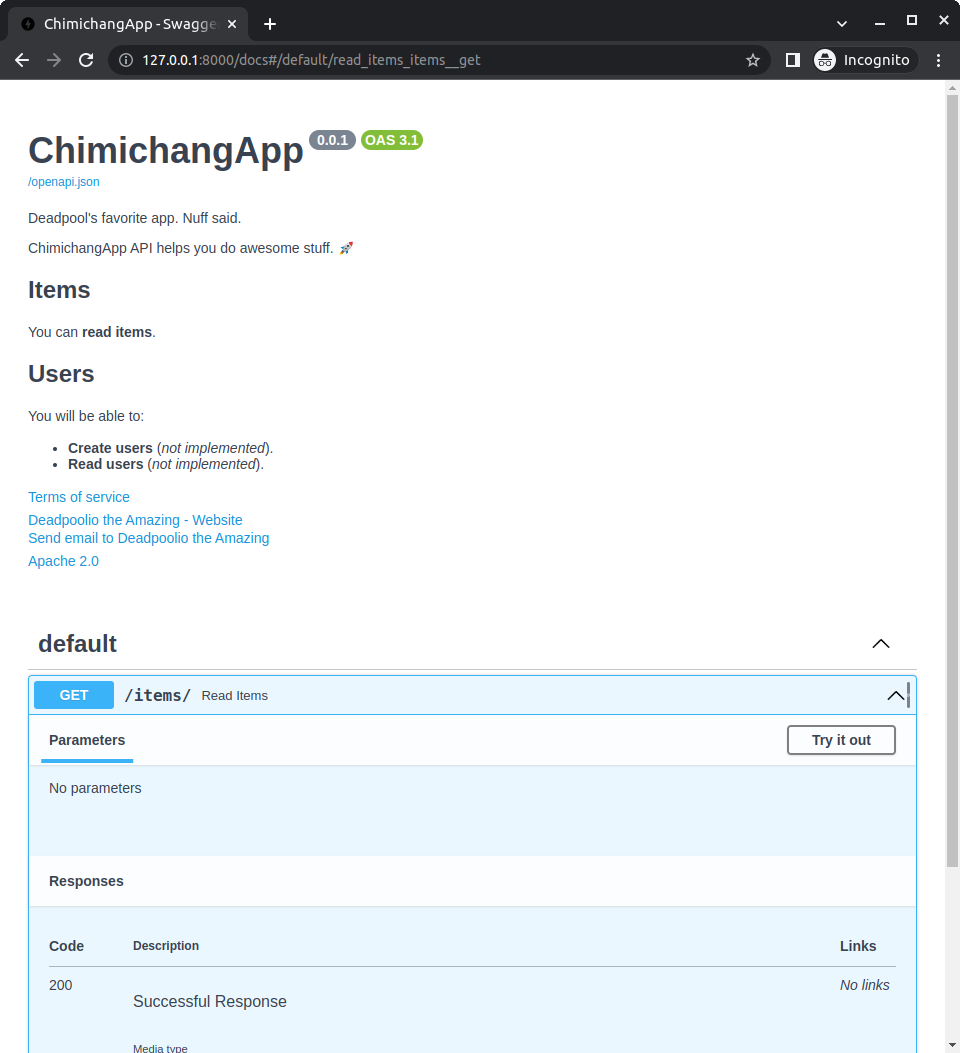
使用此配置后,自动 API 文档将显示如下:
许可证标识符
自 OpenAPI 3.1.0 和 FastAPI 0.99.0 起,你还可以使用 identifier 而非 url 来设置 license_info。
例如:
from fastapi import FastAPI

description = """
ChimichangApp API helps you do awesome stuff. 🚀

## Items

You can **read items**.

## Users

You will be able to:

* **Create users** (_not implemented_).
* **Read users** (_not implemented_).
"""

app = FastAPI(
    title="ChimichangApp",
    description=description,
    summary="Deadpool's favorite app. Nuff said.",
    version="0.0.1",
    terms_of_service="http://example.com/terms/",
    contact={
        "name": "Deadpoolio the Amazing",
        "url": "http://x-force.example.com/contact/",
        "email": "dp@x-force.example.com",
    },
    license_info={
        "name": "Apache 2.0",
        "identifier": "MIT",
    },
)


@app.get("/items/")
async def read_items():
    return [{"name": "Katana"}]
标签元数据
你还可以使用参数 openapi_tags 为用于分组路径操作的不同标签添加额外元数据。
它接受一个列表,其中包含每个标签对应的字典。
每个字典可以包含:
name(必需):一个str,包含与你在路径操作和APIRouter中tags参数使用的相同标签名。description:一个str,包含标签的简短描述。可以使用 Markdown,并将在文档界面中显示。externalDocs:一个描述外部文档的dict,包含:description:一个str,包含外部文档的简短描述。url(必需):一个str,包含外部文档的 URL。
创建标签元数据
让我们在一个包含 users 和 items 标签的示例中尝试这一点。
为你的标签创建元数据,并将其传递给 openapi_tags 参数:
from fastapi import FastAPI

tags_metadata = [
    {
        "name": "users",
        "description": "Operations with users. The **login** logic is also here.",
    },
    {
        "name": "items",
        "description": "Manage items. So _fancy_ they have their own docs.",
        "externalDocs": {
            "description": "Items external docs",
            "url": "https://fastapi.tiangolo.com/",
        },
    },
]

app = FastAPI(openapi_tags=tags_metadata)


@app.get("/users/", tags=["users"])
async def get_users():
    return [{"name": "Harry"}, {"name": "Ron"}]


@app.get("/items/", tags=["items"])
async def get_items():
    return [{"name": "wand"}, {"name": "flying broom"}]
注意,你可以在描述中使用 Markdown,例如 "login" 将显示为粗体(login),"fancy" 将显示为斜体(fancy)。
Tip
你无需为你使用的所有标签添加元数据。
使用你的标签
使用 tags 参数与你的路径操作(以及 APIRouter)将它们分配到不同的标签:
from fastapi import FastAPI

tags_metadata = [
    {
        "name": "users",
        "description": "Operations with users. The **login** logic is also here.",
    },
    {
        "name": "items",
        "description": "Manage items. So _fancy_ they have their own docs.",
        "externalDocs": {
            "description": "Items external docs",
            "url": "https://fastapi.tiangolo.com/",
        },
    },
]

app = FastAPI(openapi_tags=tags_metadata)


@app.get("/users/", tags=["users"])
async def get_users():
    return [{"name": "Harry"}, {"name": "Ron"}]


@app.get("/items/", tags=["items"])
async def get_items():
    return [{"name": "wand"}, {"name": "flying broom"}]
Info
有关标签的更多信息,请参阅路径操作配置。
查看文档
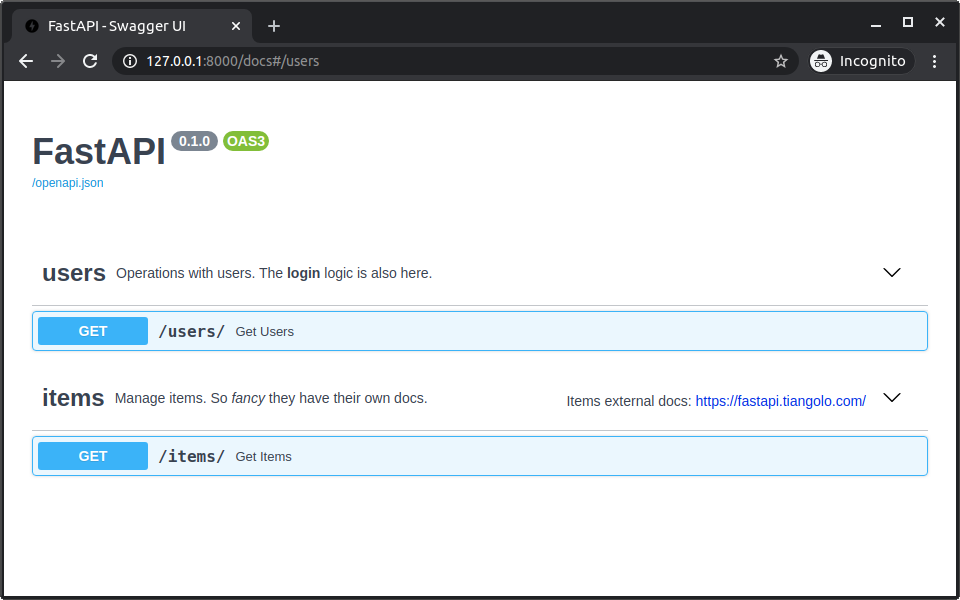
现在,如果你查看文档,它们将显示所有额外的元数据:
标签顺序
每个标签元数据字典的顺序也决定了文档界面中显示的顺序。
例如,即使 users 在字母顺序上会排在 items 之后,但它会显示在 items 之前,因为我们将它们的元数据作为列表中的第一个字典添加。
OpenAPI URL
默认情况下,OpenAPI 模式通过 /openapi.json 提供。
但你可以使用参数 openapi_url 进行配置。
例如,将其设置为通过 /api/v1/openapi.json 提供:
from fastapi import FastAPI

app = FastAPI(openapi_url="/api/v1/openapi.json")


@app.get("/items/")
async def read_items():
    return [{"name": "Foo"}]
如果你想完全禁用 OpenAPI 模式,可以设置 openapi_url=None,这也将禁用使用它的文档用户界面。
文档 URL
你可以配置包含的两个文档用户界面:
- Swagger UI:通过
/docs提供。- 你可以使用参数
docs_url设置其 URL。 - 通过设置
docs_url=None可以禁用它。
- 你可以使用参数
- ReDoc:通过
/redoc提供。- 你可以使用参数
redoc_url设置其 URL。 - 通过设置
redoc_url=None可以禁用它。
- 你可以使用参数
例如,将 Swagger UI 设置为通过 /documentation 提供并禁用 ReDoc:
from fastapi import FastAPI

app = FastAPI(docs_url="/documentation", redoc_url=None)


@app.get("/items/")
async def read_items():
    return [{"name": "Foo"}]